Home
BMW
iX
News
Watch BMW iX Perform The Moose Test: Better Than Tesla Model X
The result is relatively good but not as high as in the case of the Audi e-tron, which was tested previously.

01:57
Mark Kane 
By: Mark Kane
Feb 25, 2022 at 9:13am ET
Add InsideEVs as a preferred source in Google
- (https://twitter.com/intent/tweet?url=https%3A%2F%2Finsideevs.com%2Fnews%2F569927%2Fbmw-ix-moose-test-slalom%2F&text=Watch%20BMW%20iX%20Perform%20The%20Moose%20Test%3A%20Better%20Than%20Tesla%20Model%20X&via=InsideEVs)
- copy
Share
Comment
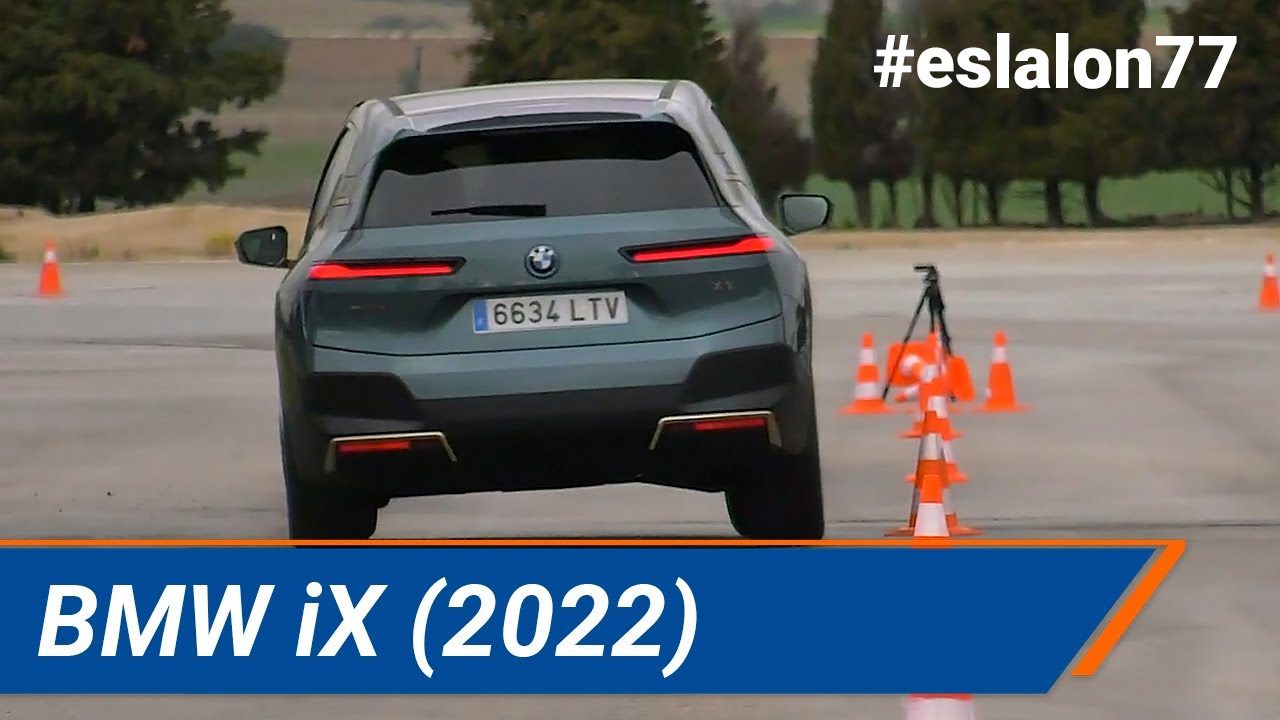
The all-new BMW iX, in the entry-level xDrive40 version (which will not be available in the US), equipped with Pirelli PZero Elect 255/50 R21 109/Y tires, performed relatively well in the "moose test."
According to the test performed by km77.com, the car was able to successfully complete the test at a maximum initial speed of 74 km/h (46 mph).
- initial part: 74 km/h (46 mph)
- middle part: 62 km/h (39 mph)
- final part: 43 km/h (27 mph)
The regenerative braking was set at a normal/medium level.
In general, with stronger regenerative braking the car starts to reduce the speed quicker (when removing foot from the accelerator), which makes it easier to complete the test, compared to a low regenerative braking setting.
Various tries at higher speeds failed, but considering the weight (2,530 kg, according to the video) and size of the BMW iX, it's not a bad result.
For reference, the 2016 Tesla Model X was able to achieve 70 km/h (44 mph). Some Audi models performed better: 2019 Audi e-tron at 77 km/h (48 mph) and 2020 Audi e-tron Sportback at 75 km/h (47 mph).
We assume that the BMW iX xDrive50, announced for the U.S. market, might achieve a slightly lower maximum initial speed due to a bigger and heavier battery - 111.5 kWh battery (105.2 kWh net usable), compared to 76.6 kWh battery (71.0 kWh net usable) in the xDrive40.
It's worth noting that the BMW iX xDrive50 recently passed a real-world moose test when during a long-distance test, Bjørn Nyland avoided a moose at highway speed. It was possible due to the driver who reacted very quickly, despite driving for many hours and some 850 km (528 miles), and at night.
What do you think?
View
Comments
Additionally, here is a slalom test:
Previous results of the km77.com's moose test for reference (initial speed):
- 2019 Tesla Model 3 LR AWD - 83 km/h (52 mph)
- 2021 Tesla Model Y LR AWD - 83 km/h (52 mph)
- 2021 Hyundai Ioniq 5 (RWD, 72.6 kWh) - 82 km/h (51 mph)
- 2018 BMW i3s [video] - 79 km/h (49 mph)
- 2021 Kia EV6 (RWD, 77.4 kWh) - 78 km/h (48 mph)
- 2020 Porsche Taycan Turbo S - 78 km/h (48 mph)
- 2021 Porsche Taycan Turbo S Cross Turismo - 78 km/h (48 mph)
- 2019 Audi e-tron [video] - 77 km/h (48 mph)
- 2021 Dacia Spring - 77 km/h (48 mph)
- 2020 MINI Cooper SE - 77 km/h (48 mph)
- 2020 Renault Twingo Z.E. [video] - 77 km/h (48 mph)
- 2020 Peugeot e-208 - 76 km/h (47 mph)
- 2021 Audi e-tron GT - 75 km/h (47 mph)
- 2020 Audi e-tron Sportback [video] - 75 km/h (47 mph)
- 2021 Fiat 500 electric - 75 km/h (47 mph)
- 2020 Honda e - 75 km/h (47 mph)
- 2020 Opel Corsa-e [video] - 75 km/h (47 mph)
- 2022 BMW iX xDrive40 - 74 km/h (46 mph)
- 2021 Citroën ë-C4 [video] - 74 km/h (46 mph)
- 2018 Hyundai Kona Electric [video] - 74 km/h (46 mph)
- 2020 Mazda MX-30 - 74 km/h (46 mph)
- 2018 Jaguar I-PACE - 73 km/h (45 mph)
- 2021 Volkswagen ID.4 - 73 km/h (45 mph)
- 2022 Mercedes-Benz EQS - 72 km/h (45 mph)
- 2020 Jeep Renegade 4xe [video] - 70 km/h (44 mph)
- 2019 SEAT Mii Electric - 70 km/h (44 mph)
- 2016 Tesla Model X [video] - 70 km/h (44 mph)
- 2019 Ford Kuga PHEV (Ford Escape PHEV in the U.S.) [video] - 68 km/h (42 mph)
- 2019 Kia Soul EV (e-Soul) [video] - 68 km/h (42 mph)
- 2021 Skoda Enyaq iV - 67 km/h (42 mph)
See also
 Watch Rimac Nevera Electric Hypercar Crash Into A Pole
Rivian R1T Snow Performance: Testing Various Drive Modes
We want your opinion!
What would you like to see on Insideevs.com?
Take our 3 minute survey.
- The InsideEVs team
Share this Story
- (https://twitter.com/intent/tweet?url=https%3A%2F%2Finsideevs.com%2Fnews%2F569927%2Fbmw-ix-moose-test-slalom%2F&text=Watch%20BMW%20iX%20Perform%20The%20Moose%20Test%3A%20Better%20Than%20Tesla%20Model%20X&via=InsideEVs)
- copy
GO TO COMMENTS
(
)
Got a tip for us? Email: tips@insideevs.com
View all comments ( )
Trending
I Drove The Electric And Gas-Powered BMW X5. I Know Which One I'd Pick.
The 2027 Ford Mustang Mach-E Has More Range As Standard
GM's Next-Generation EV Platform Has 30% Less Wiring And 20% Less Battery
Can The BMW iX3 Take Down The Tesla Model Y L And Rivian R2?
latest articles
- ‘Propulsion-Agnostic’: GM Wants To Bring Tesla-Style Software Features To Its Gas SUVs, Too Oct 22 - Features -
- Want The Best Range Rover? Get The Electric One: First Drive Oct 22 - First Drives -
- I Drove The Electric And Gas-Powered BMW X5. I Know Which One I'd Pick. Oct 22 - First Drives -
- The Ferrari Luce Officially Starts At $560,800 Oct 22 - News -
- The 2027 Ford Mustang Mach-E Has More Range As Standard Oct 22 - Official -
- BMW’s Electric M3 Had To First Win Over One Of Its Own Oct 22 - News -
- Seattle Is Installing Hundreds Of Curbside EV Chargers Oct 22 - Charging -
RECOMMENDED FOR YOU
The Longest-Range EVs You Can Buy In 2026
The Ferrari Luce Officially Starts At $560,800
The Best EV Lease And Finance Deals In September 2026
The 2027 Ford Mustang Mach-E Has More Range As Standard
BMW’s Electric M3 Had To First Win Over One Of Its Own
Seattle Is Installing Hundreds Of Curbside EV Chargers
Can The BMW iX3 Take Down The Tesla Model Y L And Rivian R2?