
America Now Has More Than 80,000 Public Fast Charging Ports
We dive deep into how U.S. charging infrastructure got faster and more widespread in the third quarter.

- The deployment of public fast-charging ports slowed in Q3 2026 in the U.S.
- However, the total number of ports added was still impressive, with a stronger Q4 expected.
- Americans logged a record 17.6 million public fast-charging sessions in July alone.
America added fewer public fast-charging ports in the third quarter than it did a year earlier, as electric vehicle sales cooled following the U.S. government’s rollback of EV-friendly policies. But the slowdown in charger deployment doesn’t tell the whole story. Charging networks continued to expand across the country, adding thousands of ports and investing in higher-powered stations hoping for an eventual rebound in EV demand.
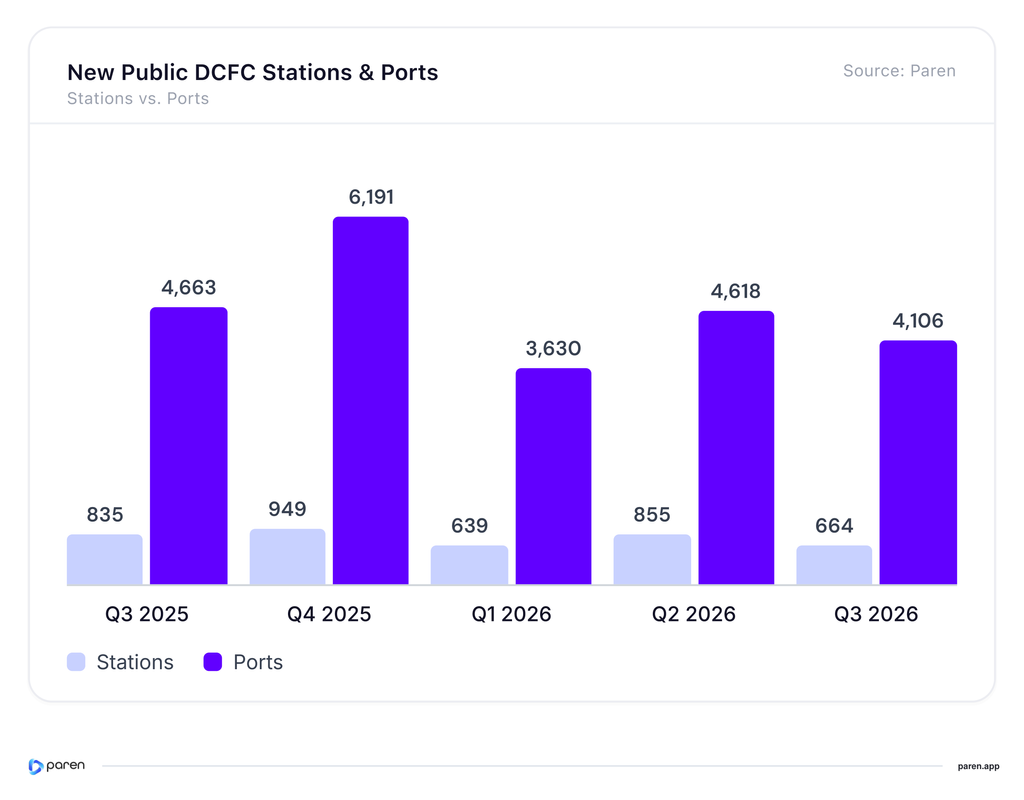
The U.S. added 4,106 new public fast-charging ports across 664 stations in the third quarter, marking a 12% decline in ports and a 20% drop in stations year-over-year, charging data platform Paren said Tuesday. Even so, the expansion was substantial enough to push the country’s public fast-charging network past 80,000 ports for the first time. Many of the new installations also offer higher charging power and are located at convenient places, such as gas stations and travel centers, where drivers already stop while roadtripping.
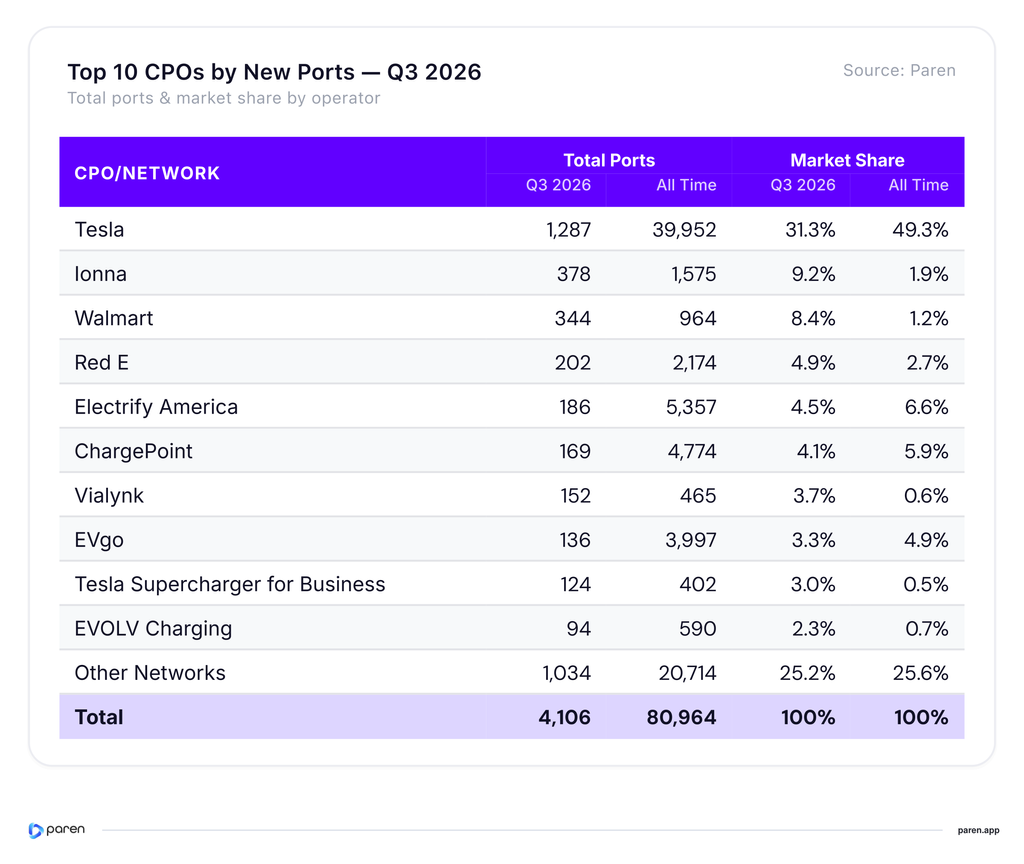
The Tesla Supercharger network accounted for much of the slowdown. Tesla added 1,287 new ports between July and September, 533 fewer than during the same period last year. However, the automaker partly offset that decline by adding 124 ports through Superchargers sold to third-party businesses, a newer line of business. Tesla nevertheless remained the country’s largest contributor to new fast-charging capacity in the third quarter, even as its speed of deployment slowed.
Ionna, the automaker-led consortium which plans to have 30,000 fast chargers in North America by the end of the decade, ranked second by nearly tripling its year-over-year rollout with 378 new ports added. Walmart rounded out the top three with 344 new ports.
The regional dynamics of this charger growth were also interesting. California has historically led the country in new charging installations, and that trend continued in the third quarter, with 87 new stations opening across the state. The next three states were all Republican-governed: Texas added 66 stations, followed by North Carolina and Georgia with 26 each, according to Paren. Still, 42% of the new openings overall last quarter were in California, Texas, Florida, Illinois, and New York.
At the metro level, Dallas-Fort Worth and Houston recorded the largest increases, followed by Oklahoma City and Kansas City. Rural areas, meanwhile, accounted for just 10% of all new ports added during the quarter. That imbalance highlights how much work remains to bring reliable fast charging to less densely populated parts of the country, where long distances between stations can make EV ownership more challenging.
Another major takeaway from Paren's Q3 report was the continued shift toward higher-powered charging stations. Networks continue to double down on delivering more power and getting drivers back on the road sooner. Some 73% of the new ports added in the third quarter could deliver at least 250 kilowatts, up from 60% during the same period last year. Stations capable of delivering 400 kW have become the most popular choice for new installations, Paren said.
Tesla is also increasing the rollout of its V4 cabinets which can deliver 500 kW. The automaker now has 42 locations and 487 ports capable of delivering 500 kW.

That’s particularly good news for the growing crop of premium EVs designed to take advantage of ultra-fast charging. The Lucid Gravity, Porsche Cayenne Electric, and BMW iX3 can all peak at charging rates of 400 kW. The Mercedes-Benz GLC and Volvo EX60 top out at around 370 kW, while Tesla Cybertruck owners have reported charging at 500 kW on the new V4 Superchargers. Actual charging speeds, of course, depend on things like battery temperature and state of charge, so those peak figures don't tell the full story.
And it’s not just expensive EVs that stand to benefit from the new infrastructure. More affordable models, including the Rivian R2, as well as the 800-volt Hyundai Ioniq 5 and Kia EV6, can also take advantage of higher-powered charging stations, alongside several other models on the market.
It's pretty clear that the future of public EV charging is about making charging faster, more convenient, and less disruptive on road trips. Drivers shouldn’t have to spend hours at a station when their vehicles and the infrastructure can support much quicker stops. Paren said drivers are already putting that infrastructure to work. EV charging sessions hit a monthly record in July, with 17.6 million sessions recorded nationwide during the summer travel surge.
Related Stories
RECOMMENDED FOR YOU
Finding And Using BP Pulse EV Chargers Just Got A Whole Lot Easier
Used EVs Are Selling Like Hotcakes. The Fastest Movers May Surprise You
Mercedes-Benz Is Giving Up On Its EV Charging Network In Europe
Defying Online Backlash, The Ferrari Luce EV Is Already Sold Out Through 2027
Rivian's Charging Network Grew 39% In A Year
Nearly 1 In 3 Hyundais Sold In October Was A Hybrid As High Gas Prices Push Buyers To Pivot
This 400 kW EV Charger Uses Old EV Batteries To Avoid Costly Grid Upgrades