
This Simple Trick Boosted My Plug-In Hybrid's Fuel Economy To 50 MPG
My Volvo wagon’s fuel economy was great to begin with, but a driving strategy change unlocked a new achievement.

Electric cars are awesome, but sales are not going quite as automakers envisioned a couple of years ago–at least not in the United States. As a result, car companies are banking on hybrids and plug-in hybrids, and more people are spending their hard-earned money on electrified cars to try to lower their fuel bills.
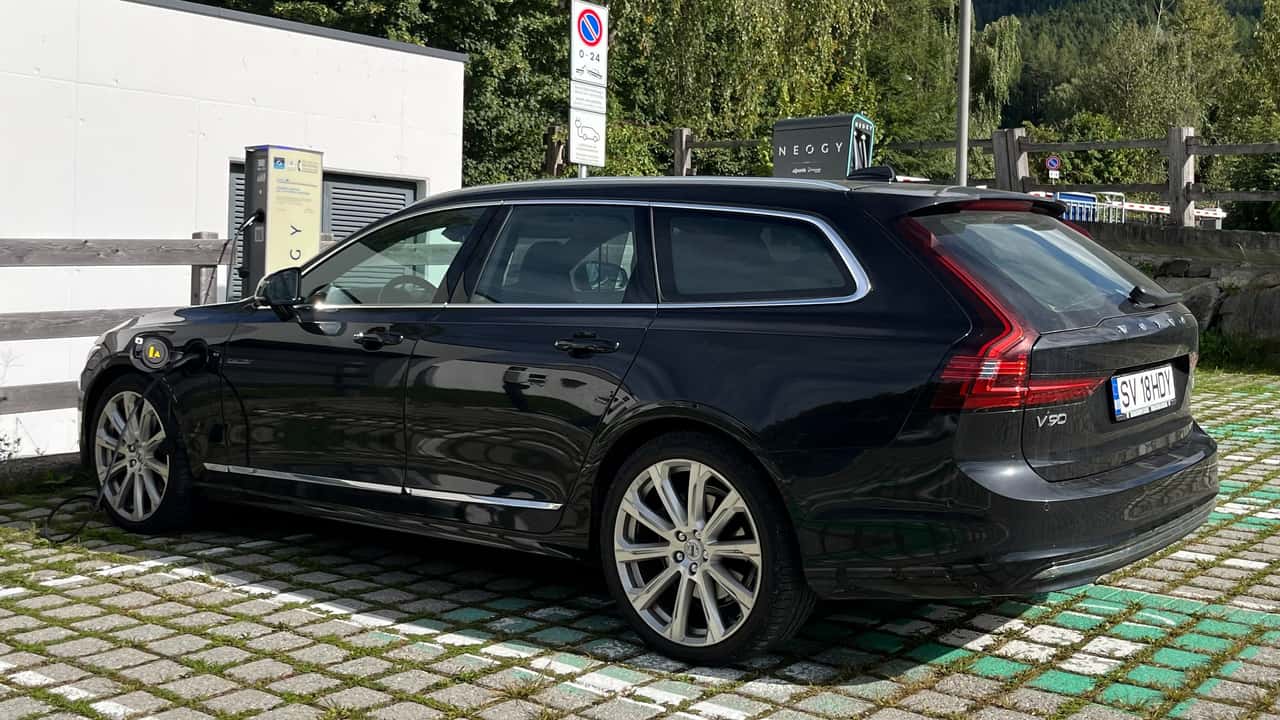
I did the same thing last year, when I bought a used 2023 Volvo V90 plug-in hybrid wagon, and during my 14-month ownership, I’ve had time to do several experiments. I’ve already checked the high-voltage battery’s degradation and found that there is nothing measurable, and now I’ve had the chance to test how big of an impact the different driving modes have on the fuel economy.

2023 Volvo V90 T8 Recharge Plug-in Hybrid charging
To my surprise, spending some time fiddling with the settings while driving made a meaningful impact, resulting in an average fuel economy of 50 mpg US (4.5 l/100 km) on a roughly 250-mile (400-kilometer) trip that began with a fully charged battery.
Last year, I did the same trip in similar weather conditions and with the same cargo, and the average fuel consumption was 42.7 mpg (5.5 l/100 km). Just like in my latest journey, I left home with a fully charged battery, so what made the MPG figure jump?
The short answer is that I was lazy the first time, and the last time was a lot more involved.
All modern Volvo plug-in hybrids have at least four driving modes and three battery management settings. My V90 defaults to Hybrid mode every time it starts, and it’s fine for most journeys. It acts as an EV, but if you press the accelerator to the floor, the gas engine kicks in. When the battery runs out, the car just works as a traditional hybrid.
I used this mode exclusively for last year’s trip, and didn’t bother to adjust the battery management settings. This year, though, I chose to start the engine when I left home, even though the battery was full.
2023 Volvo V90 T8 Recharge Plug-In Hybrid - driving modes and battery management settings. The latest software update changed the user interface, but the settings are the same.
I still chose Hybrid mode, but the battery was set to Hold, so that it wouldn’t deplete on the way to my destination. In this scenario, the gas engine still shuts off during deceleration and at very low speeds, effectively acting as a traditional hybrid without a plug. Then, in cities and other low-speed zones, I switched the battery from Hold to Auto, driving on electricity alone.
Most plug-in hybrids have similar options, so this strategy should apply to a lot of cars out there. That said, there are limitations to this approach—as is the case with PHEVs in general.
First, it’s a little annoying to keep switching between modes, seeing how Volvo, in its immense wisdom, decided to ditch the physical rotary dial for the driving modes, instead offering a screen-only approach starting with the 2022 models.
Second, the fuel efficiency gain is not exactly huge, but it can add up if you make a lot of trips that exceed the electric range but don’t need to stop to refuel. If you’re the kind of person who just wants to disconnect the charger, get in, and drive, you’ll be just fine.
I didn’t use the highway at all for this experiment, but it makes a lot of sense to use Hold when driving on the highway, as the electric motor is less efficient at high speeds, and then drive on electricity in town. However, if you only drive on the highway, with no low-speed segments, there’s no point in saving electricity for later, so it’s better to use the battery whenever possible.
For reference, I’ve seen between 30 and 35 mpg when driving exclusively on the highway at 80 mph (130 kph) with a depleted battery.


Then, if your route is a lot longer than my 280-mile trip, the high-voltage battery’s involvement will be a little less obvious than on shorter journeys. You’ll run out of electricity at some point, forcing the gas engine to take over for the rest of the drive. Plus, as is the case with Volvo PHEVs, it only makes sense to recharge the battery overnight or during an extremely long break, as they can only take in 3.7 kW. Because of this limitation, it takes roughly five hours to fully charge the battery on the 2022-and-newer models.
The most important thing of all, however, is to charge every time you get the chance. Otherwise, you're just carrying around a big and heavy battery without enjoying the benefits that it can deliver.
I charge at home every day, and it costs me pennies to do so, thanks in no small part to the solar panels that I had installed late last year. Compared to my previous car, a 20-year-old Land Rover LR3, I’ve saved at least $2,000 in fuel alone in one year—not to mention the savings from not having to crawl under the car every month or so for various repairs.
Plus, the Volvo is a lot more powerful, a lot quieter, and a little more comfortable. I can’t take it off-road, but that’s something I knew from the get-go. And now, when I have long on-road journeys, I know how to squeeze even more from a gallon of gas. If you have a PHEV, I recommend you try playing with the various modes to optimize your own efficiency. Some cars may choose the most efficient times to engage the engine themselves, but at least in my Volvo, it pays to fiddle with things yourself.
More Stuff Like This

RECOMMENDED FOR YOU
EVs Don’t Need This Gas Car Feature. So Why Do So Many Still Have It?
Study: DC Fast Charging Satisfaction Is Up, And Ionna Takes The Top Spot
Volvo's New EX50 Will Be A Sub-$50,000 Tesla Model Y Fighter: Report
Here's A Mechanic's Take On The Subaru Trailseeker
All The EVs That Got Canceled Or Delayed In 2025 And 2026 (Updated)
Mitsubishi Taps iPhone Manufacturer For its Next EV
The Volvo EX60's Excellent Range Somehow Got Even Better