
EV Myth Busted: No, They're Not 'Dirtier' Than Gas Cars, Even If You Use Fossil Fuel Power
Skeptics claim that charging your EV with grids that use fossil fuel power is just as bad as burning gas. They're wrong.
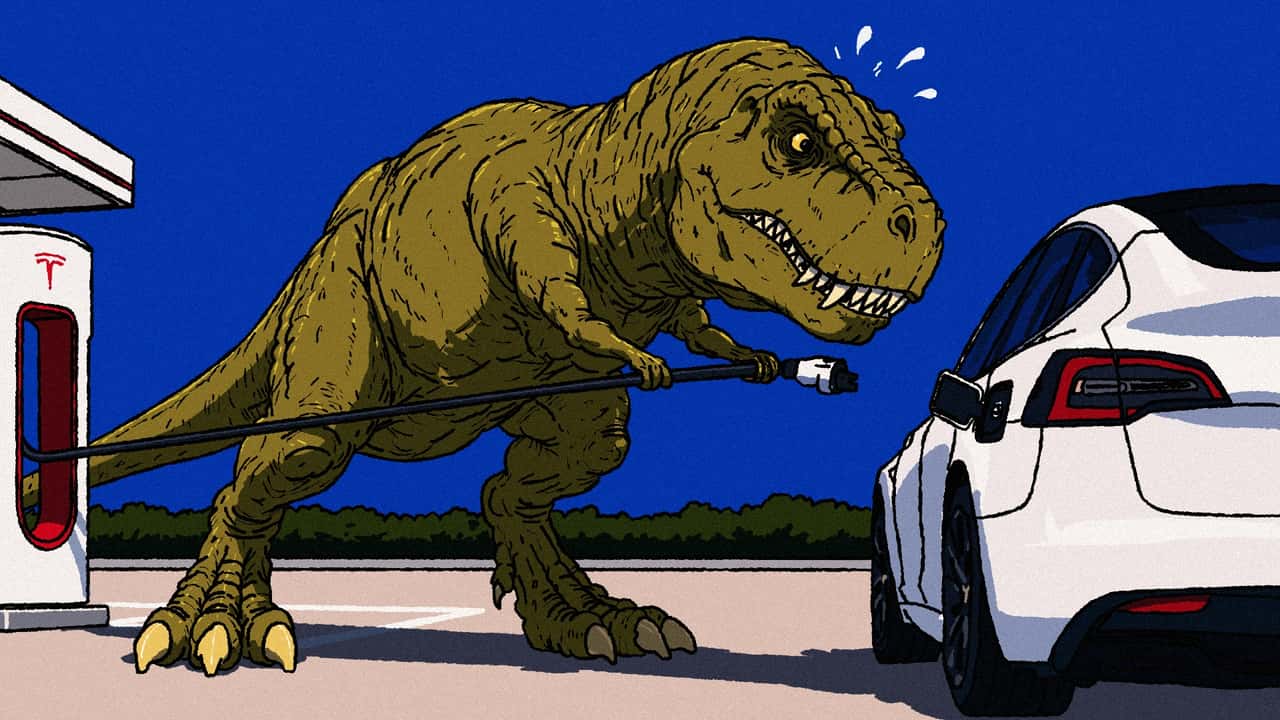

It is one of the most absurd and enduring points made by anti-EV advocates. Somehow, gas fans argue that driving a car with zero tailpipe emissions is just as harmful or more harmful to the environment than burning gasoline. The argument usually rests on the assumption that EVs powered by non-renewable energy are just offloading those emissions to the powerplants, making them just as bad.
Good news: That argument is wrong. And every year it’s getting more wrong.
Let me walk you through why.
Why EVs Are Cleaner Than Gas Cars
The first thing you need to know is that electric motors are simply more efficient than internal combustion engines. You may think your gas car’s engine primary purpose is moving you forward, but that’s really its side gig. The vast majority of the energy stored in a gallon of gas is turned into useless waste heat. More than useless, really, as the car has to spend yet more energy cooling itself off.

Even an ultra-efficient gas engine, like the one in this Prius Plug-In Hybrid, is only around 30% efficient. The average engine is a lot worse.
Only 30% of the gasoline’s energy actually translates into forward motion in the absolute best-case scenario. In some cases, it’s only 12%. The vast majority is radiated off the engine or expelled through the exhaust as heat. (This is why gas cars don’t lose as much efficiency in the cold: They produce so much waste heat that putting it in the cabin is free.)
EVs, on the other hand, are around 90% efficient. Almost all of the energy in the battery directly goes to producing forward motion. That means a Tesla Model S with a 100 kWh battery pack—the energy equivalent of just three gallons of gasoline—can travel 410 miles on a charge. Electric motors are just that much more efficient.
EVs are so efficient that this Tesla Model S can go around 400 miles using the energy equivalent of about 3 gallons of gas.
Considering our goal is to do the same amount of work—get you to work—with less emissions, efficiency is the name of the entire game. And while it’s true that an EV powered by fossil fuel power still contributes to pollution, electric vehicles’ efficiency advantage is so gigantic that even that can’t offset all of the benefits.
EVs Powered By ‘Dirty’ Grids Are Still Better For The Environment
Researchers at MIT found that EVs emit around 40-60% fewer lifecycle emissions than gas vehicles throughout the U.S. But the study went deeper than that. It looked at some of the areas of the U.S. with the dirtiest mix of electricity, where power was heavily reliant on things like natural gas and coal. Even in the worst areas, though, EVs still had the lead.
“Even with the country’s most carbon-intensive electricity mix, however, BEVs do not raise lifecycle emissions compared to ICEVs,” the researchers concluded.
Don’t take MIT’s word for it. A study by the Union of Concerned Scientists back in 2022 looked at the full well-to-well emissions picture for both types of vehicle. That means they didn’t just look at the emissions from the power EVs use, but also the emissions created in manufacturing EVs, in transporting fuel to powerplants, and in extracting fuel. Similarly, they priced in the impact of extracting, refining, and transporting oil. Unsurprisingly, their research agrees with the MIT study: EVs are just plain cleaner.
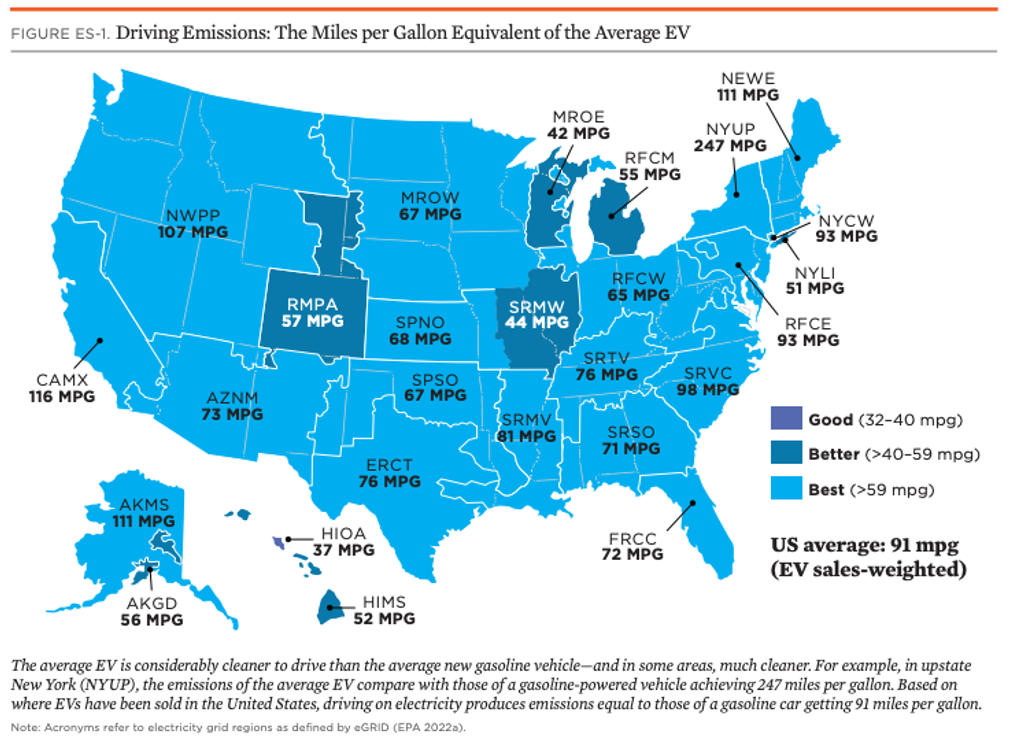
“Over 90 percent of people in the United States live in regions where driving the average EV produces lower emissions than the most efficient gasoline vehicle on the market today (59 miles per gallon),” the study said (emphasis mine). That 59 mpg figure isn’t just better than any pure gas car can manage. It’s better than the Toyota Prius, America’s most efficient hybrid. It gets 57 mpg, and because of that efficiency gap we noted earlier, it needs an electric motor to do it.
There are a few places where a hybrid car can be a bit cleaner, but they represent a tiny fraction of the U.S. population, and the data suggests they won't be like that for long. And no matter where you are in the country, an EV is going to trounce its purely gas equivalent.
EVs Are Getting Cleaner. Gas Isn’t.
Here is the other part EV skeptics miss: Our grid is getting cleaner every year. In 2005, wind and solar power combined generated less than 1% of our country’s electricity. In 2015, wind and solar accounted for about 5% of power generation. Last year, it provided 17% of our electricity. Solar and wind are the number one and number two fastest-growing energy sources in the U.S. Even accounting for the grid storage required to keep the power on at night, building solar is now cheaper than building new fossil fuel powerplants on a per-kWh basis.
That means every year you drive an EV, it’ll get even cleaner.
“While we found that the electricity mix is a big driver of the spatial variation in emissions savings of EVs, the electricity grid is decarbonizing everywhere. As that happens, emissions savings across space will become more homogenous for EVs, but the differences across one driver to another will remain,” Marco Miotti, one of the MIT study’s authors, told MIT Climate Portal.
In many ways, it’s the exact opposite of the gas car paradigm. Gas cars are less carbon-intensive to build, but the longer you own one, the more damage it does. EVs start off with an environmental deficit, but within one to two years the reduced emissions pay off that “debt.” From then on, each year they offset more and more emissions that an equivalent gas car would have produced.
I bought my Blazer EV used with 17,000 miles on it, which means it has already made up the carbon deficit it accrued during manufacturing. I power it with 100% renewable energy, which means it will keep offsetting more emissions over time. It's already better than gas, and only getting better from here.
That payback period, too, is getting shorter. Manufacturing plants are getting more efficient and relying more on renewables, decreasing the original carbon debt. Meanwhile, cleaner grids powering EVs are making them offset more emissions faster than ever before.
So no, they are not perfect yet. But they are a hell of a lot cleaner than gas-powered cars, and that gap is only widening. As the grid improves, we’re getting closer and closer to a world where your car generates zero emissions after its production.
Haters will say it’s a pipe dream. But as someone who charges his EV purely with renewable energy, I can guarantee you that zero-emissions driving is possible. It just doesn’t involve gasoline.
Contact the author: Mack.Hogan@insideeevs.com.
More Evidence That EVs Are Cleaner
RECOMMENDED FOR YOU
The EV Owners' Guide To Charging Adapter Hell
'It's Always Your Fault': Kyle Shanahan's Tesla Was On Autopilot When He Crashed. He Still Blames Himself
Why Don't EVs Come With Spare Tires?
The McLaren P1 Is Getting A Huge Battery Upgrade With 3X The Original Capacity
How To Convert Conflicting EV Range Test Cycles: EPA, WLTP, CLTC
The 2027 Kia EV3 Is Almost Here—With 280 Miles Of Range For The AWD Models
How Much Will An EV Really Cost Me?