Home
News
News
EVs Help Air Quality. And Not Just In The Obvious Way.
A new study shows that EVs are cleaner than combustion cars, but there’s something else that makes them even cleaner to run.
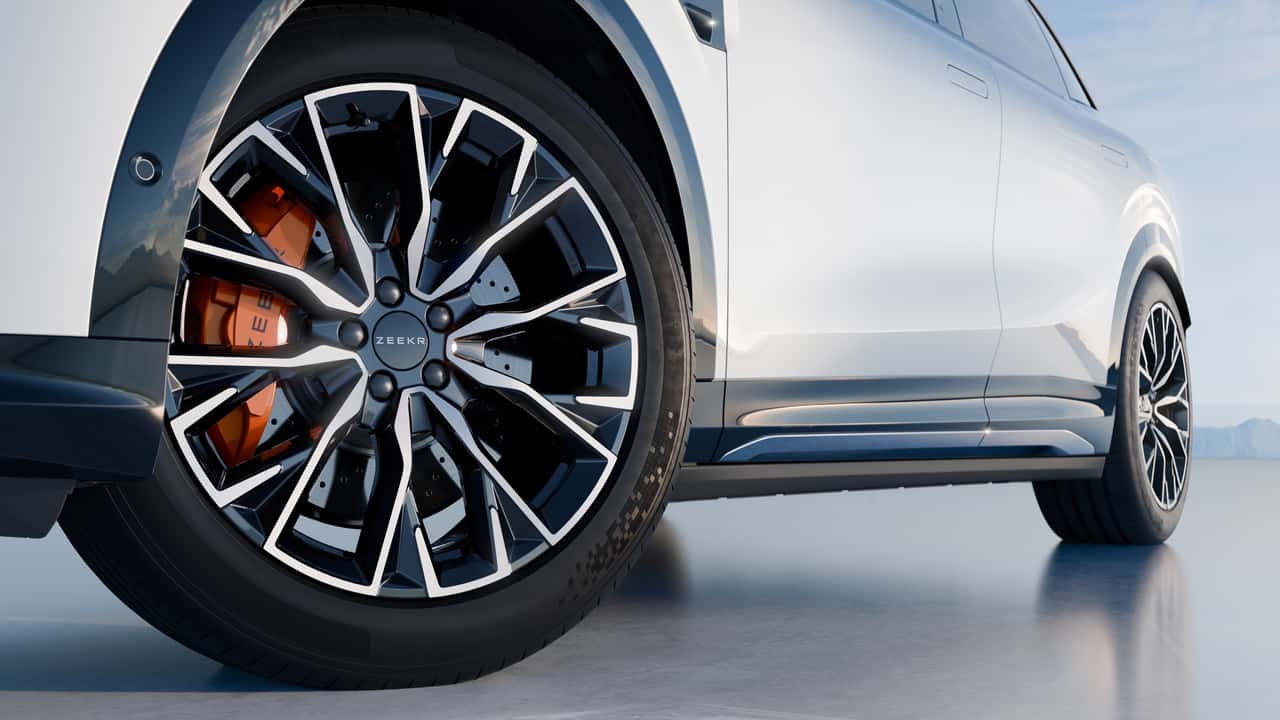
Photo by: Zeekr
Andrei Nedelea 
By: Andrei Nedelea
Jul 25, 2025 at 12:03pm ET
Add InsideEVs as a preferred source in Google
- (https://twitter.com/intent/tweet?url=https%3A%2F%2Finsideevs.com%2Fnews%2F767017%2Fbrake-dust-emissions-evs-better%2F&text=EVs%20Help%20Air%20Quality.%20And%20Not%20Just%20In%20The%20Obvious%20Way.&via=InsideEVs)
- copy
Share
Comment
- EVs can cut brake wear emissions by up to 83% thanks to regenerative braking and one-pedal driving.
- Brake dust is high in copper, and it's apparently even more harmful than diesel soot.
- The brake pads in EVs last a lot longer, up to 100,000 miles in real-world taxi use.
The lack of tailpipe emissions is the main way electric vehicles are seen as better for air quality, especially in cities packed with cars. But there is another important source of emissions that they do much better for than combustion cars, and it’s hardly ever talked about: brake dust pollution.
EVs have exactly the same friction braking system as gas cars, but because they rely on their motors for deceleration, they don’t need to put pad to disk as often to reduce speed. In fact, in EVs with one-pedal driving, where simply lifting off the accelerator pedal brings the car to a stop, you hardly ever touch the brake pedal in normal driving.
Sure, if a runaway dog sprints across the street and you have to stop quickly to save its life, you will apply the brakes, but for the vast majority of normal driving scenarios, lifting off is enough. Using the regenerative braking function not only saves your brake pads from wear, but it also puts energy back into the battery, essentially giving your EV a bit of free extra range.
Limiting brake dust emissions is important because it’s pretty nasty stuff. It’s made up of microscopic particles that easily get airborne and end up in your lungs. Modern brake pads thankfully no longer contain asbestos, a known carcinogen, but they do have a high concentration of copper and other elements that pose serious health concerns.

Get the best news, reviews, columns, and more delivered straight to your inbox.
back
Subscribe For more info, read our Privacy Policy & Terms of Use.
One study published earlier this year in Particle and Fibre Toxicology had some pretty alarming findings about just how bad brake dust is for humans. It concluded that particulate matter (PM) “from copper-enriched non-asbestos organic, and ceramic brake pads as inducing the greatest oxidative stress, inflammation, and pseudohypoxic HIF activation (a pathway implicated in diseases associated with air pollution exposure, including cancer, and pulmonary fibrosis), as well as perturbation of metabolism, and metal homeostasis compared with brake wear PM from low- or semi-metallic pads, and also, importantly, diesel exhaust PM.”
Yes, you read that right: particulates from brake dust are worse for you than those produced by diesel engines. Modern diesels have had particulate filters for nearly two decades now, drastically limiting the amount of fine particulates they spew into the air, while the amount of brake dust emissions isn’t controlled in any way. What goes into making brake pads remains largely unregulated, although Washington and California passed laws to limit the amount of copper that goes into them.
The fact that an EV’s brake pads see much less use than those in a combustion car is evidenced by how much longer they last. British automotive services company RAC quotes information from a taxi company operating Nissan Leaf cabs, which said these cars’ brake pads last between 80,000 and 100,000 miles before they have to be replaced. That is many times better than a combustion car, no matter how carefully it’s driven.
The fact that EVs are responsible for a lot less brake dust emission is another advantage they have. But how much less brake dust do they actually produce? One recent European Union-funded study published by EIT Urban Mobility found that EVs can potentially emit up to 83% less brake dust than a typical gas car.
The percentage decreases progressively the less electrified a vehicle is. For plug-in hybrids, it’s 66% lower brake wear emissions, while for non-plug-in hybrids, it ranges between 10-48%, presumably depending on how powerful their electric motor is and how much deceleration it can provide.
 Is EV Manufacturing Bad For The Environment?
Do Electric Vehicles Really Pollute More Than Gas Cars?
How Much Of A Fire Risk Are Electric Cars?
Will My Electric Car Leave Me Stranded?
5 Myths About Electric Vehicles & Charging Debunked
For pure EVs, though, 83% represents a drastic reduction, and manufacturers are even considering placing the brakes inside the electric drive unit to completely eliminate particulate emissions. Mercedes showed off its idea for in-drive brakes, which don’t produce particles as they wear, which it plans to use in its future EVs, although not the next generation of electric models, likely the one after that.
Volkswagen chose a much simpler path to achieve the same goal. All of the group’s vehicles built on the MEB platform, even those with dual-motor powertrains producing in excess of 300 horsepower, have drum brakes on the rear axle. Drums don’t quite provide the same stopping power as disks and can’t dissipate heat as quickly, so they’re not suitable for performance applications. But they are completely enclosed and since most of the friction braking is done through the front wheels, VW considered that having drums on the rear was a good solution that could essentially last the life of the car without having to be serviced.
What do you think?
View
Comments
EVs do have one downside brought by their extra weight, more brutal torque delivery and superior power compared to gas cars: their tires wear out faster. This is also a source of emissions that affects air quality. However, while EVs can’t escape the physics brought by their extra heft, their tires don’t wear out anywhere near as quickly as some deliberately misleading headlines might have you believe, although there isn’t a definitive number stating how that’s different from a combustion car.
So if you own an EV that allows you to choose the level of brake regeneration and offers one-pedal driving, and you’re not using it, maybe you should give it a second chance. It will not only help your brakes last a lot longer, but it also means the air in your area has fewer nasty particulates floating around, potentially causing all sorts of health issues.
We want your opinion!
What would you like to see on Insideevs.com?
Take our 3 minute survey.
- The InsideEVs team
Share this Story
- (https://twitter.com/intent/tweet?url=https%3A%2F%2Finsideevs.com%2Fnews%2F767017%2Fbrake-dust-emissions-evs-better%2F&text=EVs%20Help%20Air%20Quality.%20And%20Not%20Just%20In%20The%20Obvious%20Way.&via=InsideEVs)
- copy
GO TO COMMENTS
(
)
Got a tip for us? Email: tips@insideevs.com
View all comments ( )
Trending
I Drove Volvo’s Long-Range Plug-In Hybrid XC60. It’s A Great Stepping Stone To An EV.
I've Driven Dozens Of Chinese Cars. Americans Are Missing Out On These 4 Features
I’m Thankful For My Electric Car
$30,000 Ford Fathom: Inside The Structural LFP Battery That Makes It All Possible
Latest Stories
- $30,000 Ford Fathom: Inside The Structural LFP Battery That Makes It All Possible Nov 28 - Battery Tech -
- I've Driven Dozens Of Chinese Cars. Americans Are Missing Out On These 4 Features Nov 28 - China -
- EVs Outsold Gas And Diesel Cars Combined In The EU In October Nov 27 - News -
- This Audi E-Tron EV Has 125,000 Miles. Replacing Its Battery Was A Huge Pain Nov 27 - Repair / Maintenance -
- Rivian's Winter Sale Is Live: Save on Chargers, Accessories, And More Nov 27 - Pricing -
- I Drove Volvo’s Long-Range Plug-In Hybrid XC60. It’s A Great Stepping Stone To An EV. Nov 27 - First Drives -
- A Used Cybertruck Is Selling A Month Faster Than A Ford F-150 Nov 26 - News -
RECOMMENDED FOR YOU
EVs Outsold Gas And Diesel Cars Combined In The EU In October
$30,000 Ford Fathom: Inside The Structural LFP Battery That Makes It All Possible
A Used Cybertruck Is Selling A Month Faster Than A Ford F-150
I've Driven Dozens Of Chinese Cars. Americans Are Missing Out On These 4 Features
Europe Gets This Tiny New Suzuki EV. It Makes A Mini Look Big
This Audi E-Tron EV Has 125,000 Miles. Replacing Its Battery Was A Huge Pain
Audi Wants To Make Buttons That Deploy From Behind The Touch Screen