Home
Volvo
Features
Zero Battery Degradation: My Volvo PHEV Is Still Going Strong After 42,000 Miles
My “unicorn” Volvo V90 plug-in hybrid wagon is almost four years old. Here’s how healthy its high-voltage battery is.
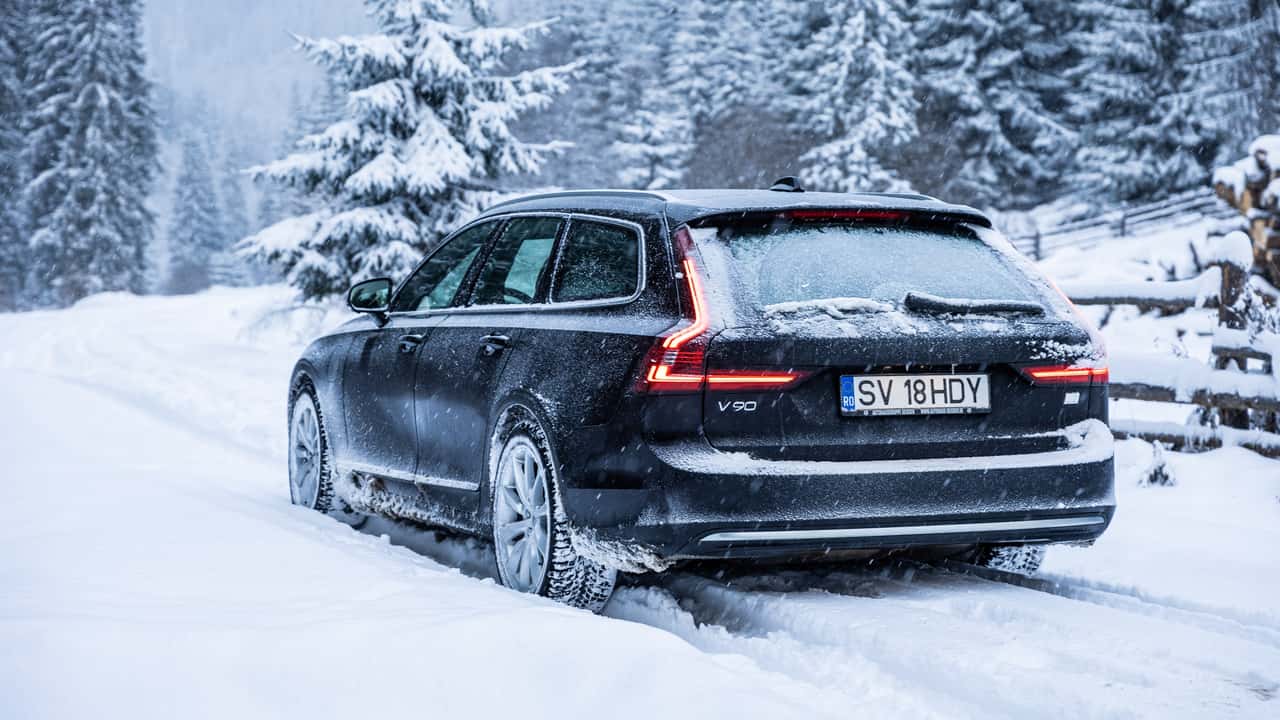
Photo by: Iulian Dnistran / InsideEVs
Iulian Dnistran 
By: Iulian Dnistran
Jan 11, at 7:00am ET
Add InsideEVs as a preferred source in Google
- (https://twitter.com/intent/tweet?url=https%3A%2F%2Finsideevs.com%2Ffeatures%2F783799%2Fvolvo-v90-t8-phev-battery-degradation-test%2F&text=Zero%20Battery%20Degradation%3A%20My%20Volvo%20PHEV%20Is%20Still%20Going%20Strong%20After%2042%2C000%20Miles&via=InsideEVs)
- copy
Share
Comment
Battery degradation is inevitable. But as technology advances and carmakers come up with better ways to improve battery life, it’s slowly becoming a non-issue. That’s what the statistics say, and that’s what I discovered after doing a battery capacity test on my own 2023 Volvo V90 plug-in hybrid wagon, which I’ve owned for almost a year.
My car is rare, and that's one of the reasons why I bought it in the first place. But the results should apply to any four-cylinder Volvo PHEV built after 2022—that’s when the Swedish automaker upgraded the battery packs and rear electric motors in its SPA-based plug-in hybrids. In other words, 2022.5 and newer S60s, V60s, S90s, V90s, XC60s and XC90s that came from the factory with an Android Automotive OS-based infotainment system.

Photo by: Iulian Dnistran / InsideEVs
How I Tested
Volvo doesn’t offer an easy way to check the battery health of its plug-in hybrids—not in the infotainment screen, and not in the data that can be checked with an OBD dongle. So I had to do it the old-fashioned way, by completely draining the battery and then charging it to 100%.
By doing so, I discovered some interesting information that quickly explains why Volvo hasn’t integrated a charging limit feature in its PHEVs. In all EVs, owners can limit charging at whatever level they wish—typically 80%—to protect the battery in the long term, but Volvo PHEV owners don’t have this functionality.
You have to manually unplug if you want to stop charging at anything but 100%. But you don’t need to, as I discovered.
I used an OBD diagnostics tool and a free smartphone app to keep an eye on the battery pack’s state of charge and voltage, as reported by the car’s battery management system (BMS). This is important because, as you’ll see, what the driver sees in the instrument cluster isn’t the same thing as what the BMS sees.

Stay informed with our newsletter every weekday
back
Subscribe For more info, read our Privacy Policy & Terms of Use.
The Data
Volvo’s official figures say that my car (and all the other PHEVs that use the same setup) has a gross battery capacity of 18.8 kilowatt-hours, while the usable capacity is 14.9 kWh.
I drove my car until the range estimate in the instrument cluster went down to zero and the engine kicked in to keep the wheels moving. But here’s where the interesting part begins. In Hybrid mode, which is the default mode in which the car boots up, the battery’s actual state of charge, as indicated by the BMS, was 21%, while the voltage was 361 volts.
In Pure mode, which can add one or two miles to the total electric range by accessing more of the battery’s capacity, the reported state of charge was 17% when the engine kicked in, with a voltage of 357V. So even if the gauge cluster says zero miles, it doesn’t mean that the battery doesn’t have anything more to give.
When the electric range is depleted, the engine kicks in to keep the wheels moving. In Hybrid mode, the actual state of charge is 21%, as reported by the car's brain.
Photos by: Iulian Dnistran / InsideEVs
In Pure mode, the engine kicks in when the BMS-reported state of charge reaches 17%.
Photos by: Iulian Dnistran / InsideEVs
The same goes for a full charge. After plugging into a 240-volt, 16-amp home charger and charging the battery to an indicated 100%, the BMS reported an actual state of charge of 94% and a voltage of 418V. This is the key that keeps the battery healthy for a long time.
By artificially limiting the real charge level and creating a buffer, battery degradation will be minimal, as I found out on my own. Even though it’s counterintuitive to omit a manual charging limit feature, the car does a great job of keeping things in check automatically.
After a full charge, the car's digital gauge cluster reported 100%. The BMS, however, read 94%.
Photo by: Iulian Dnistran / InsideEVs
Degradation
After doing all of the above, my home charger said that it had delivered 16.77 kWh of energy for a full charge. After subtracting 10% for losses, I get 15 kWh of usable energy that went into the battery. Volvo’s official figure says 14.9 kWh of usable energy, so the logical conclusion is that my car’s battery hasn’t degraded at all after nearly four years and 42,000 miles.
That’s fantastic news, especially considering that I’ve tried to drive on electric power as much as possible during my ownership, and I’ve fully charged the car almost every day for the past nine months and 11,500 miles.
Digging deeper into the numbers, the BMS keeps roughly 23% of the battery’s total capacity out of reach, which seems like a lot, but it works out extremely well in the real world.
Gallery: 2023 Volvo V90 T8 Recharge Plug-In Hybrid Battery Capacity Test
14






Source: Iulian Dnistran / InsideEVs
Looking Toward The Future
Just because my car’s battery hasn’t degraded so far doesn’t mean that it won’t be affected in one way or another in the future. A recent statistic from Germany’s ADAC, the country’s largest car club, showed that the average Volvo PHEV still had 85% of its original battery capacity after about 125,000 miles (200,000 kilometers), so I expect my car to go down the same path.
What’s more, not all PHEVs are created equal. According to the same study, Mercedes-Benz plug-in hybrids see the least degradation, while Mitsubishi PHEVs experience the most degradation.
What do you think?
View
Comments
As for the actual electric range figures, I’ve been getting approximately 37 miles (60 km) in the winter and roughly 55 miles (90 km) in the summer from a full charge. That said, I did max out at 68 miles (110 km) at one point, but that hasn’t happened a second time yet.
I like my car. It’s a luxurious family hauler that has halved my fuel costs, while also being the fastest and most powerful car I’ve ever owned. And judging by this battery test, I won't need to get rid of it anytime soon.
More Volvo Stories
The Volvo EX60 Is Here To Show Tesla That There’s A New Range King
Volvo Admits Software Is Hard. But Its 2026 Cars May Finally Fix the Problem
Some Plug-In Hybrid Batteries Degrade Much More Slowly Than Others
Used Volvo V90 PHEV Ownership Update: Costs, Efficiency And Annoyances
We want your opinion!
What would you like to see on Insideevs.com?
Take our 3 minute survey.
- The InsideEVs team
Share this Story
- (https://twitter.com/intent/tweet?url=https%3A%2F%2Finsideevs.com%2Ffeatures%2F783799%2Fvolvo-v90-t8-phev-battery-degradation-test%2F&text=Zero%20Battery%20Degradation%3A%20My%20Volvo%20PHEV%20Is%20Still%20Going%20Strong%20After%2042%2C000%20Miles&via=InsideEVs)
- copy
GO TO COMMENTS
(
)
Got a tip for us? Email: tips@insideevs.com
View all comments ( )
Trending
I Drove Volvo’s Long-Range Plug-In Hybrid XC60. It’s A Great Stepping Stone To An EV.
I've Driven Dozens Of Chinese Cars. Americans Are Missing Out On These 4 Features
I’m Thankful For My Electric Car
$30,000 Ford Fathom: Inside The Structural LFP Battery That Makes It All Possible
Latest Stories
- $30,000 Ford Fathom: Inside The Structural LFP Battery That Makes It All Possible Nov 28 - Battery Tech -
- I've Driven Dozens Of Chinese Cars. Americans Are Missing Out On These 4 Features Nov 28 - China -
- EVs Outsold Gas And Diesel Cars Combined In The EU In October Nov 27 - News -
- This Audi E-Tron EV Has 125,000 Miles. Replacing Its Battery Was A Huge Pain Nov 27 - Repair / Maintenance -
- Rivian's Winter Sale Is Live: Save on Chargers, Accessories, And More Nov 27 - Pricing -
- I Drove Volvo’s Long-Range Plug-In Hybrid XC60. It’s A Great Stepping Stone To An EV. Nov 27 - First Drives -
- A Used Cybertruck Is Selling A Month Faster Than A Ford F-150 Nov 26 - News -
RECOMMENDED FOR YOU
I Drove Volvo’s Long-Range Plug-In Hybrid XC60. It’s A Great Stepping Stone To An EV.
$30,000 Ford Fathom: Inside The Structural LFP Battery That Makes It All Possible
Volvo Is Bringing Humanoid Robots Into Its Factories. Here's When They'll Start Working
I've Driven Dozens Of Chinese Cars. Americans Are Missing Out On These 4 Features
The U.S. Let Volvo Keep Selling Cars. Polestar Got A No. What About Mercedes?
EVs Outsold Gas And Diesel Cars Combined In The EU In October
The Best EV Lease And Finance Deals In November 2026