
After A Year Without Tax Credits, EVs Are Down But Not Out
We look back at what happened in the EV market this year, and where things are headed next.
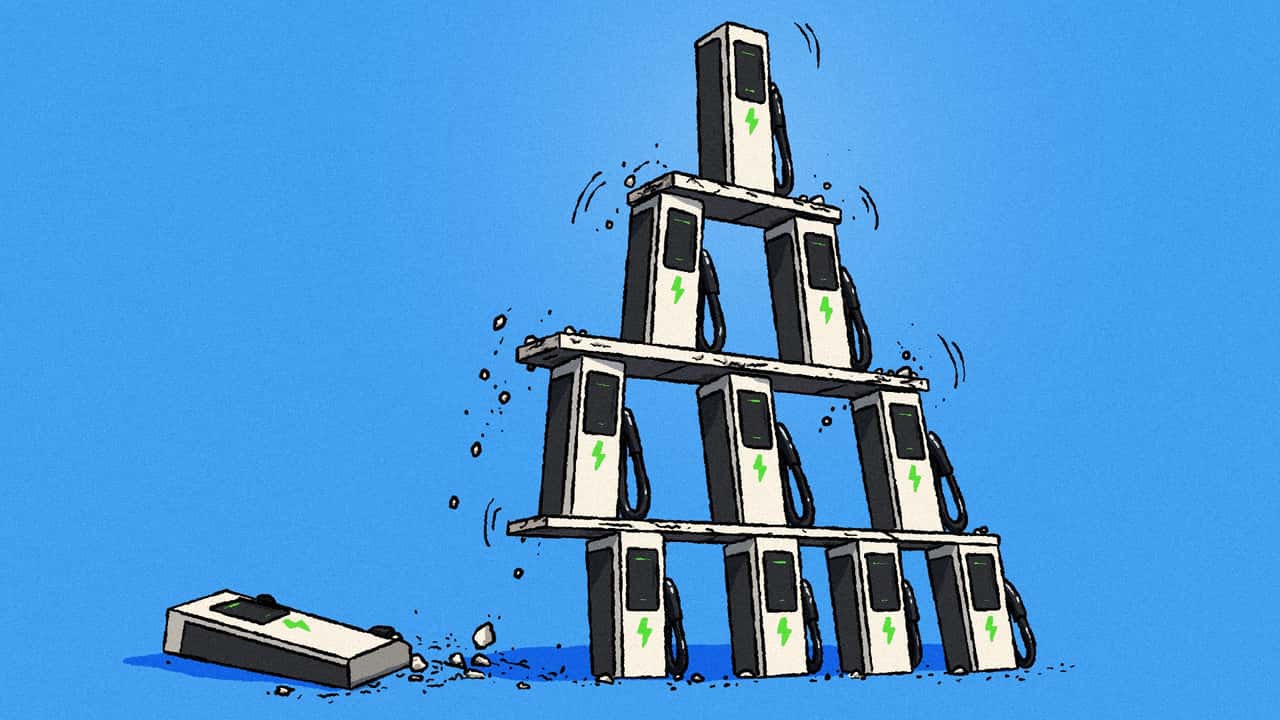

It’s been a year and change since the biggest shock America’s electric car market has ever seen. The $7,500 EV tax credit met its untimely demise on September 30, 2025, as the Trump administration and Congress also axed fuel economy regulations and other policies pushing EVs along.
So, a year after the great EV reset, what’s changed?
The EV Market Is Bouncing Back, Slowly
EV sales cratered at the end of last year—not just just because a big incentive to buy one abruptly vanished, but also because so many Americans had rushed to get one while the getting was good. In September of 2025, the electric share of retail car sales soared to over 14%, according to data from JD Power. In October, that plunged to 7.1%, but the pain wasn’t through. By November, just 5% of retail sales were battery-powered, a level not seen since 2022.
“That was something that nobody expected, and it made very important and sudden changes in the market, and for us too, right?” Hyundai CEO José Muñoz told me last month. “All of a sudden, you either add the incentive, or you lose sales, or you do something in between.”
It wasn’t clear how quickly or to what degree things would bounce back. But the market is showing new signs of life and has started to gradually rebound.
“In general, the EV market has been perhaps more resilient in some ways than we would maybe expect,” Tyson Jominy, JD Power’s senior vice president of data and analytics, told me. “Sales certainly fell as expected, but we kind of hit the floor quickly.”

Hyundai CEO José Muñoz says dealers started asking for more Ioniq 5s once the war in Iran raised the price of gas.
Share bounced back over 6% in December, and climbed to over 8% in May, the firm says. JD Power puts September’s EV share of retail sales at 7.9%. “We only went back about two years,” Jominy said, “which doesn’t seem so bad.”
While high gas prices haven’t produced a big spike in sales like they have in other global markets, anecdotally they may be helping on the margins. Muñoz said Hyundai dealers who had been asking the company to dial back shipments of Ioniq 5s suddenly started asking for more of them after the war in Iran started.
There are other signs of a normalizing market. The number of days EVs are spending on dealer lots has dropped every month from April through September, according to data shared by Cars.com. In September, it took 89.4 days for the average EV to sell, down from 115.6 days in March and only slightly higher than the 80.5 days seen during last year’s EV-buying frenzy.
“That, I think, is showing that we're getting closer to the moment where the demand and the supply are in good balance,” Jenni Newman, the vehicle marketplace’s editor-in-chief, told me.
Tesla And Rivian Are Carrying The Team
That’s the macro picture. But the recovery is far from evenly distributed. A few automakers, notably Tesla and Rivian, are carrying much of the industry’s comeback.
Between the second and third quarters, overall EV sales in the U.S. grew by 6.1% to hit some 262,000 units, their highest level since the tax credit ended, Cox Automotive says. Take Tesla out of the equation, though, and the market would have shrunk slightly instead, according to the firm’s sales estimates. (Tesla doesn’t break out its regional sales.) On a year-over-year basis, Tesla’s sales fell 19.7% in Q3, Cox says, while the market as a whole contracted by close to 40%. It means Tesla’s share of the EV market is back up above 50%.
“Tesla has pretty much withstood the decline we've seen among the non-disruptors,” said Tom Libby, director of loyalty solutions and industry analysis at Mobility Global.
Tesla has weathered the EV slowdown better than most, and it's back up over 50% of America's electric car market.
In part, that’s because Tesla has built a great product that people keep coming back to. Around half of Model Y owners get another one as their next vehicle, Libby said, while model-level loyalty across the board lands at 26%. At Rivian, deliveries have surged this year on the back of the new R2, one of the best all-around Model Y rivals in years and its first product with mainstream potential.
There’s another big reason for the divide: EV-only manufacturers couldn’t simply pivot to gas models when the policies shifted like other manufacturers did. Since last year, legacy automakers have canceled or delayed some two-dozen electric models, like the Ford F-150 Lightning, Volkswagen ID.4, and Honda Prologue. The product vacuum was bound to hurt sales, but cutting back on EVs also makes perfect sense as a reaction to looser regulations and changing incentives.
“A lot of people, myself included, tend to forget that the manufacturers are not really in business to make cars,” Libby said. “They're in business to make money.”
While many legacy players struggle to regain momentum, Toyota is a notable outlier, having steadily grown EV sales as it’s introduced new models this year.
Used EVs Are Having A Moment
The used EV market is another bright spot. It isn’t just surviving, it’s thriving, suggesting there’s strong demand for battery power at the right price.
Sales took a dive after the EV tax credit went away, but they rebounded quickly and have rocketed upward ever since. Last month, Americans snapped up over 47,000 used electric cars, Cox Automotive says, a 21% year-over-year jump that gave EVs their largest-ever share of the used car market.

The fact that your options aren’t limited to low-range Chevy Bolts and Nissan Leafs anymore is certainly helping. There’s better supply of lightly used EVs than ever, as an increasing number of modern, long-range cars, particularly ones that were leased over the last few years, hit the secondhand market.
And the demand is there too, boosted in part by $4-a-gallon gas, industry-watchers say. Used EVs are selling in 41 days on average, according to Cars.com, about 12 days faster than internal-combustion models. And while prices for lightly used gas cars have stayed roughly flat over the last year, used EV prices are up close to 10%, iSeeCars says.
The EV Revolution Isn't Canceled. Just Delayed.
Despite the rocky road, industry watchers and auto executives broadly think EVs will continue displacing gas vehicles in the U.S.—albeit at a slower rate than before.
“We remain optimistic, quite frankly, on the space,” Jominy said.
The Rivian R2 is part of a new class of EVs that could drive sales higher in the coming years.
EVs are taking off globally, he said, and data shows that once someone goes electric they tend to be hooked. Plus, electric cars have fewer parts and are cheaper to manufacture at scale than combustion vehicles, putting slower-moving automakers at a disadvantage as EV sales climb around the world. At some point, the economics of scale in the industry will be far more favorable to electric propulsion, he said. “Once you can produce something 30% cheaper,” he said, “you really can’t just maintain the old way for very long.”
On top of that, U.S. charging infrastructure is improving quickly; last quarter, the U.S. surpassed 80,000 DC fast charging ports, up from 70,000 at the end of last year. Promising new models like the R2, Ford’s $30,000 Fathom pickup, the Slate Truck, and a slew of high-tech cars from luxury manufacturers could take sales to the next level. While Hyundai is investing heavily in various types of hybrids to buck the EV slowdown, Muñoz sees a future for electric cars in America too.
“What you see everywhere when you look at the trends in the market, EV is there to stay,” he told me.
Contact the author: Tim.Levin@InsideEVs.com
We Think You'll Enjoy...
RECOMMENDED FOR YOU
Tesla's Cybercab Is Built In A Radical New Way. Here's How It Works
Waymo's Public Fast-Charging Problem Is Infuriating EV Drivers
Tesla FSD Is Hitting Europe. It's Not Perfect
‘We Are Long-Term Committed In Europe’: Why Tariffs Won’t Scare Zeekr Off
South Korean Police Are Cracking Down On Tesla Owners Jailbreaking FSD
Volkswagen Can't Afford Its Upcoming Electric Golf Right Now
Do Those Funky Tesla Wheel Covers Actually Boost Range?