Home
News
Hyundai’s Big 2027 Launch: An EREV With 600 Miles of Range
Hyundai promises long-distance "EV-like driving experiences" by adding gas power to the mix. We'll see the first of these in 2027.
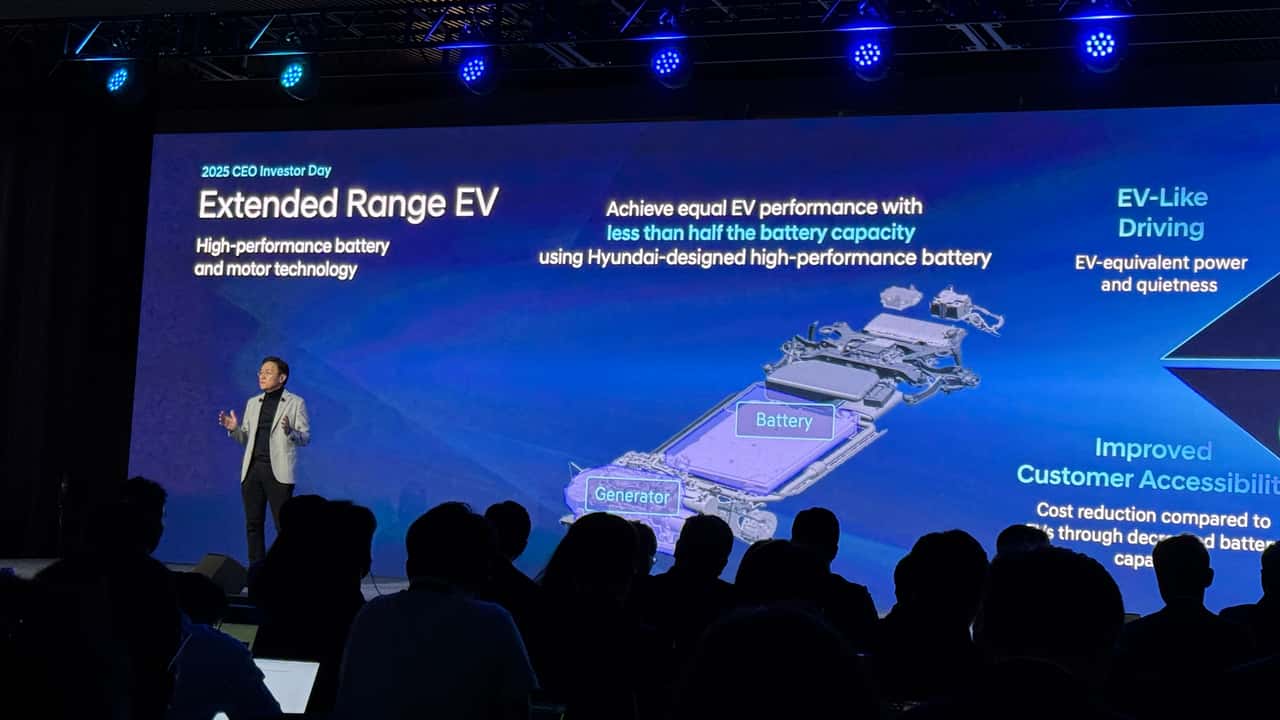
Photo by: Patrick George
Patrick George 
By: Patrick George
Sep 18, 2025 at 5:00am ET
Add InsideEVs as a preferred source in Google
- (https://twitter.com/intent/tweet?url=https%3A%2F%2Finsideevs.com%2Fnews%2F772645%2Fhyundai-erev-2027-release%2F&text=Hyundai%E2%80%99s%20Big%202027%20Launch%3A%20An%20EREV%20With%20600%20Miles%20of%20Range&via=InsideEVs)
- copy
Share
Comment
- At Hyundai's annual CEO Investor Day in New York, the Korean automaker made several major announcements about its electrified future.
- Among them: an expansion into extended-range electric vehicles, or EREVs, has been confirmed for 2027.
- Hyundai and Genesis together aim to sell 3.3 million electrified vehicles by 2030, including more than 18 hybrid models and "a comprehensive EV lineup."
For its next act as it pushes toward a more electrified future, the Hyundai Motor Group will turn to gasoline power for some help.
At its annual CEO Investor Day event in New York today—its first outside of South Korea—the automaker will announce that its first extended-range electric vehicle, or EREV, will go on sale in 2027. This seems to track with earlier announcements that its EREV model will be built in North America and China in 2026.
An EREV is a nascent class of electrified vehicle that's catching on quickly in China and poised to do the same in North America in the coming years. Essentially, it's an electric vehicle platform that adds a gas engine, not to power the wheels but to act as a generator that only recharges the battery. In theory, this would allow for an EV-like driving experience—charging, instant torque, quietness and so on—with the ability to refuel as needed to eliminate range anxiety.
While it isn't clear whether Hyundai or its luxury division, Genesis, will get an EREV, the answer could be both. But Hyundai offered a few new details about what to expect from this technology.
"Launching in 2027, Extended Range EVs (EREVs) will utilize high-performance batteries and motors to deliver EV-like driving experiences with more than 600 miles (960km) of range through optimized battery-engine integration," the automaker said in a statement.

Stay informed with our newsletter every weekday
back
Subscribe For more info, read our Privacy Policy & Terms of Use.
Moreover, these EREVs should need smaller batteries than Hyundai's current EVs do; if a Hyundai Ioniq 5 is any indication, that could be a 30-to-40 kilowatt-hour battery augmented by a small gas engine.
"Unlike conventional EREVs, Hyundai’s approach utilizes in-house high-performance batteries, achieving full EV power performance with less than half the battery capacity, improving accessibility while maintaining exceptional range and performance, and eliminating range anxiety," the automaker said.
The company did confirm that Genesis would add EREV powertrains to its lineup as it also branches into hybrid cars in the coming years. Like Toyota and Ford, Hyundai has seen considerable success with its hybrid lineup as more customers get curious about EVs but may be unwilling to make the full switch. "The company will expand its hybrid lineup to more than 18 models by 2030, including the introduction of Genesis hybrid models starting from 2026," the automaker said.

Genesis Neolun Concept
Photo by: Genesis
EREVs have been floated as a possible solution to the problems dogging large EV trucks and SUVs: In order to achieve big range, towing and hauling features, you need a big battery. But that extra weight penalty can make large batteries inefficient, while their overall range gets reduced when they have to put in the work. This is why EREVs are becoming a popular powertrain setup for some of China's larger vehicles.
In the U.S., several automakers are branching into the EREV market in the coming years. Among them are the Scout Terra and Traveler, which pack a gas engine to supplement their batteries and are targeting a 500-mile range, or the recently renamed Ram 1500 REV, which now takes the place of a purely electric Ram truck.
What do you think?
View
Comments
In general, the Hyundai Motor Group has seen considerable success with its modern lineup of EVs. With class-leading range, fast-charging and eye-catching style, the electric models have served as a kind of brand reset for the Korean automaker. But even Hyundai isn't immune to the volatile EV market. For now, it seems to be turning to electrified vehicles like hybrids and EREVs as it adjusts to a world where EV sales are less brisk than expected.
Contact the author: patrick.george@insideevs.com
More EREV News
This Chinese EREV Has Over 900 Miles Of Range
Your Future Deliveries Could Come From This Range-Extended Electric Truck
Ram Has Canceled Its Electric Pickup Truck
Ford To Build EREV SUVs, Super Duty Trucks As EV Plans Shift
Extended-Range EVs Are The Next Big Thing. Will Drivers Plug Them In?
Hyundai Ioniq 9 Three-Row SUV To Be Built In America; 560-Mile 'EREV' In 2026
We want your opinion!
What would you like to see on Insideevs.com?
Take our 3 minute survey.
- The InsideEVs team
Share this Story
- (https://twitter.com/intent/tweet?url=https%3A%2F%2Finsideevs.com%2Fnews%2F772645%2Fhyundai-erev-2027-release%2F&text=Hyundai%E2%80%99s%20Big%202027%20Launch%3A%20An%20EREV%20With%20600%20Miles%20of%20Range&via=InsideEVs)
- copy
GO TO COMMENTS
(
)
Got a tip for us? Email: tips@insideevs.com
View all comments ( )
Trending
Kia EV3 Lease Deals Are Here, And It’s Cheaper Than The Chevy Bolt And Nissan Leaf
I Let Android Auto Plan My EV Roadtrip. Here’s How It Worked
This Chevy Bolt Has 470,000 Miles. Here’s How Much A New Battery Was
Here's What It's Like To Take Delivery Of A Rivian R2
latest articles
- This Chinese EV Is Now Made In Europe. More Are Coming Oct 20 - News -
- GM Is Closing Its Detroit EV Battery Plant Oct 20 - Industry -
- The 2027 Lexus NX Plug-In Hybrid Gets A Bigger Battery And Fast Charging Oct 20 - Official -
- Kia EV3 Lease Deals Are Here, And It’s Cheaper Than The Chevy Bolt And Nissan Leaf Oct 20 - Pricing -
- Here's What It's Like To Take Delivery Of A Rivian R2 Oct 19 - News -
- Used EVs Hit A Record Share Of Overall Used Car Sales In September Oct 19 - Sales -
- Nio's Little Electric Car Has A Cool Party Trick: Upgradeable Range Oct 19 - News -
RECOMMENDED FOR YOU
The Longest-Range EVs You Can Buy In 2026
GM Is Closing Its Detroit EV Battery Plant
Hyundai’s Next Two EVs Could Be A Little More Normal
The 2027 Lexus NX Plug-In Hybrid Gets A Bigger Battery And Fast Charging
2027 Hyundai Tucson Bets On Hybrids And A Modern Infotainment System
Kia EV3 Lease Deals Are Here, And It’s Cheaper Than The Chevy Bolt And Nissan Leaf
The Best Electric Sedans To Buy In 2026: Top Picks For Range, Performance & Style