
I Drove The 2027 Nissan Rogue Hybrid And Toyota RAV4 Back To Back. One Stood Out
The fourth-generation Rogue drives like an EV, with buttery smooth acceleration and top tier refinement.

As drivers get squeezed at the pump due to high gas prices, they’re increasingly seeking cars that can go farther on a tank of gas, leading to record sales of hybrids for Toyota, Honda, Hyundai, and Kia this year.
Nissan, however, has been notably absent from this party, with no plug-less hybrid in its U.S. lineup. The 2027 Rogue Hybrid finally changes that, and it will lock horns with rivals such as the Toyota RAV4, Honda CR-V Hybrid, and Hyundai Tucson Hybrid. But does it have what it takes to challenge these more established names in this segment?
I drove the new Rogue last week and came away impressed. Its unique powertrain makes the gas engine work solely as a generator to charge the battery. The engine has no mechanical connection to the wheels, which are driven by electric motors the whole time.
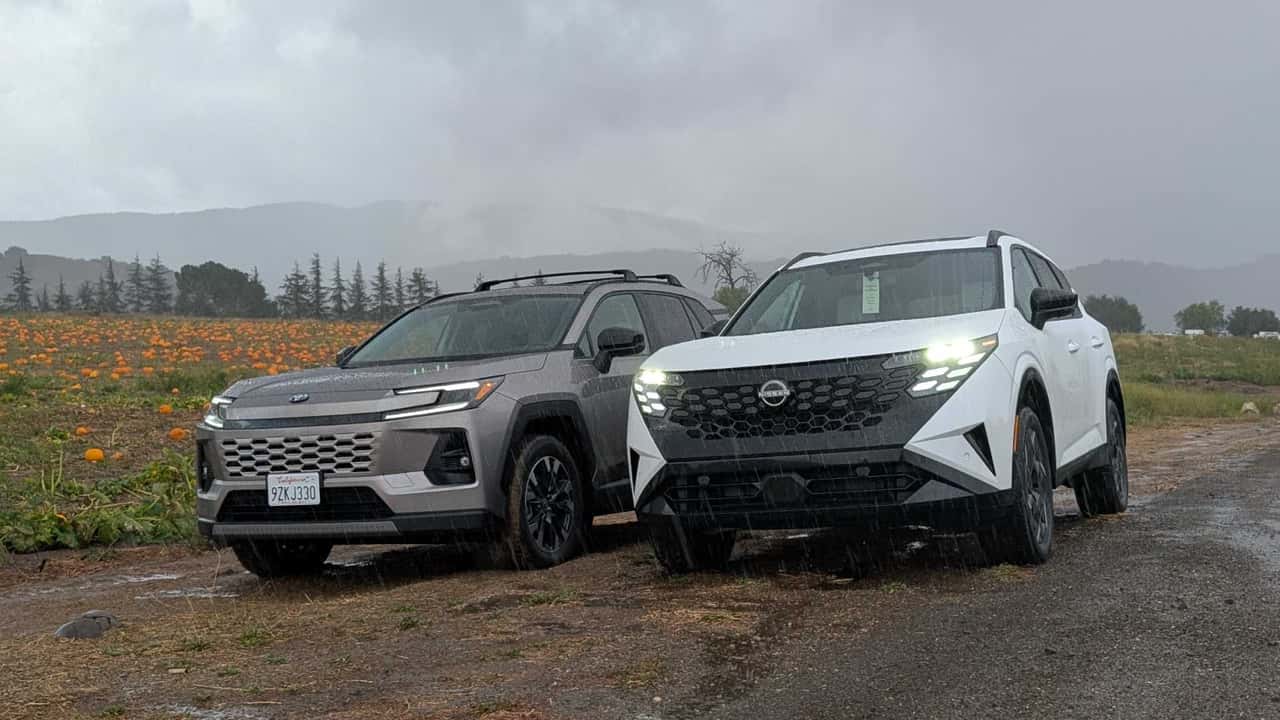
As a result, the Rogue drives like an EV with impeccable refinement and smoothness. I drove it back to back with the RAV4, and the Rogue felt superior with its EV-like traits. The RAV4 outperforms in some other areas, but the Rogue is particularly strong when it comes to driving characteristics. Let’s dive right in.
[Full Disclosure: Nissan invited me to drive the 2027 Rogue Hybrid in Santa Barbara, California. It paid for travel, accommodation, and food.]
Gallery: 2027 Nissan Rogue Hybrid







Nissan’s Third Generation e-Power System Explained
Don’t let anyone fool you into thinking that hybrids are new. They’re older than the iPhone. The Toyota Prius made its U.S. debut in 2000, and while hybrid technology has incrementally improved since with efficiency and performance gains, the basic formula is unchanged: pair a gas engine with one or more electric motors and a small battery for better fuel economy.
Nissan’s e-Power hybrid system isn’t new, either. The automaker has sold nearly 2 million vehicles equipped with the technology worldwide since 2016, but it’s bringing it to the U.S. only now.
So why the wait? Nissan executives said the first two generations of e-Power were designed for markets such as Japan and Europe, where smaller, front-wheel-drive vehicles are more common. The Rogue Hybrid’s third-generation e-Power system, with a more powerful, dual-motor all-wheel-drive setup, is tailored to North American driving conditions. It was developed for higher speeds and American drivers’ performance needs, Nissan said.
The 5-in-1 electric drive unit combines the reducer, inverter, increaser, motor, and generator. It's showcased here within the broader 1.5 liter engine assembly.
The Rogue, however, feels refreshingly different from rivals. It is powered by a 1.5 liter, three-cylinder turbocharged gasoline engine which shares no components with the power plant on the current Rogue, according to the company. The engine is paired to a 1.67 kilowatt-hour lithium ion battery, which powers two permanent magnet motors, one on each axle.
It is designed to run in its most efficient power band around 2,000 rpm for regular driving but it can rev up to 5,500 rpm under extra load. The generator converts the engine’s mechanical rotation into electricity, whereas the inverter handles alternating current (AC) to direct current (DC) conversion for the high-voltage battery and back to AC for the e-motors. With no direct mechanical linkage between the engine and the wheels, or between the front and rear axles, the electric motors do all of the driving.
That’s the primary distinction between this system and the ones that power Toyota and Honda hybrids. Engines in those hybrid systems are also connected to the wheels, and they use an electronic-continuously variable transmission (e-CVT). There’s no traditional transmission on the Rogue hybrid, just direct drive to the electric motors via the battery.
2027 Nissan Rogue Hybrid Specifications
2027 Nissan Rogue Hybrid: Driving Impressions
Pulling out of the parking lot, I could barely tell the Rogue’s engine was running. Around town, the SUV is quiet and smooth, with the combustion engine largely imperceptible. It was only once I hit the freeway that I began to hear a faint, distant rumble. There’s no instant torque like an EV, no turbo lag like a combustion engine, nor any flat acceleration like a traditional hybrid—just a smooth, consistent, and progressive power delivery.
Hopping into the RAV4 back to back made the Rogue Hybrid’s strengths even more clear. Under acceleration, the RAV4 produces that coarse and unpleasant rubber band effect from its e-CVT. With no transmission, the Rogue makes no such noises. It’s plenty quick, too, hitting 60 miles per hour in 6.4 seconds, which Nissan said makes it the fastest accelerating SUV in the segment. However, the build up of speed is more effortless than jarring—you’re not going to scare your passengers away when you floor the throttle.
It also gets one-pedal driving and recovers energy from braking for better efficiency. One pedal driving worked as advertised, although it didn’t slow down the vehicle as quickly as an EV. I found myself having to lift off the accelerator earlier than I would have liked to give it enough room to stop before a crosswalk or a stop sign. Until you learn to anticipate its braking behavior, you’ll find yourself reaching for the brake pedal more often than you would in an EV with stronger regenerative braking.
The Rogue also gets what Nissan calls “Smooth Stop.” It basically avoids head toss when the SUV fully stops, something we’ve also experienced in the BMW iX3. It does this by precisely controlling the brake force moments before the vehicle stops, factoring in things like gradient and speed, to avoid your head from bobbing forward and back. It will also sense your foot’s pressure on the pedal. If you’re feathering the brake or pressing hard, head toss is controlled regardless. It’s a small feature, but can make stop-and-go traffic feel less tiring.
The Rogue Hybrid delivers an EPA-rated city/highway/combined fuel economy of 41/36/38 miles per gallon. All of that is better than the non-hybrid third-generation Rogue currently on sale, which is rated for just 30 mpg combined and less than that on most trims. The RAV4 is more efficient, with an EPA rated city/highway/combined fuel economy of 46/39/42 mpg. In my testing earlier this year, I observed 47 mpg combined and up to 56 mpg in the city with the Toyota. So the RAV4 is both more efficient in the city and on the highway, but the Rogue Hybrid doesn't appear to be far behind. (The fuel economy varies slightly depending on trims.)
The suspension also felt sophisticated on the new Rogue. The ride around town was supple, with the springs absorbing the bumps really well and minimal jolts filtering into the cabin. The SUV doesn’t thud or crash over large expansion joints and feels planted at highway speeds. The excellent ride, plus the EV-like refinement and smooth acceleration makes it feel like a premium SUV belonging to a segment above.
2027 Nissan Rogue Hybrid Interior And Technology
While Nissan seems to have gone all-in on making the driving experience great, the same effort doesn’t quite extend to the cabin.
The seats are soft and comfortable, but the interior lacks a cohesive design language. The center console, in particular, feels like an afterthought, with square, plasticky gear selector buttons and climate controls that look out of place. At least they work well, and I’m glad Nissan hasn’t succumbed to the trend of burying basic functions in touchscreen menus.
The dual 14.3-inch displays looked crisp, and the central touchscreen felt slick and responsive, although my limited time with the vehicle didn’t allow for a more comprehensive review of the infotainment. Wireless Apple CarPlay and Android Auto come standard, while the top-spec Platinum trim adds Google built-in with Gemini and a 10-speaker Bose audio system.
There are some thoughtful touches, too. The wireless phone charger is MagSafe-compatible, so your iPhone won’t rattle. The rear doors open to nearly 90 degrees, so you have more room while installing child seats and easier ingress and egress.
While the Rogue Hybrid’s cabin is very practical, I like the RAV4’s interior better. It feels more upscale with generous use of soft touch materials on the dashboard, gun metal finish to physical controls, and a more cohesive overall cabin design.
2027 Nissan Rogue Hybrid
2026 Toyota RAV4 Limited Interior
2027 Nissan Rogue Hybrid: Early Verdict
The new Rogue Hybrid comes with a premium for its unique powertrain. At $37,065 including destination, it costs about $3,500 more than the entry-level RAV4, which is priced $33,495. The Tucson Hybrid is also cheaper at $32,950, although the CR-V Hybrid starts at nearly the same price as the Rogue.
For that premium, you get a more refined, EV-like driving experience, with smooth acceleration, and none of the coarse engine noises associated with conventional hybrids. I also loved the one-pedal driving and remarkably smooth stops that minimize head toss. It all makes the Rogue feel upscale, almost Lexus-like from behind the wheel. The cabin, however, falls short of delivering that same premium experience, with materials that feel cheap.
It’s still a gas car at the end of the day, so you don’t have to worry about plugging in at all. Its EPA-rated 38 mpg combined trails the RAV4 Hybrid’s 42 mpg, although it edges out the CR-V Hybrid’s 37 mpg and the Kia Sportage Hybrid’s 35 mpg.
I'd pick the Rogue Hybrid over the RAV4 for its driving experience alone. Its electric motors deliver a level of refinement that makes everyday driving feel far more polished. The RAV4, however, is the more compelling all-rounder, with better fuel economy and a lower starting price. Which one makes more sense ultimately depends on whether you value driving experience over outright efficiency and value.
Contact the author: suvrat.kothari@insideevs.com
Related Stories
RECOMMENDED FOR YOU
The Best Affordable Electric Cars In 2026: Cheap, Reliable Options For Everyone
Volkswagen Can't Afford Its Upcoming Electric Golf Right Now
Used EVs Hit A Record Share Of Overall Used Car Sales In September
Toyota Is Turning The bZ EV Into A Waymo Robotaxi, Starting in 2027
The Longest-Range EVs You Can Buy In 2026
Ford Fathom: Everything We Know About The Sub-$30,000 Affordable EV Truck (Updated)
Nissan's New Plug-In Hybrid Pickup Is Part Of A Much Bigger China Trend