
Rivian Says Fight Over Apple CarPlay Is 'Completely Obsolete' Thanks To AI
Rivian says the tremendous progress of AI-powered voice assistants will make CarPlay a thing of the past.
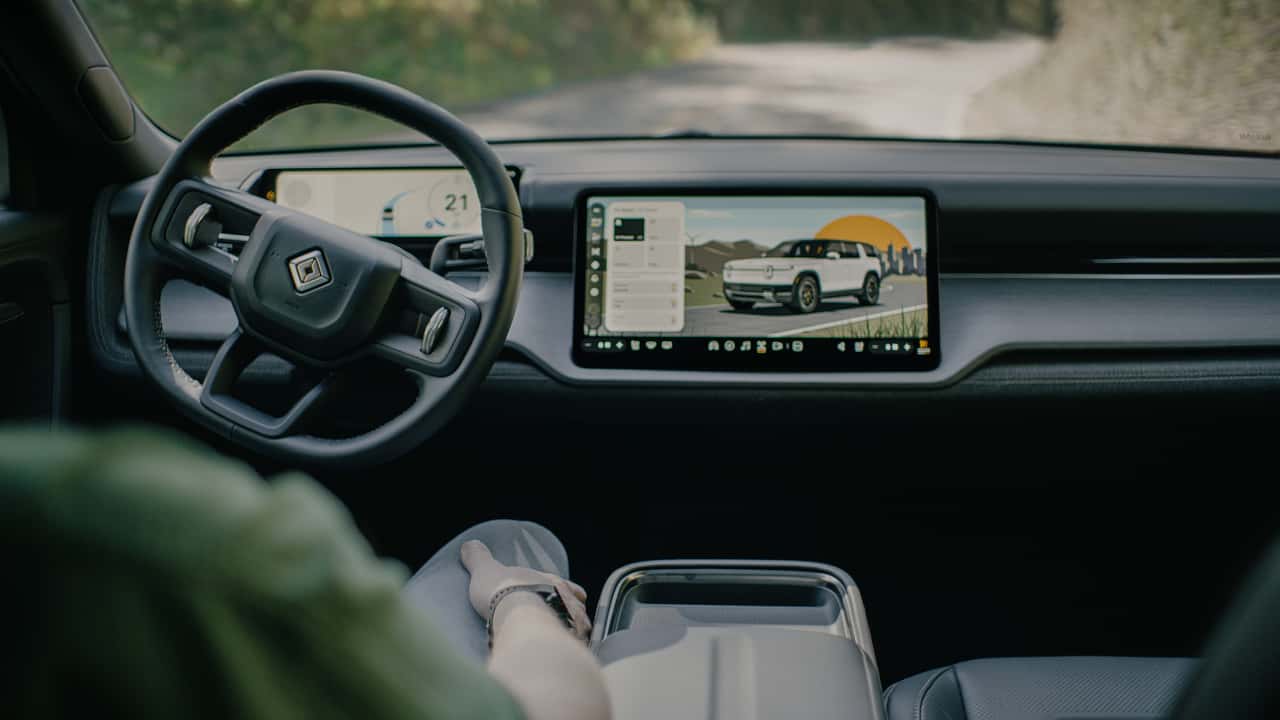

- Rivian says that AI in the cabin is the future of in-car controls.
- This essentially puts the debate over Apple CarPlay integration to bed, at least in Rivian's eyes.
- Whether consumers agree remains to be seen.
A lot of people love Apple CarPlay and Android Auto. The idea of mirroring your phone to the infotainment system is a huge selling point. But an increasing number of automakers, including Tesla, General Motors, and Rivian, to name just a few, are turning their nose up at the idea and instead using their own in-house solution.
Recently, Rivian's chief software officer, Wassym Bensaid, elaborated on the company's software philosophy. It turns out that the EV maker still isn't a huge fan of stuffing CarPlay into its cars and instead believes that no amount of buttons or screen mirroring can replace the interface that really matters: your voice.

Bensaid revealed the automaker's software direction during a recent interview on the Decoder podcast. He noted that screen-mirroring tech like CarPlay presents the unique challenge of taking over every single pixel of a car's infotainment, which isn't how Rivian sees itself interacting with the people using its software.
Moving forward, Rivian believes that everyone's favorite buzzword—AI—will be the preferred way that drivers interact with their cars. This means that features like Rivian Assistant will be front and center, controlling major vehicle functions as the tech matures.
That last nugget about the tech maturing is the most important part. We all know that using voice assistants has been a subpar experience on certain vehicles. Even Rivian's customers have complained about the in-car voice recognition in the past, which means putting a lot of trust in the company to fixing the software moving forward (and won't accidentally turn off your headlights while driving like some other brands).
Bensaid says that the use of AI makes the CarPlay argument moot. Here's an excerpt from Decoder's interview:
What we’re seeing right now with the advancement of AI technologies is just another reason why I deeply believe that RJ and Rivian made the right choice by investing into our own technology and software. Cars are moving from, as you said, the buzzword “software-defined” to “AI-defined.” The possibilities now for such deep AI integration in the car make the entire CarPlay debate completely obsolete.
I really believe that the way you interact with apps—which are mono-threaded with single buttons or single icons—will be completely reshaped into a world where an agentic integration presents itself as a wholesome user experience.
He continued to note that Rivian believes that voice "has the chance to be the primary interface in the car," meaning that while buttons do exist, they shouldn't be the primary way that the driver interacts with features inside of the vehicle.
This, of course, minimizes the need for additional hardware and helps to cut the cost of physical parts. But it also eliminates the need to dig deep into software menus to find certain features.
The problem with CarPlay's integration is that this sort of agentic use of AI isn't really available to Rivian or other automakers, at least not yet. So Rivian can quickly pump out new features and improve functionality much more quickly than if it were waiting on a third-party partner.
Bensaid also noted that Rivian's number one requested feature was CarPlay. Five years ago, more than 70% of respondents surveyed by Rivian said they wanted CarPlay in their vehicle. Rivian didn't budge, though, and that request has recently dropped to less than 25%. Bensaid attributes that success to the number of features that Rivian shipped over the last five years, essentially upping the level of convenience of the in-car tech faster than Apple could pump out similar integrations in CarPlay.
And while you may be burning tokens with frontier models, using AI as your primary control interface, Rivian says it could rate-limit users if they spend hours talking to the assistant like a conversation partner, to keep compute costs low. But even better, Bensaid says that much of the AI inference could be moved down to local compute, presumably thanks to the upcoming XMM3 infotainment chipset. That means the vehicle would be able to process conversational commands using its own hardware and software, rather than fully relying on data centers thousands of miles away.

Rivian is probably right that future cars will eventually stop revolving around mirroring our phones. The industry will eventually pivot to the solution that provides greater convenience for the driver and more usable data for the automaker. That very well could be a homegrown solution like the one Rivian has built.
Now, whether Rivian or any other automaker can truly deliver the magical AI-powered car at scale remains another question entirely. Admittedly, these voice assistants have become alarmingly good at interpreting what humans are asking for, as we've seen with the latest Volvo EX60 that InsideEVs recently reviewed and came away impressed with its Gemini integration. So the long-awaited future of making in-car voice assistants truly capable may arrive sooner than we think.
More Rivian News
RECOMMENDED FOR YOU
Amazon Added 10,000 Rivian Electric Vans In Just Six Months
Audi's U.S. Hybrid Push Is About To Get A Lot Bigger
Rivian R2 Range Tested Until It Died: Here's How Far It Went At 70 MPH
This Quad-Motor Electric Land Rover Defender Restomod Has More Range Than Some Teslas
Something Doesn’t Add Up About The Rivian R2’s EPA Efficiency Rating
Tesla Reaches Its Biggest Manufacturing Milestone Yet With 10 Million EVs
Rivian's Electric Van Outsold Its Rivals Combined—By 70%