
The Mercedes-AMG GT 53 EV Trades Power For Over 500 Miles Of Range
The entry-level AMG four-door EV uses one fewer motor than the GT 63, yet still makes 536 hp and hits 60 mph in 3.4 seconds.
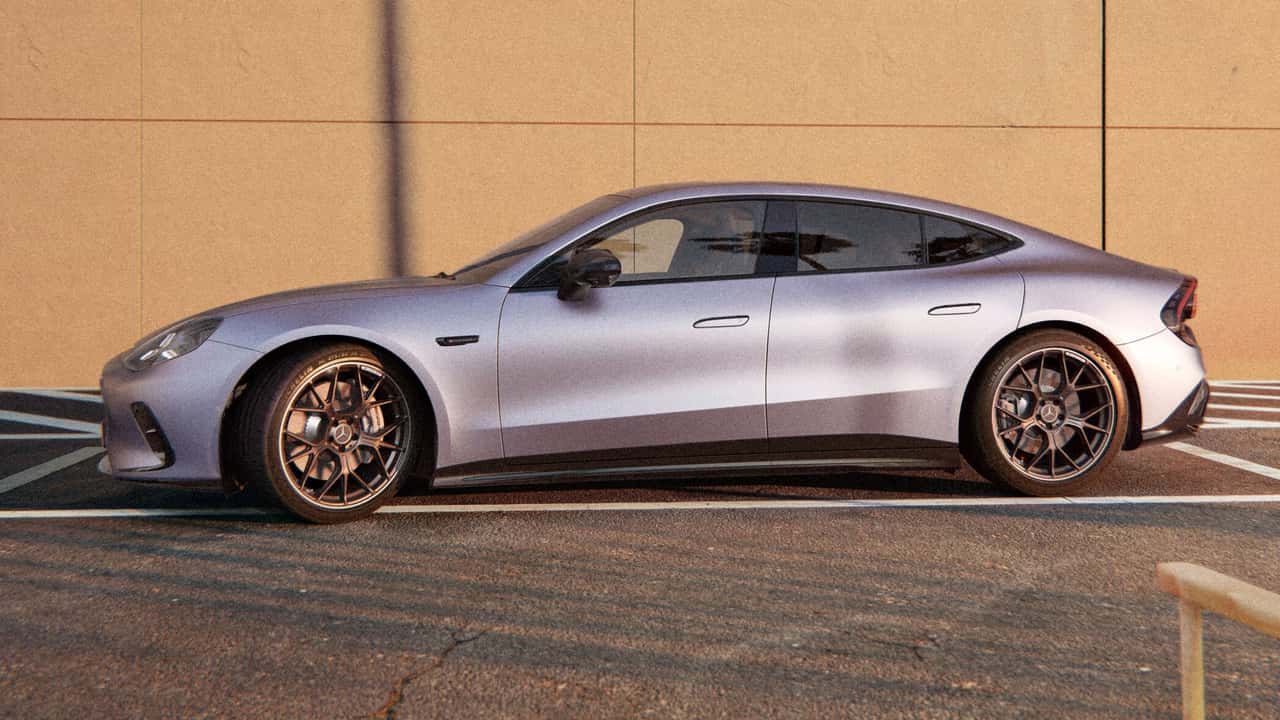

- The AMG GT 53 makes 536 hp, hits 60 mph in 3.4 seconds and offers up to 503 miles of WLTP range.
- It keeps the GT 63’s 106-kWh battery and 600-kW charging, despite using two motors instead of three.
- The GT 53 loses the 63’s extreme power, active chassis hardware and track-focused modes, but gains efficiency.
Mercedes-AMG has revealed a cheaper, entry-level GT 4-Door with more range than the tri-motor models. The AMG GT 53 loses one motor and more than half the flagship’s output, but retains its advanced battery and ultra-fast charging power and offers considerably more range.
The GT 53 features two permanently excited synchronous motors—one powering each axle—producing a combined 536 hp and 590 pound-feet (800 Nm) of torque. Mercedes says it will reach 60 mph in 3.4 seconds with one-foot rollout, or 3.8 seconds from a standstill, before hitting an electronically limited top speed of 143 mph (230 km/h).
It’s far less extreme than the 63, whose three axial-flux motors—one at the front and two at the rear—give it 1,153 hp and 1,475 lb-ft (2,000 Nm), allowing it to reach 62 mph in as little as 2.1 seconds with rollout (or 2.4 seconds without it).
Gallery: 2027 Mercedes-AMG GT 53 4-Door Coupe




The GT 53 also slots below the GT 55, which retains the flagship’s three axial- flux motors, but dialed down to 805 horsepower and 1,328 lb-ft (1,800 Nm). In Germany, the 55 variant launched at €154,700, versus €196,350 for the GT 63. The new dual-motor 53 therefore introduces a simplified powertrain formula and should be even cheaper, closer in price to its natural rival, the entry-level all-wheel drive version of the Porsche Taycan, which starts at €107,300.
The GT 53’s front motor primarily serves as a booster, engaging when extra traction or performance is needed. When not in use, a mechanical disconnect unit decouples it to reduce drag, allowing the car to operate as a rear-wheel-drive EV to boost efficiency. The rear motor powers the wheels through a two-speed transmission, with a short first ratio for acceleration and urban driving and a taller second gear for high-speed performance and highway efficiency.
The result is an expected WLTP range of up to 503 miles (809 km) from the same 106-kilowatt-hour battery as the other two variants. The GT 63 is rated at up to 432 miles (696 km) WLTP. Neither model has an official EPA rating yet, though, and Mercedes’ quoted figures are also preliminary and could change.

But even though it’s considerably slower and less powerful than the tri-motor variants, the 53 retains its 600 kW peak charging power rating. Thanks to its 800-volt architecture, it can go from 10% to 80% in 11 minutes, adding over 70 kWh back into its pack.
There are also significant chassis differences. The GT 53 uses AMG Ride Control air suspension with adaptive dampers, whereas the GT 63 gets a more sophisticated AMG Active Ride Control system with hydraulically linked dampers and active roll stabilization. The 63 also has rear-wheel steering, additional track-focused driving modes, and more extensive adjustments to its traction control and handling balance. AMG hasn’t confirmed whether the 53 also comes with rear-steer.
Both cars use fully variable AMG Performance 4Matic+ all-wheel drive and torque vectoring, but only the 55 and 63 versions can control two rear motors independently. That should give them greater freedom to manipulate the car’s cornering behavior and improved capability.
That could also explain why the 53 has fewer driving modes, at least ones listed in the official press release. It says the 53 retains six drive programs and adjustable accelerator response, but loses the 63’s Race mode, nine-stage traction control and dedicated Drift, Drag Race and Track Race functions.
Mercedes has even differentiated their artificial engine sounds. The GT 63 imitates an AMG V8—which I experienced as a passenger in a prototype last year—while the GT 53’s AMGForce Sport+ mode recreates the sound of the turbocharged straight-six from the previous AMG E53. It also simulates gear changes and lets the driver control shifts using steering wheel-mounted paddles.
The GT 4-Door EV will reach the U.S. in stages. The 805-hp GT 55 launches first later this year, while both the 1,153-hp GT 63 and the newly revealed GT 53 are scheduled for early 2027. That explains why Mercedes’ U.S. configurator currently lists only the GT 55—the GT 63 has been confirmed for America, but its order book has not opened yet.
RECOMMENDED FOR YOU
The New Mercedes-AMG CLA EV’s Huge Power Comes From Three Tiny Motors
New York City Is Finally Making EV Charging Easier With 600 New Curbside Chargers
Lucid Cosmos Mid-Size SUV: Here’s A First Look At The Tesla Model Y Rival
Some Owners Say Tesla's New FSD Update Is Causing Their Cars' Computers To Overheat
EVgo Will Install Tesla Superchargers At Its Charging Stations
Here’s What Autobahn Speeds Do To EV Range
Zoox's Autonomous Pod Without A Steering Wheel Wants Your Money Now