
This EV Battery Is Terrifyingly Over-Engineered. Here's Where You'll See It First
Heat is the nemesis of EV performance. Mercedes-AMG engineers went all-out to contain it.
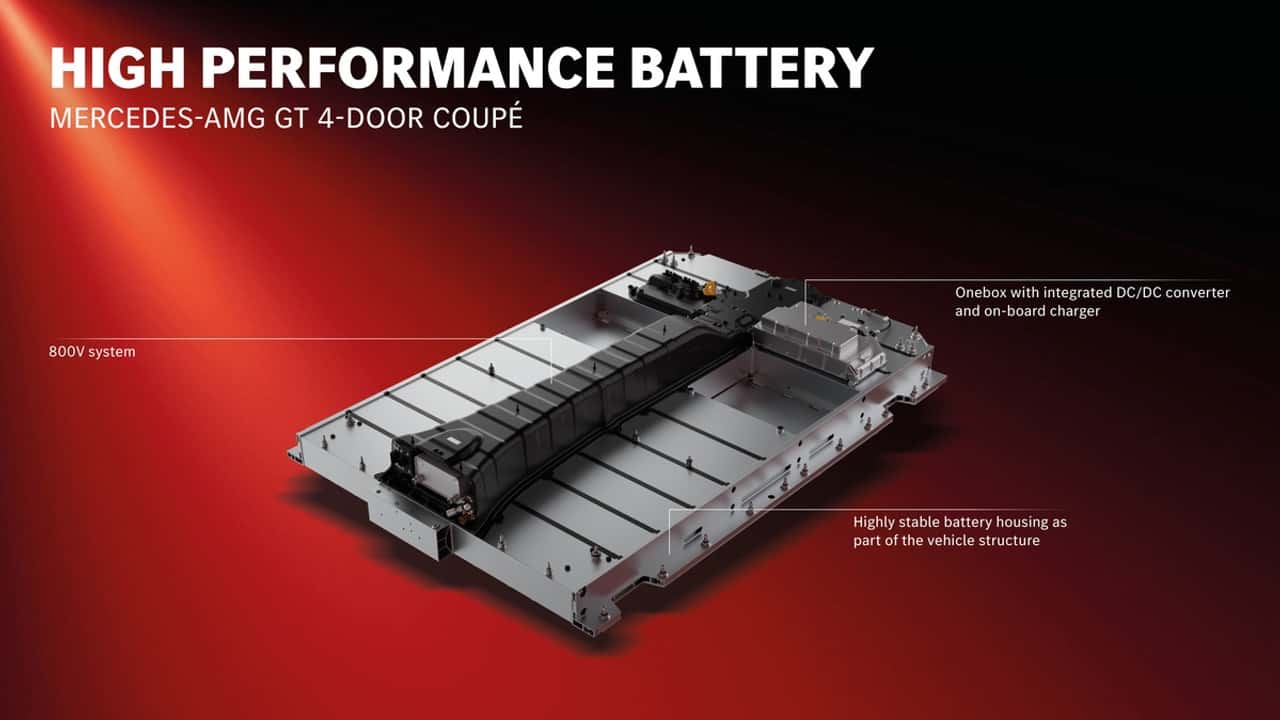

- Silicon anodes are now entering production to improve electric vehicle charging speeds.
- They're still blended with graphite as startups work to develop 100% silicon anodes.
- This unique battery allows the Mercedes-AMG GT to charge from 10-80% in just 11 minutes.
Electric vehicle batteries live a tough life. Temperature swings, punishment from bad roads, repeated hard acceleration, and fast-charging cycles can push the cells to their absolute limits. The combined effect of these forces can generate enormous amounts of heat. Managing that heat is the difference between a battery that works and a disaster waiting to happen.
Thankfully, recent innovations in battery technology have given automakers access to cells capable of handling the extremities of high-performance EVs. The new Mercedes-AMG GT 4-Door Coupe sheds light on several such innovations.
In its latest generation, the super sedan has ditched its V8 engine for an all-electric powertrain.
Its polarizing design and headline numbers like 1,153 horsepower and 600 kilowatts of peak charging power turned eyeballs at its launch last week. But beneath the spectacle, some major battery details seem to have slipped under the radar. Two stand out: the silicon anode and an overengineered cooling loop.

But first, let’s start with the basics. The AMG GT’s 106 kilowatt hours of usable battery capacity delivers up to 700 kilometers (434 miles) of range on the European WLTP cycle, translating to well over 300 miles of comparable range on the tougher U.S. EPA cycle. When the car reaches U.S. shores later this year, it will be the fastest-charging EV in America, with a claimed 10-80% time of just 11 minutes.
The silicon anode is what makes that charging performance possible. Think of the anode as the part of the cell responsible for how much energy the battery can store and how quickly it can charge.
Traditionally, battery makers have relied on graphite anodes for their stability and energy density. But with China maintaining a chokehold on graphite supply chains—and with environmental concerns about graphite mining—automakers are now integrating silicon-graphite anodes as an interim solution. The end goal is to phase out graphite entirely, replacing it with either 100% silicon or synthetic graphite alternatives.
Mercedes-AMG isn’t alone here. Several other companies are working on silicon anodes, including General Motors and startups like Group14 and Sila. It’s worth noting, though, that silicon anodes are a niche technology. They’re commercially available in limited quantities, but not yet cost-competitive and scalable enough to challenge traditional graphite anodes at volume.
On the AMG GT, the silicon-containing anode reaches a cell-level energy density of 298 watt hours per kilogram, which is at the high end of today’s commercially available automotive-grade lithium-ion cells. The cathode, on the other hand, contains nickel, cobalt, manganese, and aluminum (NCMA), which automakers have historically associated with longer range and better energy density.
This combination, according to Mercedes-AMG, allows the AMG GT to charge at 600 kW, recoup nearly 250 miles of EPA range in just 10 minutes of charging, and deliver a consistently high discharge rate enabling that 1,000+ horsepower.
Gallery: Mercedes-AMG GT 4-Door






To manage such high performance, Mercedes-AMG used various cooling systems and a new cell design. The automaker is using slim and tall cylindrical cells measuring 4.1 inches high and 1 inch in diameter. This smaller diameter, Mercedes said, reduces the distance from the cell core to the surface, allowing faster and more efficient heat dissipation.
The cells themselves are encased in laser-welded aluminum, allowing them to cool down or warm up faster. Coolant flows evenly around each of the 2,660 individual cells to dissipate heat, the company says. Mercedes also incorporated what it calls “on-demand cooling” to keep temperatures even for each battery module. If one part of the battery gets hotter, the system can cool it down precisely, rather than increasing coolant flow to the entire pack and potentially wasting energy or over-cooling other areas.
At the heart of all this is a coolant pump module, an oil-water heat exchanger, and a central coolant hub. The pump pushes the coolant across the pack, while the heat exchanger removes heat. The coolant hub further streamlines the coolant into one compact housing. It helps the AMG GT with targeted cooling of components. For example, if the battery pack is operating at ideal temperatures, the system can redirect the coolant towards components that need more cooling, like the electric drive units.
Combined, Mercedes-AMG said the systems can remove about 20 kilowatts of heat, significantly more than the 5-8 kW of cooling capacity in a typical EV battery's thermal management system.
On paper, it all sounds remarkable. But the real test will come once the AMG GT hits the road and the years after that, when we find out whether this battery can hold up with minimal degradation and sustained performance over time. The bigger hope, though, is that this technology eventually finds its way into mass-market models. Blistering charging speeds shouldn't be a privilege reserved for six-figure EVs.
Contact the author: suvrat.kothari@insideevs.com
Related Stories
RECOMMENDED FOR YOU
AMG’s New Electric SUV Has 1,153 HP. The Charging Specs Are Even Wilder
‘Propulsion-Agnostic’: GM Wants To Bring Tesla-Style Software Features To Its Gas SUVs, Too
I Drove Mercedes’ New EV With A Silicon Anode Battery. The Future Is Here
Want The Best Range Rover? Get The Electric One: First Drive
The Roadster Will Have Tesla’s Most Advanced Battery Pack Yet
I Drove The Electric And Gas-Powered BMW X5. I Know Which One I'd Pick.
Tesla Supplier Reports Record Earnings From EV And Energy Storage Batteries