
MG Is Putting Semi-Solid Batteries In Its Next Plug-In Hybrids
The company had already announced that it will soon also introduce its first pure EV with a semi-solid-state battery in Europe.
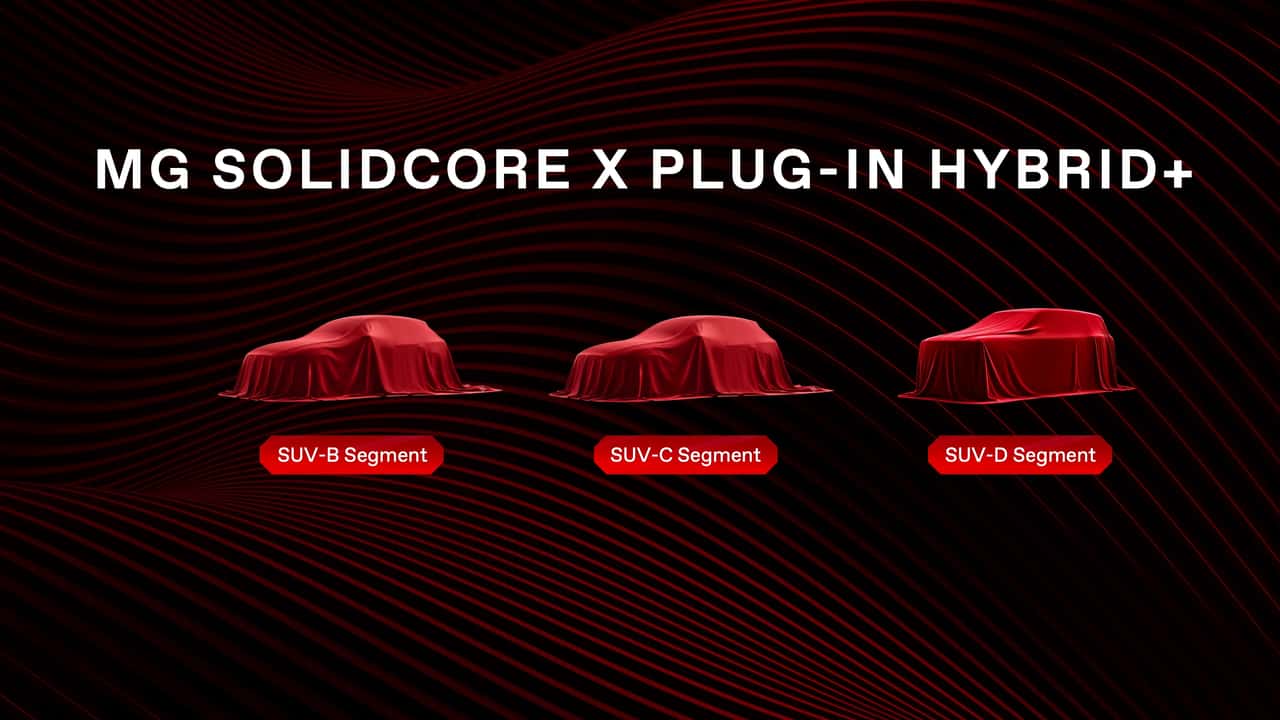

- MG will bring semi-solid-state SolidCore batteries to future plug-in hybrids across three SUV segments.
- Its new Plug-in Hybrid+ system uses 42%-plus efficient engines and EV-first low-speed operation.
- MG claims stronger cold-weather performance, quieter EV driving and less power loss with a depleted battery.
SAIC-owned MG has big plans in Europe, where it sold 190,000 vehicles in the first half of 2026, up more than 20% over 2025. It recently revealed a concept that previews a future pure electric Renault 5 rival for Europe, which may be getting the company’s first production semi-solid-state battery.
However, MG has confirmed it plans to introduce this battery technology in three new plug-in hybrids, but it didn’t say when they will arrive.
MG calls its semi-solid-state battery technology SolidCore and says it will eventually appear in three new SUVs spanning the B, C, and D segments, although it has not named them or provided a launch schedule. Separately, its Plug-in Hybrid+ system will be offered with dedicated 1.1-liter and 1.5-liter turbocharged engines that achieve claimed peak thermal efficiencies of more than 42% and 43%, respectively. Power outputs and cylinder counts remain under wraps for now.
Gallery: MG Plug-in-Hybrid+



The system will behave more like an EV at low speeds, remain efficient when the battery is depleted, and avoid the performance and refinement drop-off that some plug-in hybrids exhibit when they have to both propel the vehicle and charge it at the same time.
The system also uses a new power-split hybrid transmission that continuously varies the contributions of the engine and electric motors based on speed and load. It may behave somewhat like an electronic continuously variable transmission, but MG has not classified it as a conventional CVT. It also features a disconnect mechanism that can completely isolate the generator during electric driving, reducing mechanical drag and boosting efficiency.
Disconnecting the generator is also said to make electric driving noticeably quieter. MG claims noise is reduced by up to 5 decibels in EV mode compared with conventional plug-in hybrid systems, bringing the experience closer to that of a pure EV.

MG claims the engine can maintain above 40% thermal efficiency during around 90% of driving conditions, while electric drive efficiency can reach 90%. The second figure is difficult to evaluate, though, because MG does not specify what it measures.
It will prioritize pure electric propulsion at lower speeds, use power-split operation at medium speeds, and switch to direct engine drive at higher speeds, where combustion power is generally more efficient. MG says vehicles using the new system will be capable of accelerating from 0 to 62 mph (100 km/h) in under 6 seconds, with the 50-75 mph (80-120 km/h) dash taking as little as 3.5 seconds. However, it has not confirmed which model or engine achieves those figures.
The most interesting part of the system remains the semi-solid battery. MG claims it has become the first automaker to mass-produce semi-solid-state batteries, but there are already EVs in production in China with batteries using similar technology, so there is some vagueness about who was first.
MG’s SolidCore batteries were developed with QingTao Energy, and its cells reportedly use a manganese-based chemistry, a silicon-carbon anode, and only around 5% liquid electrolyte. That’s less than what is typically used in a conventional lithium-ion battery, where the percentage is closer to 10% to 15%.
MG did not disclose the capacity, charging rate, or electric range of these PHEV packs. It already uses a manganese-based semi-solid battery in the Chinese-market MG4 Anxin Edition. Reports indicate a capacity of 53.95 kWh with around 180-185 Wh/kg of energy density, 2C charging, and up to 537 km (334 miles) of CLTC range. MG also claims 13.8% better range retention at 19°F (-7°C) than an equivalent LFP battery, although the exact specifications vary slightly between sources.
Their cell chemistry is the lesser-used LMO, short for lithium manganese oxide, which uses a manganese-rich cathode that generally offers strong thermal stability and power delivery, but lower energy density and cycle life than the NMC chemistry commonly used in long-range EVs. LMO is unusual for a plug-in hybrid, where rapid power delivery, safety, and consistent performance matter more than maximizing electric range, but it makes sense in this role.
RECOMMENDED FOR YOU
Launch Mode Actually Makes The 2026 Tesla Model Y Performance Slower
GM Wants To Lower EV Owners’ Energy Bills With Smarter Home Charging
Honda Just Axed Its Last EV In The U.S.
The Most Important Range Rover EV Is Coming Sooner Than We Thought
Americans Can't Have These Affordable Chinese EVs. But They're Coming To Canada
This Tiny New EV Motor Cuts Weight And Size For Impressive Efficiency
Volvo Could Bring An Electric Sedan And Wagon To U.S. By 2028: Report