
The Mercedes VLE Is A Brave Gamble. Will It Pay Off?
Mercedes' ultra-luxury van could crack Americans' van stigma. But that's only if they don't balk at the price.
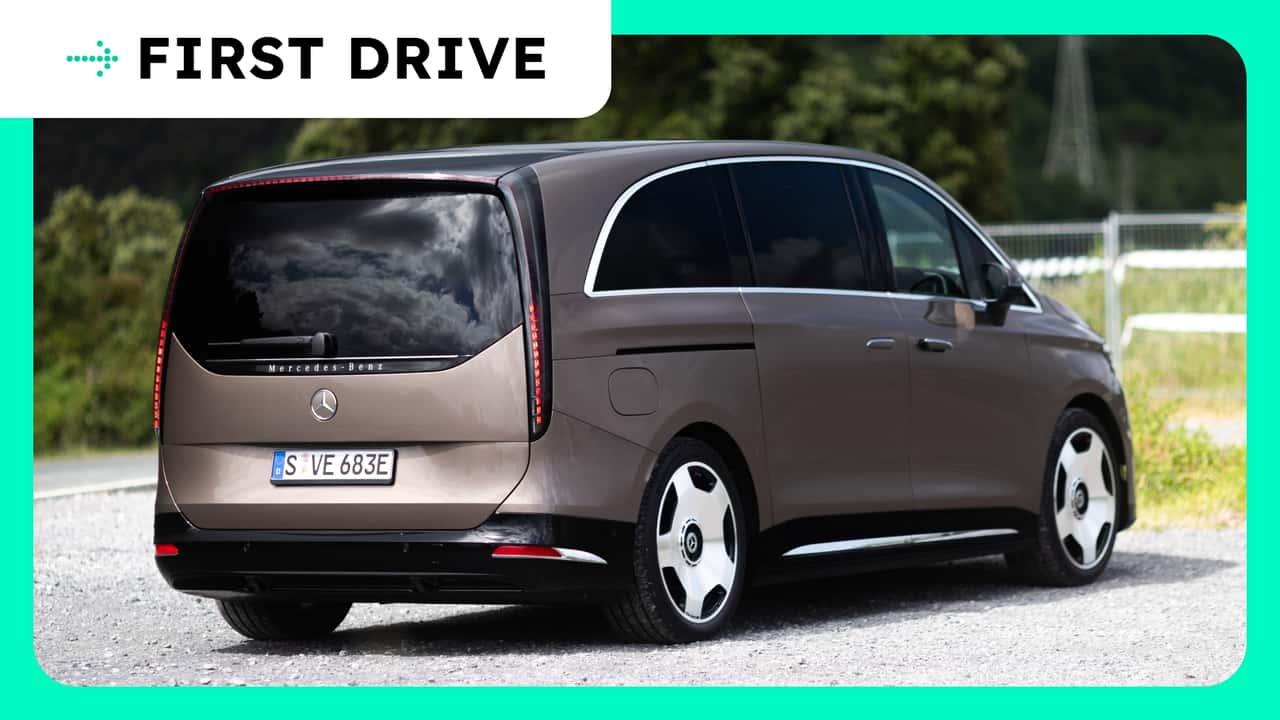

It’s a rare thing to see a safe, stable megacorporation take a huge swing. Automotive planning is often measured in decades, not months, and boring things like cost projections, risk analyses, and many layers of interdepartmental memos occur before pen is ever put to engineering draft paper. By that metric, the fact that the Mercedes VLE, an electric luxury van exists at all is unbelievable. Even stranger? It’s coming to the United States.
If there was ever a country that a van could succeed in, it would not be here, in 2026. But Mercedes has decided the time is ripe to take a swing at a product category that doesn’t currently exist, and to sell three versions: the VLE, VLS, and VLS Maybach. All of them are fully electric, with brand-new platforms and an eye-glinting dream. And despite Mercedes saying it won’t hit our shores until 2028, I went to Spain to try the VLE myself.
(Full Disclosure: Mercedes flew me to Spain for the launch of the VLE and put me up in a nice hotel.)
2028 Mercedes-Benz VLE 400
“Van” and “luxury” rarely come together for a reason. There’s a utilitarian practicality to a van, especially Mercedes vans of the past, that clashes with the idea of opulent status signaling. In America, a van is for families, not high-class jet-setting transport.
Mercedes understood this well enough to position and engineer the VLE as a luxury product, and it took the opportunity to make an all-new electric van platform. From go, Mercedes upped structural rigidity to reduce NVH and packaged the rear suspension tightly to allow for a completely flat floor. It also baked in more sound insulation than usual, as well as nice, soft bushings for ride quality.
Gallery: 2028 Mercedes VLE 400 Review

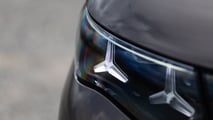
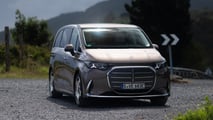
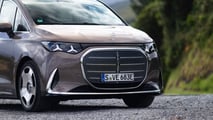
Then, it trimmed the VLE like a premium Mercedes. Though US-bound trim levels aren’t final, Mercedes representatives said the long-wheelbase version would be the base van, and that we would only get versions with a standard panoramic roof, Burmester stereo, and a triple-screen MBUX infotainment system. The plan is to have an ultra-luxury variant with king’s chairs, like the one we drove, and a slightly more flexible version with normal reclining seats. Since it is a van, all the seats are mounted on a convenient rail system, and the second and third rows are completely removable, or partially removable depending on the seat split.
MBUX is also new, and particularly improved compared to before. With twin 14-inch displays for the center and passenger, a new layer of software helps improve the MBUX experience. Many of the major controls, like HVAC, driver’s assistance systems, and settings, take up less screen real estate, but are easier to access than before. Most functions only took a single menu jump, and MBUX’s central screen contains a ton of shortcuts at its perimeter.
It is very glitzy as a system, with a ton of animations and life all over the screen. This approach is also reflected in the dazzling 10.25-inch gauge cluster. But a combination of the great resolution and high refresh rate makes the system feel incredibly slick. There are some misses, however. It was slightly unintuitive to access the heated and cooled seats, as they were a submenu under the climate control (à la BMW), and CarPlay was windowed diminutively within the large display. The on-board navigation also prompted turn-by-turn AR displays, which I thought were cool but could be a lot for someone who isn’t used to tech.
Otherwise, the VLE is… a van. The seating position is high and commanding, but the pedals are practically parallel with the floor, and the steering column is angled toward the ceiling. In that way, it cannot shake its roots, and it feels distinctly pedestrian to drive. It has light, linear inputs that make it easy to drive smoothly, but it's hard to shake the feeling that the party is in the back. Which, it is.
The back seat is the place to be.
The front seats are comfortable, but the second row reclining seats are the business. Suddenly, you can appreciate the materials and quality that Mercedes added to the VLE, especially compared to its mainline stuff. Squeaks and rattles were nonexistent, which is almost unheard of in a modern Benz. It was whisper-quiet at highway speeds, and its ride quality was decent, too. It was unbelievably soft and floaty, but crashed into its bump stops if the bumps got too big. Points for a truly smooth ride, but points away for poor body control.
In imagining the VLE cruising down the interstate, I can see its objective appeal. It will make an incredible road tripper with great range—435 miles WLTP—and decent efficiency. I observed around 3.6 to 3.8 mi/kWh, with a heavy bias toward slower-speed city and European expressway driving. On an American highway, it’s much more likely to be in the low 3s and high 2s.
But is it desirable enough for Americans? Especially when it will cost around $100,000 for a decently trimmed one? For that answer, we’ll have to wait and see. But in full Benz spec with AMG Monoblocks and two-tone paint, I think it’s cooler than any SUV.
Related Stories
RECOMMENDED FOR YOU
Home EV Charging Has A Hidden Cost. Here’s How To Reduce It And Lower Your Bill
These Affordable EVs Just Got A New Lifeline: Replacement Motors Cost 30% Less
Mercedes Boss Says The Auto Industry Went 'Too Far' With Removing Buttons
Audi’s China-Only EVs Are Coming To Europe—And They Cost Less Than Local Models
A Bill Taking Aim At Chinese Cars In America Just Advanced In The Senate. It Could Hit Mercedes Too
This 100-Year-Old EV Came With More Range Than The First Nissan Leaf
VIDEO: I Drove China's Best Selling Car. It's Really Good