
I Drove One Of China's Fastest EVs And Found It Surprisingly Easy To Drive—Despite Its 1,500 Horsepower
The Xiaomi SU7 Ultra could be the easiest 1,526-horsepower car I’ve ever driven. And starting at $75,000, it's a bargain.
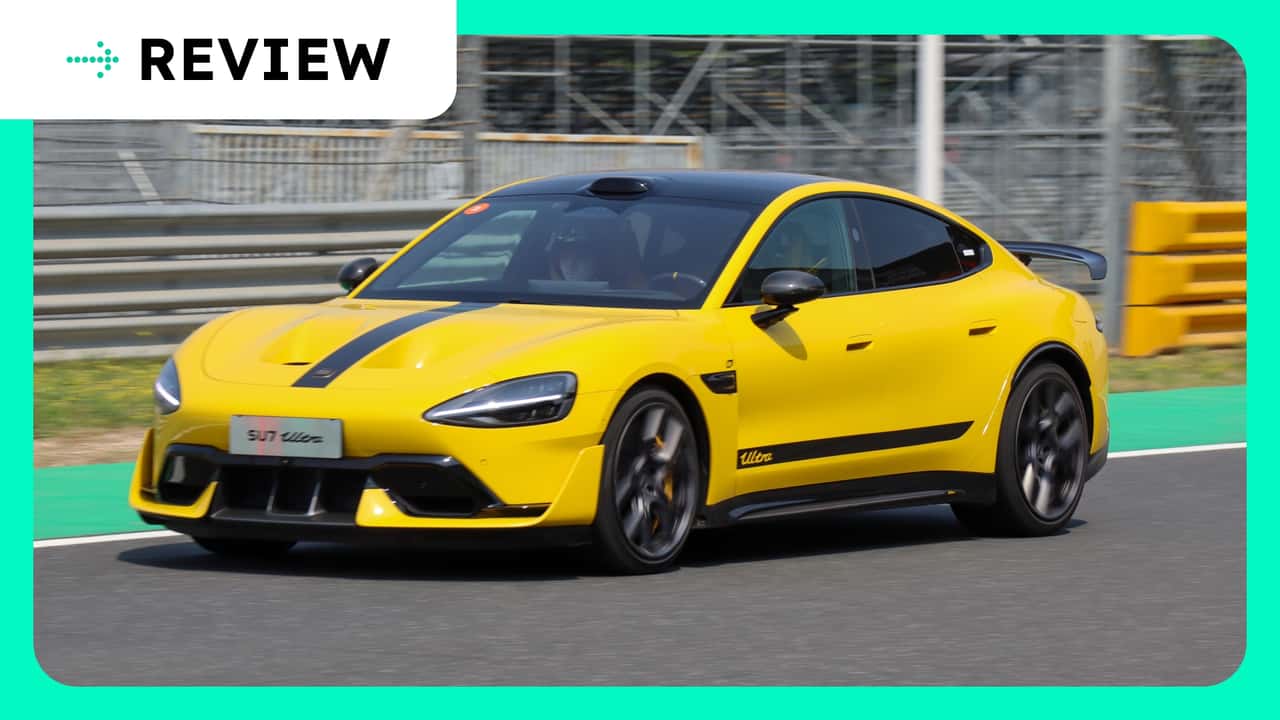

When Xiaomi founder and CEO Lei Jun announced his intention to build the high-performance SU7 Ultra electric sedan in 2024, he made it a point to say that while his car wouldn’t be cheap, it would be a cost-effective rival to Porsche, BMW, and Audi. It follows the classic Xiaomi playbook: creating high-tech devices that match those from bigger tech brands, but are accessible to a wider group of people. Sure enough, within weeks, the 1,500-horsepower, super-powered car would be available on China’s car market for about $75,000 before any options. On paper, it looked to match or beat supercars like the McLaren Artura for less than a quarter of the price.
But I wanted to know: Is it any good? Chinese cars have a reputation. Sure, they’re technologically advanced, taking the world by storm with their surprisingly strong value and quality. These cars are chock-full of features found on expensive models, but at a way lower price. However, when it comes to driving dynamics, things can be hit or miss. Some industry insiders claim that China just can’t tune a car, and that the country’s engineers don’t understand what goes into making a car fun to drive.
I don’t think that assertion is universally true, but I don’t think it’s necessarily untrue either. I’ve driven more than my fair share of well-resolved Chinese cars that are sharp to drive. But I have also sampled a few that were dynamically underbaked and needed a little more time in the oven. During the Beijing Auto Show, I got a chance to put the SU7 Ultra through its paces on a track. I wanted to understand which camp Xiaomi’s super sedan fell into; would it be an unrefined heavy mess incapable of handling its power? Or would it be a cut-rate Porsche Taycan sold for half price, like all of the Nurburgring records suggest it is?
And most of all, did Lei succeed in making a high-performance car relatively accessible to the masses? Or is it just all flash and no substance?
Gallery: Xiaomi SU7 Ultra






(Full Disclosure: Xiaomi and Geely covered my travel for the Beijing for the Auto Show and provided lodging and test cars)
Xiaomi SU7
What is it?
At its core, the SU7 Ultra is a super high-performance version of its blockbuster SU7 sedan. Giving the car almost five times the power of a base SU7 meant piling on a laundry list of upgrades.
Some of the changes can be seen with the naked eye and don’t need a degree in engineering to be understood. There are bigger wheels and retuned aerodynamics, such as a big rear wing, a new rear splitter, and a redesigned front bumper, plus the car now has functional ducting to cool the brakes.

The Xiaomi chassis has been tuned specifically to go around the Nurburgring. The high-performance brakes are able to operate at temperatures of up to 2,300 degrees, which is necessary to rein in such a big and fast car. Xiaomi claims it has the largest carbon ceramic brake discs of any production sports car. These big brakes are augmented by the car’s ability to smartly use its regenerative braking system, which Xiaomi says can generate a stunning 400 kW of energy and decelerate at 0.6 G. That’s pretty amazing, matching what you’d get from a Taycan or Audi E-Tron GT, but for a much, much lower price.
The heart of the SU7 Ultra, of course, is its powertrain. This car uses three motors—two in back, one in front—all developed by Xiaomi. The two in the back are Xiaomi’s HyperEngine V8s, while the front uses a HyperEngine V6s; together, the three motors produce 1,526 horsepower and 1,305 lb-ft of torque, making the SU7 Ultra one of the most powerful production cars on the planet.
The immense power needs meant sourcing a battery that can back that up. Made by CATL, this 93.7 kWh pack has a maximum discharge rate of 1,330 kW. Even at under a 20% state of charge, Xiaomi says that the car can put out 800 kW.
That’s a hell of a lot of car for only $75,000. I do need to note that the unit I tested had the roughly $13,000 track package. That adds on 21-inch forged aluminum wheels, a carbon fiber roof, Bilstein EVO R adjustable coilovers (which replace the standard air suspension of the base SU7 Ultra), and Pirelli P Zero Trofeo RS tires. Still, at a roughly $88,000 as-tested price, the SU7 is still packing a lot of value. By comparison, a Porsche Taycan Turbo is a whopping $230,000 in China, and it’s actually slower from 0-60. The BMW i4 M60 is about $66,000 in China, but it’s not really on the same level. It has about a third of the power of the SU7 Ultra, and is about two seconds slower to 60 mph compared to Xiaomi’s car.
How does it drive?
Electric cars are very fast, and it was nice to finally be on a track that could handle the immense capability of a hypercar-rivaling electric sedan. The first time I went to China, although I was able to get a good impression of another brand’s EVs, I did complain that the Beijing Goldenport circuit just didn’t provide enough space to open up such a powerful car.
Luckily, Xiaomi had done its homework. For the test, it took us to Tianjin V1 Automobile World, just outside of Beijing. This track is wider and longer, with significantly more runoff than what I had experienced before. Most of the track was available to us, save for the longest straightaway. We were each given two laps at full tilt, although I got an extra lap because I was having too much fun and drove right past the pit lane. Whoops.
Within the first lap, I understood how Xiaomi set so many records on the Nurburgring. This car is fantastically easy to drive. It could be the easiest car to drive hard that I’ve ever experienced, and it certainly rivals the EV greats I’ve had seat time with, like the Lucid Air or Hyundai Ioniq 5 N.
I’ll be honest that although I do like driving fast and driving hard, I’m not as skilled as others who might spend most of their free time at the track, racing cars. Yet, I never once felt out of control.
Despite having four-digit levels of horsepower and the ability to throw you back in the seat with its sub 2-second 0-60 time, the car doesn’t ever feel like it's out to get you.
Throw the SU7 Ultra into a corner at a high rate of speed, and the car kind of sorts itself out. Accelerate hard out of a turn, or maybe brake a little too intensely, and the car will forgive your minor mistakes. Upset the rear of the car, and its traction control and suspension work together to guide you back to the right path without any rear-end scuttling or insecurity. The car is willing to rotate in turns and handles its power admirably—it’s staggering how accessible the SU7 feels, despite its otherworldly capability. It made me think of the BMW i4 M50, which gave me the opposite impression. Although it is a fast car that handles well, it feels almost mean-spirited in how unforgiving its power delivery and handling balance are executed.
The Ultra’s steering is fast, with lots of heft, although I agree with some other reviewers that it could use a bit more feel. Still, that could just be a matter of taste; the SU7 Ultra remains fantastic. It’s especially astonishing when you remember that Xiaomi has only been selling cars for around two years, and that this is its very first attempt at making a car with this level of capability.
So, What Now?
Between growing anti-China sentiment from the U.S. and an impending ban on Chinese connected car tech, there’s a snowball’s chance in hell that this will ever come here. It’s a shame that we likely won’t ever get it.
Still, I think the SU7 Ultra is still a very important global milestone for both China’s car industry and for Xiaomi itself. It proves that China absolutely can keep up with the best in the West and knows how to tune a car to be engaging. The SU7 Ultra was completed and tuned before Xiaomi had opened its new European R&D facility. I don’t doubt that its new European team can make the SU7 Ultra even better, but I can’t help but feel like there’s not a hell of a lot for them to do here, because Xiaomi’s home team nailed it on the first try.
Moreover, I think Lei and the Xiaomi EV development team really succeeded in crafting a car that meets China’s market where it is. The SU7 Ultra is cheap for the kind of performance it offers. And it’s surprisingly easy and fun to test its limits on track. It’s a car that feels like it was made by people who are excited to introduce the joy of driving to a new group of people. And I think we need more cars like that.
Contact the author: kevin.williams@insideevs.com
Related Articles
RECOMMENDED FOR YOU
I Drove The 2026 Porsche Taycan 4. It Proves EVs Don't Need 1,000 Horsepower To Be A Blast
Want The Best Range Rover? Get The Electric One: First Drive
The Mazda CX-6e Is Easy To Like, But Hard To Take On A Road Trip
I Drove The Electric And Gas-Powered BMW X5. I Know Which One I'd Pick.
Xiaomi's First EV Just Hit A Massive Milestone
The Ferrari Luce Officially Starts At $560,800
VIDEO: The New Xiaomi SU7 Is Very Much Ready For Europe