
Tesla's New 12V Li-Ion Auxiliary Battery Has CATL Cells Inside
It's time for an in-depth teardown and presentation of Tesla's lithium-ion 12V auxiliary battery.


With the refreshed Model S/Model X, Tesla switched from conventional lead-acid to an all-new lithium-ion 12 V auxiliary battery (Model 3/Model Y still uses a conventional one).
Thanks to an outstanding, two-part presentation and teardown conducted by Ingineerix, we can take an in-depth look at this new solution, hinted at in early 2021 by Elon Musk and shown only briefly at the delivery event.
The video starts with a general overview of why EVs still use 12 V auxiliary batteries and why they continue to use lead-acid ones, while the main traction battery is lithium-ion.
The lead-acid batteries turned out to be problematic in EVs, due to a different use case than a starter battery and manufacturers are expected to switch to lithium-ion versions sooner or later (partially, with the potential transition to 48 V auxiliary systems). Some individual users were already replacing their 12 V batteries with a li-ion version on their own (like here).
In general, a lithium-ion battery should be smaller, lighter, more reliable and last longer. It could be a bit more expensive, but the total cost of ownership should be lower.
The old lead-acid battery vs new lithium-ion
As we can see in the video, previously Tesla was using in the Model S/Model X a 12 V, 33 Ah lead-acid AGM battery. It stores about 0.4 kWh of energy, but weight is quite substantial: 27 lbs (12 kg).
According to Ingineerix, such batteries last in Teslas about 2-4 years, which is pretty low and sometimes causes unexpected problems if the car stops working.

The new,lithium-ion battery is much smaller and much lighter (only about 4 lbs / 1.8 kg). That's because it's much higher energy density, but also has a lower energy content. We assume that with a more reliable and "smart" solution, there is no need for 0.4 kWh.
The battery has only a 0.1 kWh of energy (99 Wh to be precise) and a capacity of 6.9 Ah, according to the description.
The nominal voltage is slightly higher than normally in lead-acid battery (12.8 V). With four cells in series (3.7 V nominal) it should be at 14.8 V for most of the time.
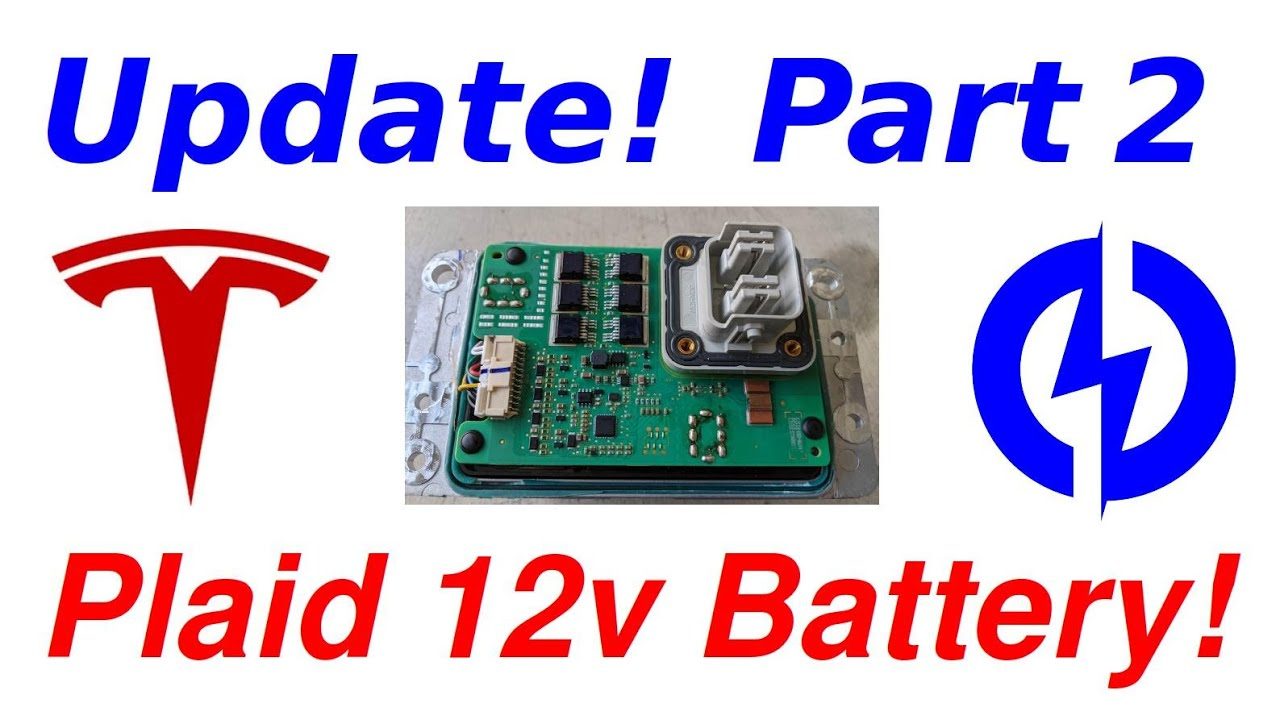
As we can see in the second video (on the bottom of this post), the new battery consists of a BMS circuit board made by CATL and four prismatic NMC lithium-ion battery cells (6.9 Ah each), connected in series.
It means that not only are the entry-level Model 3/Model Y equipped with CATL batteries (LFP traction batteries), but also the all-new flagship Model S/Model X has CATL batteries (just the auxiliary, not traction ones).
There are no signs of a heating system for the battery, which indicates that it's not required. According to the general CATL specs, the battery cells can accept charging at temperatures as low as -10°C. And they can discharge at temperatures as lows as -20°C.
There is a theory that the system can heat up the battery with a repeated slow charging/discharging if needed.
The cycle life appears to be high at over 2,000 cycles until the capacity will decrease to 80% of the initial value. If everything was well designed, it should last as long as the car.
Tesla Model S Plaid lithium-ion 12 V auxiliary battery:
- 6.9 Ah minimum (7.5 Ah maximum)
- 99 Wh
- four cells in series (1P4S)
- lithium-ion NMC prismatic cells manufactured by CATL
- Cell specs (according to CATL's general spec for 6.9 Ah cells):
NMC chemistry
6.9 Ah
3.7 V nominal (4.2 V max charge voltage, 2.75 V minimum)
charging temperatures: from -10°C to +45°C
discharging temperatures: from -20°C to +60°C
max charging: 10C
max peak discharging: 50C
cycle life: >2,000 cycles (80% of initial capacity at 3C rate)

See also
RECOMMENDED FOR YOU
Used Tesla Model S Prices Have Fallen Dramatically. But Their Batteries Are Holding Up Great
This New App Puts 200,000 EV Chargers Across North America in One Place
I Drove An Original Tesla Model S To See If It's Still Worth Buying In 2026
The Genesis GV90 Is Here And It's Like a Luxury Lounge On Wheels
One Owner Just Did What Tesla Couldn't: Upgrade An Older Car To HW4
BMW's Chinese-Market iX3 50L Just Drove 640 Miles On One Charge
Tesla’s New Three-Row EV Is The Longest-Range Model Y Tested By Edmunds