
I Drove Slate’s $25,000 Electric Truck. It Could Be A Real Game-Changer
InsideEVs finally got to drive the Slate Truck. Despite the budget price, this simple EV feels planted, solid, and comfortable.
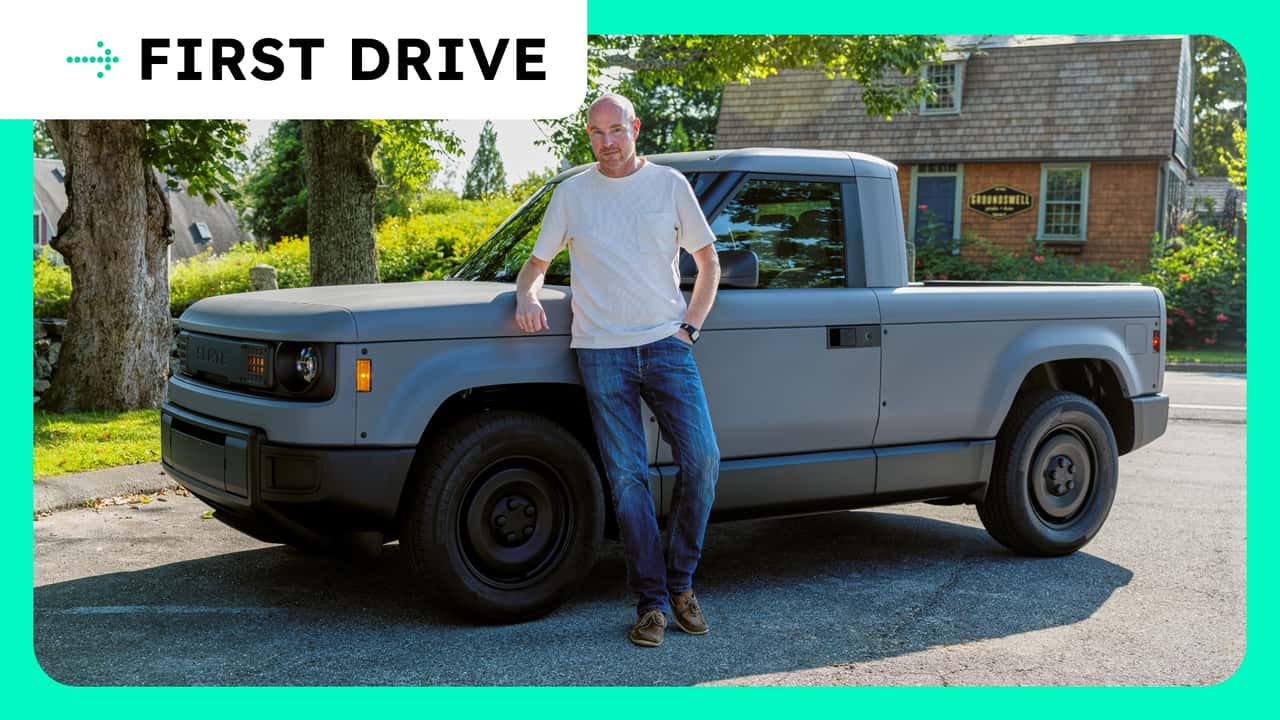

Launching a new carmaker from scratch is one one of the most challenging endeavors possible. The graveyard of automotive startups is filling up with brands that failed to cash in on the electric transformation. But unlike other aspirants, Slate doesn’t just have massive financial backing, it’s also following a far more unique path. Shunning the usual top-down approach used by companies like Tesla and Rivian, Slate’s all-electric truck is entering the market right at the bottom. InsideEVs has covered its story from the beginning; now, it’s time to find out how it holds up on the road.
I got the opportunity to test it out around Newport, Rhode Island. Slate had a few writers over to spend actual time behind the wheel of a pre-production unit, shipped from the Warsaw, Indiana factory in absolute bargain-basement specification. The only add-on fitted to the truck was a demo speaker system. I got to drive it for almost a full hour on back roads and highways, on smooth, bumpy, and loose surfaces, and in generally good weather conditions.

InsideEVs drove Slate Truck in pretty much its most basic form.
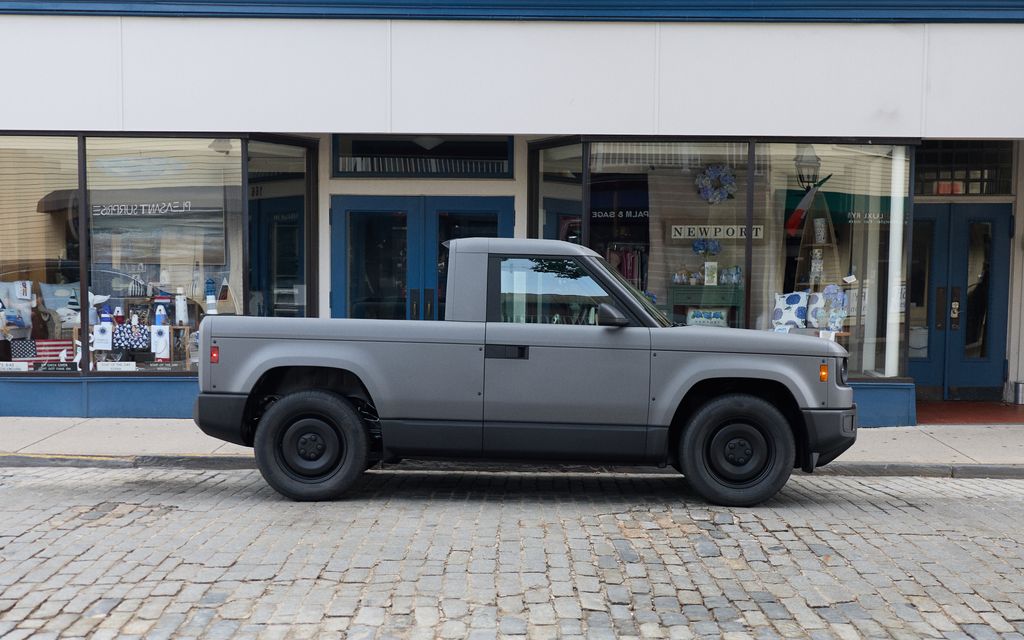
Judging from photos and depending on the color, the Slate might seem almost toy-like, appealing to your protective instincts. But in reality, it is a substantial truck. It is virtually identical in size with the first-gen Ford Explorer 3-door and the 1990s Chevy S-10 Blazer. As a pickup, it is shorter than a current Ford Maverick, but that’s only because it has a regular cab with one row of seats. Its bed is actually longer than the Ford’s.
This flexibility is a major feature of the Slate: The basic pickup—the “blank Slate”—is priced at a mere $24,950 (plus a requisite $1,450 delivery fee). This means it undercuts the conventionally powered Ford Maverick by more than $3,000, making it the most affordable truck on the market. Beyond the open-bed truck, there is the $5,000 Squareback SUV kit, which radiates Land Rover Defender vibes, and the more elegant $7,000 Fastback SUV kit, which faintly evokes the International Scout and the roof style of late 1970s and 1980s Broncos and Blazers.
Slate Truck
The SUV versions come with second-row seats with rear airbags, and can be factory ordered. But it is also possible to convert a pickup later, a process that has been made even more easy by a recent design change: Slate has moved the third brake light to the tailgate.
It’s Not A Toy
When we headed out for the drive, I went second, which I didn’t mind. Following the Slate in a chase car gave me the opportunity to assess how it presents itself on the road. It’s one thing to see a new vehicle in a studio; it’s another to see it out in the wild. In my eyes, the Slate passed the test with flying colors. It looks substantial and polished, with a powerful shoulder, the character lines and gaps defined with absolute precision, and the “Slate” lettering, which serves as a logo, slightly embossed on the tailgate. Chief designer Tisha Johnson knows what she is doing.
The Slate Truck looks polished and substantial out in public—not like a toy.
What about the interior? Any similarities with other trucks and SUVs vanish here. You enter by pulling a pleasantly industrial-looking door handle, the door closes with a reassuring thud, and from the fabric-clad front seat, the driver looks at an austere cockpit defined by straight lines and flat surfaces.
I am a tall guy, but finding a good seating position presented absolutely no problem. The seats are firm, comfortable, and sufficiently supportive. The cabin feels roomy and airy, and it is easy to see all four corners of the Slate. That’s a rare treat, and combined with its compact footprint and the tight 37-ft turning circle, it makes the Slate an absolute pleasure to maneuver in urban surroundings.
More EV Reviews
For a truly open-air experience, you can also take off the doors, like on a Bronco or Wrangler. This interior is a good place to sit, but I’d spice it up with some colorful aftermarket touches—if this were my daily driver, I would find it a bit too gray. Slate will offer a variety of colorful trim to address this issue, though it also invites owners to customer it themselves or with third-party kit. There are plenty of fastening points to let you fit equipment you want. By the way: The front end houses a massive frunk with 7.0 cu.ft. of storage and a water drain. The pickup bed holds an additional 35.1 cu.ft of cargo.
Operating the Slate is as simple and intuitive as it can get. Right in front of the three-spoke steering wheel, there is a small screen with a digital speedometer; the left stalk operates the wiper, the right stalk selects the gear, and the HVAC system is operated by traditional knobs—all of it as God intended. Despite the prototype state of our test car, the controls feel firm and solid - and everything functioned. Though keep in mind that “everything,” thankfully, means rather less than in most other cars.
The Slate Truck's interior is basic as can be, to the point that there's no built-in infotainment screen or navigation system.
It’s all BYOD: bring your own device. Slate doesn’t bother with navigation and infotainment. There is no Apple Car Play or Android Auto because there is no screen to project it onto. Isn’t this reduction and decluttering a form of luxury? I can think of only one current car that reduces digital screens to a similar extent: The Bugatti Tourbillon. And that doesn’t have a bed.
Ah, and the defining element: The manual window cranks. Easy to use and smoothly calibrated, I wouldn’t have the Slate any other way, though power windows will of course eventually be added to the list of aftermarket options. Of course, the manual windows are a bit of a gimmick, a mascot more than anything. Slate doesn’t take its frugal approach to absurd extremes: Air conditioning, for instance, is always included, as are power steering and power locks.
The Slate At (Nearly) Top Speed
Having passed the visual and tactile test, the looming question remained: Is the Slate a real truck, or will it turn out to be a glorified quad? I stuck the key fob into the receptacle, put it into drive, and tried it out. There is no fuss, no simulated startup sequence—and, so far, no obnoxious fake sound. Production versions of the Slate, though, will of course be subject to the federal requirement for low-speed pedestrian warning sounds in EVs.
Out on the road, the Slate has a perfectly acceptable amount of power and torque.
The power rating of the single, rear-mounted motor has been downgraded from the initially communicated 150 kW (201 horsepower) to 135 kW (181 hp). What matters more are the almost 200 lb-ft of torque, enough to move the 4048-pound truck with real authority. This gets the Slate to 60 mph in 8 seconds flat, and provides enough shove to tow a 2,000-lb trailer.
The square little truck runs out of steam at 90 mph, a velocity I almost managed to reach on a short stretch of road: I pushed it up to 85 mph and thus, according to a Slate representative, attained “the highest speed ever reached by a non-employee.” The acceleration is strong even on the upper end, it doesn’t trail off like on some other entry-level EVs.
The powertrain is fed by a 65-kWh LFP battery pack, which can be charged at up to 90 kW. A larger battery option with 240 miles of range, initially announced, has been discarded. But at the same time, the upgraded standard battery’s range has been improved from 150 to 205 miles. On a DC charger, getting from 20% to 80% takes precisely 30 minutes. That’s not top-tier performance, but pretty solid for the cheapest truck on the market.
The Slate delivers its fully satisfactory (if not overwhelming) performance in a remarkably effortless manner. I was prepared for all sorts of powertrain whine, not to mention body and chassis creaks, but there was no need for the company reps to explain anything away. It takes off in near-absolute silence, and it keeps wind, road, and powertrain noise at pleasantly low levels up to highway speeds. It feels production ready.
It's pretty quiet and planted too.
The steering is precise and offers good feedback, fully on par with the most refined compact trucks and a universe away from, say, the ponderous steering of an Ineos Grenadier. The brakes are pleasantly easy and linear to modulate, and it is rarely necessary to engage the hydraulics. The Slate has one of the most aggressive recuperation settings on the market, with one-pedal driving that’ll bring you down to a complete stop. You can’t adjust it. It is what it is, and it works well.
The Slate comes with a MacPherson strut front suspension and a rear DeDion axle with coil springs, which allows for low unsprung weight. My test vehicle was fitted with the standard 245/65 Kenda Klever S/T EV tires on 17-inch steel wheels. Bigger wheels and all-terrain tires are available, but even in standard configuration, the chassis design translates into remarkably good dynamics, a comfortable ride, and none of the hopping and bouncing that one might expect from the short wheelbase.
What’s more, the truck remains solidly planted to the road up to the outer limits of its capabilities, or at least as close to them as I could get during my somewhat spirited drive. Body roll is noticeable but not excessive, and on a loose surface, it’s actually possible to induce a bit of oversteer. Of course, the truck is fitted with a stability control system, but many of the obtrusive nanny systems that make operating a new car such a nuisance are absent. I can’t thank Slate enough for that.
Even Better Than I Expected
While the “Blank Slate” looks positively frugal with its gray outfit and dark wheels, it can be enhanced and personalized in countless ways. Beyond the three bodystyles, it can be wrapped in a plethora of colors, partial decor and stripes; there are multiple options and covers to change the look of the head- and taillights, there are larger bumpers and fender flares, an external spare tire mount, roll bars and the like. Camping accessories will be added as well.
This abundance of exterior options is reflected in the cockpit, which can be fitted with colorful decor and various visual upgrades, speaker systems, and playful badges called “Slatelets.” All options are applied after the vehicle is produced. Depending on your skill level, all modifications and wrapping can be carried out at home, Slate claims, and that includes the full color wraps, which are available from a surprisingly low price of $499. This also means that the Slate can change its appearance over the years at low cost, with ever-new options and add-ons expected to be offered on the aftermarket.

There are, however, a few options that Slate will not offer. That includes a range-extender gasoline engine—a hard no—or all-wheel drive for the time being. Unlike, most notably, Scout, Slate has decided that the electric powertrain is and will remain a core part of the truck’s character. And an all-wheel drive system is simply not in the books right now, although we are confident that many customers would happily pay a substantial extra amount for this capability.
I always liked the design and the basic idea behind the Slate. What really impressed me during the drive, though, was the genuine sophistication in which the minimalist philosophy was executed. It’s real, it’s good, and I think has the potential to be a game changer, pivoting the market away from ever more screens, features, gadgets, and unusable levels of performance. On a personal note, I have an early reservation. After driving the Slate, I am very tempted to follow through.
You Might Enjoy...
RECOMMENDED FOR YOU
Exclusive: We Finally Know The Slate Truck's Destination Fee. Here's The Final Price
Pilot, GM, and EVgo Now Have 300 EV Charging Stations Nationwide
PODCAST: The $25K Slate Truck Is Here. What's Next?
Porsche CEO Confirms The Electric 718 Is Still Coming
Slate Truck Vs. Chevy Bolt Vs. Nissan Leaf: Which Affordable EV Actually Wins?
Toyota’s Next Generation Hybrid Batteries Promise Lower Cost, Better Performance
Why The Slate Truck Will Use LFP Batteries After All