
I Think The Hyundai Ioniq 9 Is The Best Three-Row EV Value. But That Might Not Be Enough
Everyone is charmed by the Hyundai Ioniq 5. I actually think the three-row Ioniq 9 is Hyundai's best EV.
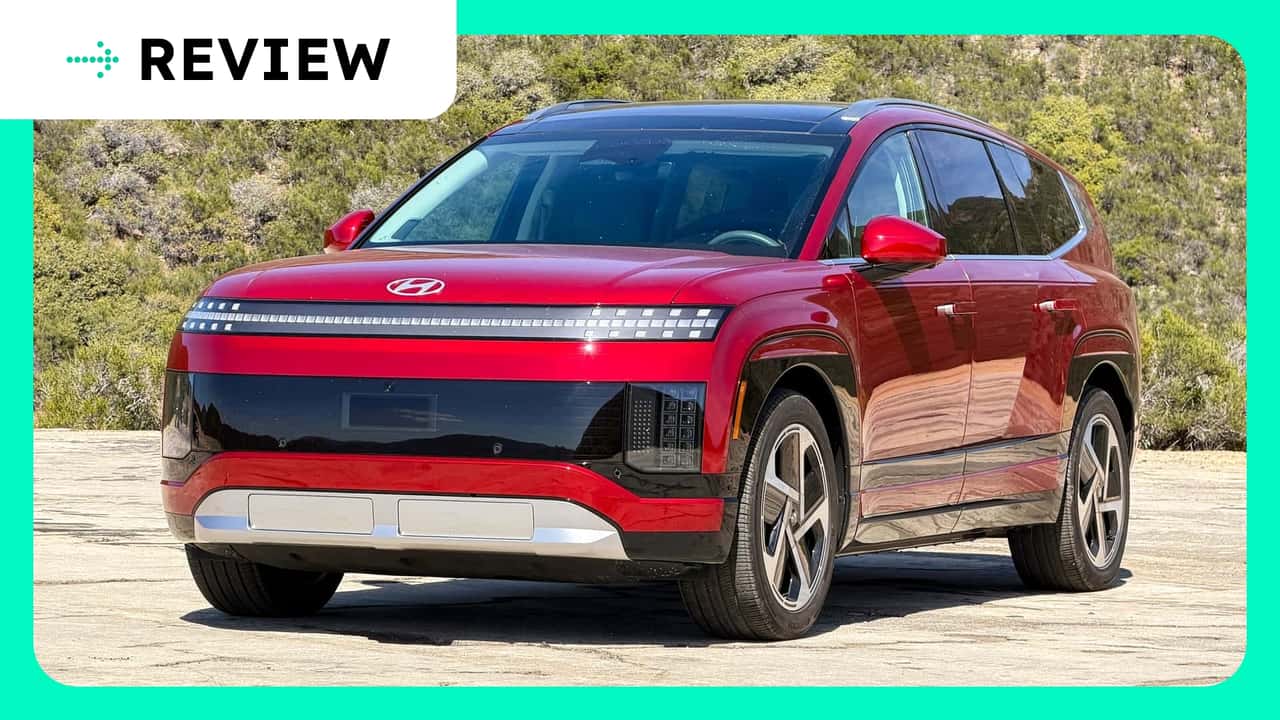



The Hyundai Ioniq 5 has been an EV fan darling since its launch in 2021. Its dazzling design, refined dynamics, and fast-charging 800-volt architecture catapulted it to the top of everyone’s “Best Non-Tesla EV” lists. But here’s a secret: It’s not the best EV Hyundai makes.
That honor belongs to the Hyundai Ioniq 9. While the Ioniq 5 may be slugging it out with the Tesla Model Y, Chevy Equinox EV, and Rivian R2 for the “best compact electric SUV title,” the Ioniq 9 is a clear favorite for the best three-row family EV on sale.
Its only competition for the throne is the Kia EV9, a car built by the same conglomerate on the same architecture. That’s a clear sign that the company has gotten something right.
WHY LEMONADE?
This story was published in partnership with Lemonade. Lemonade Insurance uses technology to keep things simple and offer lower prices for a wide array of EV drivers. They offer discounts for safe and low mileage driving, and further discounts for drivers of EVs and PHEVs. If you have a Tesla with FSD, you can even get discounts for the miles driven on FSD. Click here to get a quote for your EV today.
*Lemonade and the FSD discount are available in select states, learn more at the link above.
Design & Interior
The first thing you notice about the Ioniq 9 is its striking sheetmetal. In a world where three-row crossovers increasingly look identical, the Ioniq 9 operates from an entirely different playbook. Its futuristic front end, smooth contours, and wagon-like proportions make it stand out in a sea of anonymously blocky crossovers.
Gallery: Hyundai Ioniq 9 Review Gallery

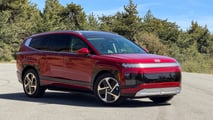
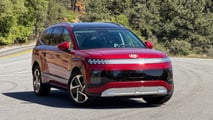
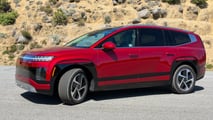
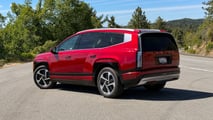
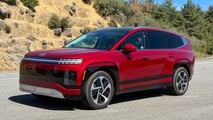
I particularly love its lighting choices. The front light bar has become something of an industry trope, but the Ioniq 9’s pixelated lighting style and hidden lower lights pull off the look better than most. Out back, the vertical LED strips subvert the industry-standard horizontal lightbar expectation and—combined with the tailgate mounted license plate—make it look like an electric version of the first-gen Volvo XC90.
2026 Hyundai Ioniq 9 Limited Performance AWD
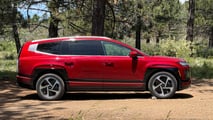
The side profile is nothing like an XC90, though. Its powerful haunches and low roofline evoke performance wagons, a boon in my book but potentially a con for those seeking the manly-man aesthetic of a taller, squarer SUV.
Overall, I like every detail of the Ioniq 9, but find the entire design a bit disjointed. I never quite expect to see such a conventional and flat rear end affixed to such a bold and flowing front 3/4s. I think it’s particularly noticeable in lighter colors like the Ultimate Red of my tester. Between the clear-white vertical light strips, black negative spaces on the license plate surround and bumper, silver brightwork on the bumper, white “IONIQ 9” lettering, and red paint, there are just too many things competing for your eye. You can alleviate this by opting for a darker color, but I still consider the Ioniq 9’s design just shy of great.
Inside, I think it’s an aesthetic home run. My tester had white seats with a good mix of grays and silvers on the dash and doors, helping avoid the monotony of some single-color designs. The things you touch often are laid out in bright aluminum-effect plastic, helping to guide your eyes and hands. It all looks a cut above its price tag.
2026 Hyundai Ioniq 9 Limited AWD Review
Yet while your eyes may struggle to discern the difference between this and a BMW or Land Rover in terms of quality, your hands tell a different story. The brushed aluminum look is certainly welcome, but inevitably leads to some disappointment when you grab what turns out to be painted plastic. It’s no worse than the plastic you get in any competitive vehicle. It just looks better, which can lead to unfairly high expectations.
This has long been a frustration of mine in Hyundai EVs. I hate when things feel worse than they look. But there’s a fair counterpoint: Many other companies make cabins that look as cheap as they are. At least the Hyundai makes a better first impression.
For its MSRP, too, I can’t fault it. This isn’t priced like a Land Rover or BMW, after all. The seats are comfortable, the components impeccably assembled, and the space well-used. I fit comfortably in all three rows, and found the second-row recliners in my $73,800 Limited AWD tester suitably posh. This wasn’t the top trim, either, though I struggle to imagine needing more kit in such a car; my tester had highway driving assist, heated and cooled front seats, the aforementioned recliners, and a panoramic roof.
More EV Reviews
Stepping up to the Calligraphy would add cooled second-row seats, a massaging driver’s seat, a head-up display, a digital rearview mirror, and body-color-matched wheel arches. I don’t think that makes it worth the $3,740 premium, but sometimes your neighbor buys a Limited and you have to show them who’s King of the Cul-de-Sac. I get it.
Range, Charging, And Specs
The 2026 Hyundai Ioniq 9 comes with up to 335 miles of EPA range. But that figure only applies to the rear-wheel-drive model, which I don’t suspect many people will opt for. RWD is only available on the base model S trim, which starts at $61,055 with destination fees.
2026 Hyundai Ioniq 9 Limited AWD Review
The Limited Performance AWD model I drove starts at $71,250 with destination—$73,800 as tested— and comes standard with dual-motor all-wheel drive. Range is quoted at 311 miles, though you can squeeze a few more miles out of the 110.3 kWh battery if you opt for the SEL AWD, which gets up to 320 miles of range thanks to smaller wheels.
Regardless of trim, you get the advantages of Hyundai’s fast-charging 800-volt architecture (actual nominal voltage, if you’re curious: 610V). The Ioniq 9 can charge from 10-80% in just 24 minutes, although you’ll likely need an adapter to do it. The Hyundai comes standard with a Tesla-style NACS port, but since V3 Superchargers aren’t built for 800V vehicles, your 10-80% time on one will be closer to 40 minutes.
This issue will fade as more third-party NACS charging stations pop up and as Tesla deploys its V4 Superchargers. But for now, if you want peak charging rates, stop at a CCS 350kW or 400kW station and use the car’s included NACS-to-CCS adapter.
Speaking of power, the Ioniq 9 Limited has plenty of it. The dual-motor performance powertrain produces 422 horsepower and 516 pound-feet of twist, enough to make the 5,994-pound barge feel positively feisty. Zero to 60 supposedly takes 4.9 seconds based on Hyundai’s estimate, but Car and Driver clocked it at 4.5 seconds. The latter feels more indicative of what I felt behind the wheel.
2026 Hyundai Ioniq 9 Limited AWD Review
Not all AWD Ioniq 9s are so blessed with power. Dual-motor SE and SEL models get just 303 hp, which feels low for such a heavy vehicle. They still should be quick enough off the line, though, with 446 lb-ft of torque. I can’t say the same for the RWD Ioniq 9 which—with 215 hp and 258 lb-ft of torque—seems to me like it’d be an absolute dog. It takes over eight seconds to hit 60 mph, still quicker than the base Hyundai Palisade but glacial by EV standards.
Still, this thing is for hauling families, and haul it does. The Ioniq 9 offers 21.9 cubic feet of space behind the third row, good enough for your weekly grocery haul. With 46.7 cu. ft. behind the third row, four-adult road trips are more than achievable, while the 86.9 cu. ft. space with both rows folded is large enough to swallow a full e-bike with room to spare.
All of these figures are roughly in line with what you’d get from gas-powered alternatives like the Toyota Highlander and Honda Pilot, even if the Grand Highlander and Chevy Traverse have it beat. A tiny frunk in the Ioniq 9 closes a bit of the gap, but it’s mostly just a place to keep your charging cable and adapters. The only real practicality trade-off you make going for the Ioniq 9 is its cargo opening, which is smaller than in a traditional three-row thanks to its sloping roofline. There may have been plenty of room for a big e-bike, but getting it inside was anything but easy.
What’s It Like To Drive?
The Ioniq 9 is as composed and enjoyable as any three-row SUV out there. None of the cars in this segment will light your hair on fire, but the Ioniq 9 is over three seconds quicker to 60 than a Highlander, has a lower center of gravity, more responsive power, and far more eager handling. Credit the weight distribution for that.
2026 Hyundai Ioniq 9 Limited AWD Review
Handling is not the focus, though. While it’ll outrun any gas-powered family hauler in the twisties, its tires will be screeching the whole time, and it won’t be particularly charming while doing it. It’s built for long highway hauls and around-town runs, and for that it is well-suited. The suspension is suitably cushy, the cabin suitably quiet, and the steering suitably light.
The only real snag is its maneuverability, as the long-wheelbase Hyundai feels a bit more cumbersome in tight parking lots than many gas and electric rivals. Its 41.0-foot turning circle is about four feet wider than a Highlander’s. Thankfully the Limited model has 360-degree cameras to ease this burden, and it’s still easy to slot into any parking lot that regularly sees full-size trucks.
Last, I’ll note that Hyundai’s Highway Driving Assist 2 is feature-rich but functionally frustrating. It’s capable of keeping you within the lane and managing your throttle and brakes, but it requires more input and more vigilant supervision than competitors. I found it bouncing me against lane markings and losing tracking more often than I’d have liked. It’s fine for the price, but a replacement for Super Cruise or Full Self-Driving (Supervised) this is not.
What’s It Like To Live With?
It has taken me a while to get around to writing this review. That is for a simple reason: I find most Hyundais absolutely agreeable and undeniably well-specced for the price, but rarely memorable. The Ioniq 9 is another in that line.
Throughout my time with it, it did nothing wrong. There were no warning lights or obtuse design decisions. But the cars that stick with me are ones that do little things perfectly, and the Ioniq 9 doesn’t quite get there. The software still looks and feels a generation behind the best in the class, with graphics that feel a decade old. It has all the features you’d technically want—route planning, connected car services, over-the-air updates. But none is implemented particularly well.
2026 Hyundai Ioniq 9 Limited AWD Review
Hyundai’s built-in route-planning is lackluster and, in my experience, not up to date about which chargers are functional. I’ve never heard of a Hyundai getting meaningful updates over the air, either, except for navigation data. And while Hyundai has been optimistic about the potential for revenue from connected car services, the company doesn’t really offer any compelling software features.
The Ioniq 9 does benefit from a lovely menu of settings and tools. I love that Hyundai includes a Camp-Mode-adjacent Utility Mode, and I love that the car supports 1.9 kW of vehicle-to-load capability, with a full three-prong outlet in the cargo area of the limited. I like that there are physical knobs and buttons for media and climate controls, too.
I like that there are configurable levels of regenerative braking accessed via paddles on the steering wheel. But I hate that there’s no way to leave it in one-pedal mode on startup, and that I always need to use the start button.
For buyers coming from traditional cars, none of these things are issues. The Ioniq 9 starts, stops, and feels like a gas car, with slightly more sophisticated technology. But if you’re expecting a full-fledged EV experience with meaningful over-the-air updates, killer native apps, default one-pedal driving, and world-class software, you’re going to be disappointed.
Hyundai Ioniq 9 vs Kia EV9: Which Is Better?
Regardless of my software gripes, this is still a better value than just about any other three-row family EV on the market. It’s pricier than the new Tesla Model Y L, but also far bigger and more practical. It’s not as sophisticated as a Lucid Gravity or Rivian R1S, but it’s way cheaper and likely to be far more reliable.
2026 Hyundai Ioniq 9 Limited AWD Review
Its only direct competitor is the Kia EV9, with which it shares its platform. If you want a reasonably equipped all-wheel-drive version of either Korean three-row EV, you’ll be spending around $65,000, though the Kia is to be a bit cheaper.
That’s partially because it’s down about 10 kWh in the battery compartment, leading to a max AWD range of just 280 miles to the Hyundai’s 320. That alone may seal the deal for many, or the fact that the Kia has a few cubes less storage space.
Me, though? I’d take an EV9. On an objective basis I’d say the Ioniq 9 is a marginally better car, with more of what buyers in this segment prioritize: Space and range. But I find the Kia more charming to look at, more eager to drive, and more unique.
Verdict
The Hyundai Ioniq 9 is the odds-on favorite for the best car in its segment. The issue is that its segment is relatively weak.
There just aren’t many three-row electric family SUVs in the mainstream segment.Unfortunately, that’s for a good reason. An equivalent gas-powered Hyundai Palisade three-row is around $20,000 cheaper. The electric version may be better to drive, quicker, cooler looking, cheaper to run, and less maintenance intensive, but 20 grand is 20 grand.
It is therefore easy to see why Hyundai sold just 5,189 Ioniq 9s last year compared to—gulp—123,929 Palisades. Three-row EVs remain a niche market, and until we get closer to cost parity, I don’t expect that to change.
But I’m grateful that Hyundai is staying in the arena. Three-row EVs may not be profitable or popular at the moment, but they are the future of the segment. The best gas cars have already been built; the best EVs are decades away. As costs come down and technology improves, it won’t be too long before Americans are gobbling up large family EVs in droves. When that day comes, Hyundai’s early experience should give it a big leg up.
Contact the author: Mack.Hogan@InsideEVs.com
You Might Enjoy...
RECOMMENDED FOR YOU
I Drove An Original Tesla Model S To See If It's Still Worth Buying In 2026
After 500 Hard Miles In A BMW iX3, Range Anxiety Feels Outdated
I Drove Jeep’s First Proper Hybrid. It Feels More Like A Toyota, And That's Not A Coincidence
Volvo Wants To Make You A Safer Driver—And Lower Your Insurance Bill
I Was Going To Go Back To Gas. Here’s Why I Just Couldn’t Give Up My EV
They Bought A 78,000-Mile Tesla With An Unknown Past. Then They Tested The Battery
I Used To Hate Giant EVs Like The Cadillac Escalade IQL. Then I Drove One