
This Dodge Charger EV Prototype Packs An Experimental Semi-Solid-State Battery
Dodge parent Stellantis is exploring the viability of semi-solid-state batteries with real-world testing. The test mule: A Charger EV.
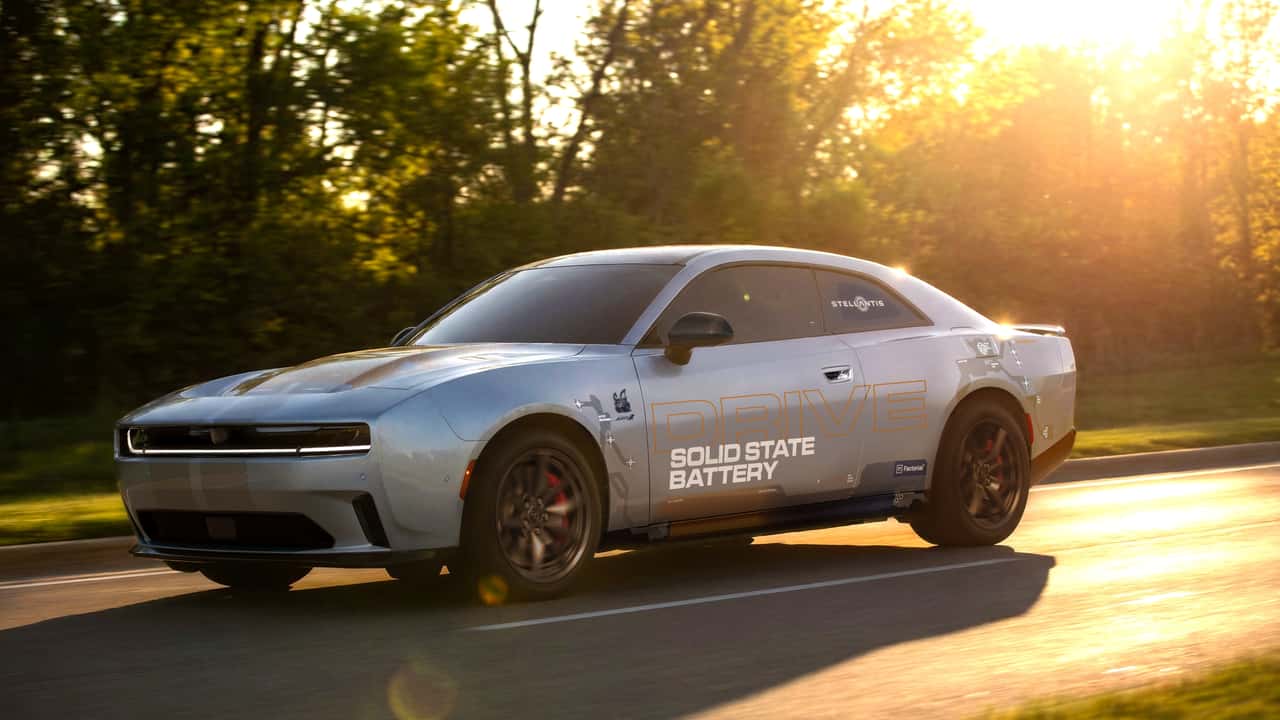

- A Dodge Charger Daytona EV equipped with semi-solid-state cells is now undergoing real-world tests.
- The program is part of Stellantis' collaboration with battery startup Factorial.
- The automaker said the battery could make EVs go further, charge faster, and cost less.
Stellantis, the parent company of Jeep, Ram, Dodge, and 11 other automakers, has started real-world tests of semi-solid-state batteries, the automaker announced Thursday.
Solid-state batteries have proven notoriously difficult to develop and scale. That hasn't stopped a growing list of automakers from betting on them, even as conventional lithium-ion technology continues to improve and benefits from deeply established supply chains.
The company has outfitted a Dodge Daytona Charger EV with a semi-solid-state battery pack from Massachusetts-based startup Factorial Energy and is now putting it through real-world tests. Stellantis says the development vehicle will be used to fine-tune and validate the pack's safety, performance, and reliability under actual charging and driving conditions.

“This milestone shows we are bringing solid-state batteries closer to our customers with the potential for longer range, faster charging, and lower costs,” Ned Curic, the automaker’s chief engineering and technology officer, said in a statement.
At the heart of this test program is Factorial's FEST cell with a semi-solid-state chemistry boasting an energy density of 375 watt hours per kilogram. For context, conventional lithium-ion batteries typically land in the 200-300 Wh/kg range. Stellantis says the pack can charge from 15-90% in just 18 minutes and operate across a temperature range of -22 degrees Fahrenheit to 113F. That's a meaningful leap over the current Daytona's lithium-ion pack, which charges from 10-80% in roughly 30 minutes.
“Real-world road testing is exactly the kind of deep full-stack collaboration that solid-state has always required,” Factorial CEO Siyu Huang said in a statement.
Stellantis says it integrated the battery into the existing pack design using a new, patented mechanical architecture engineered to extract maximum performance from the cells.
Factorial has previously told InsideEVs that its semi-solid-state cells, which use a gel-like electrolyte rather than a fully solid one, offer meaningful advantages over conventional lithium-ion batteries. Crucially, what the company learns from these cells will feed into the development of its all-solid-state Solstice battery, so the real-world tests are as crucial to Factorial as they are to the automaker.
This is also not the first time Factorial’s batteries have come out of the lab into real-world tests. Last year, Factorial’s semi-solid-state cells were also installed in a Mercedes-Benz EQS. When the automaker took this prototype EQS on a cross-country road trip in Europe, it covered a staggering 749 miles on a single charge, with 85 miles of range still remaining when the journey was over.
Last year, BMW also started testing all-solid-state cells from Colorado startup Solid Power in a prototype i7. The German automaker has also tapped Samsung SDI to help develop and validate Solid Power’s cells. Toyota has its own solid-state program in the works, and multiple Chinese automakers such as BYD, Nio, and MG Motor are working on solid-state batteries.
Contact the author: suvrat.kothari@insideevs.com
Related Stories
RECOMMENDED FOR YOU
Toyota’s Next Generation Hybrid Batteries Promise Lower Cost, Better Performance
The 2027 Kia EV3 Is Almost Here—With 280 Miles Of Range For The AWD Models
Factorial Taps Hyundai Supplier To Solve Solid-State Batteries’ Biggest Problem
GM Walks Away From $3.5B Battery Factory, Leaving Samsung SDI In Full Control
Inside BMW's Plan To Produce The iX5’s Gigantic Battery Pack In The U.S.
Tesla Burned Through Its California EV Rebate Funds In Just Five Days
Battery Startup Raises $300 Million Promising 20% More EV Range