Home
Reviews
Comparisons
2027 Lexus ES Review: Which Is Better, The Hybrid Or The EV?
The new Lexus ES is available only as a hybrid or full-on EV. I drove both to find out which one is better.
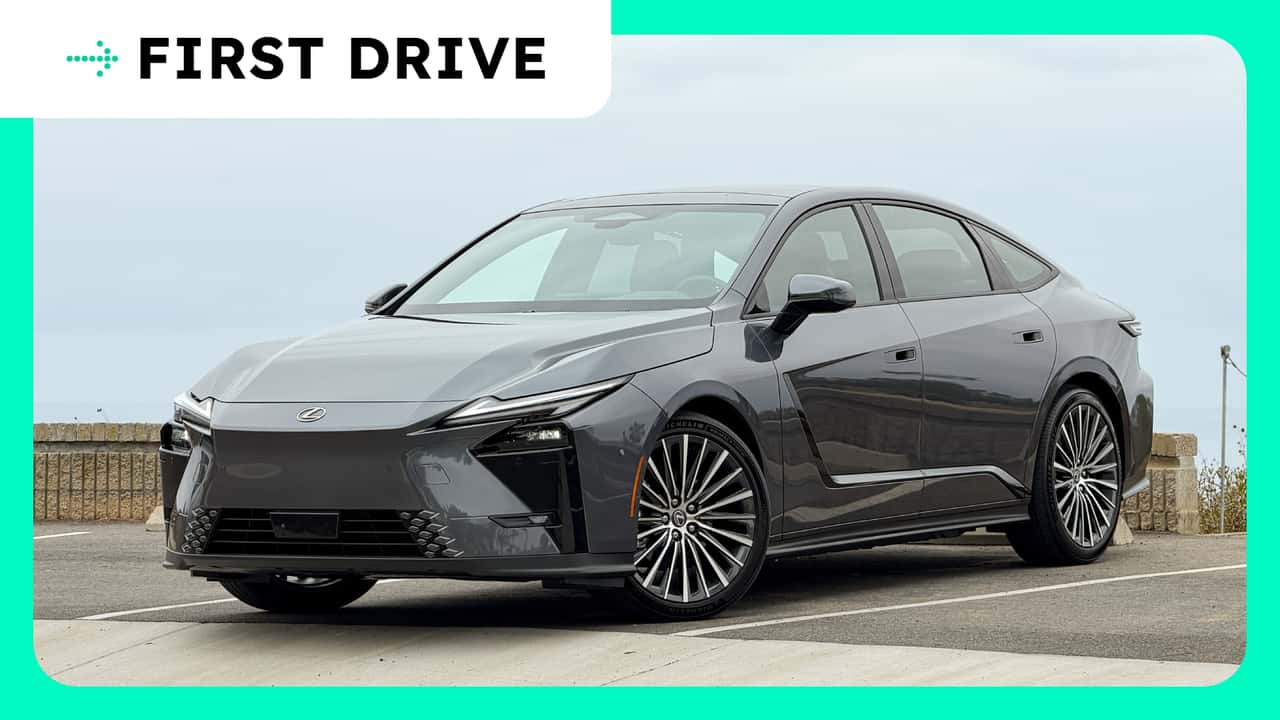
Photo by: Mack Hogan/InsideEVs
Mack Hogan 
By: Mack Hogan
May 27, at 7:00am ET
Add InsideEVs as a preferred source in Google
- (https://twitter.com/intent/tweet?url=https%3A%2F%2Finsideevs.com%2Freviews%2F797015%2F2027-lexus-es-hybrid-vs-ev%2F&text=2027%20Lexus%20ES%20Review%3A%20Which%20Is%20Better%2C%20The%20Hybrid%20Or%20The%20EV%3F%20&via=InsideEVs)
- copy
Share
Comment


The Lexus ES has been a central pillar of the Lexus brand since its foundation, back in 1989. Even as sedans have receded from primacy, the ES has soldiered on as a standard-bearer for the old-school luxury approach, serving a core constituency in the brand. And with the LS flagship going out of production after 37 years, that leaves the ES as the longest-running nameplate in the lineup and the flagship sedan, at least for now.
To serve its new role, the ES gets new powertrains. For 2027, it is electrified across the board, available solely as a hybrid or an EV. The strategy is a departure for Lexus: It’s the brand’s first EV to ride on a platform shared with the hybrid version. So while the Lexus RX equivalent is the highly distinct RZ, and the Lexus TX gets a wholly different TZ electric alternative, the company is taking the EZ route here. They’re all ESes, and they’re all broadly similar.
WHY LEMONADE?
This story was published in partnership with Lemonade. Lemonade Insurance uses technology to keep things simple and offer lower prices for a wide array of EV drivers. They offer discounts for safe and low mileage driving, and further discounts for drivers of EVs and PHEVs. If you have a Tesla with FSD, you can even get discounts for the miles driven on FSD. Click here to get a quote for your EV today.
*Lemonade and the FSD discount are available in select states, learn more at the link above.
So what’s best, the hybrid or the EV? I drove both to find out. And while there’s a lot to like with either version, it’s the money factor that decides it in the end.
Gallery: 2027 Lexus ES EV & Hybrid: First Drive

29





Source: Mack Hogan/InsideEVs
Specs Comparison
The new ES is available in four configurations: ES350h FWD, ES350h AWD, ES350e FWD, and ES500e AWD.
That’s a lot of “E’s” to throw at you, but it’s not as messy as it looks. The ES350h is the hybrid, and the only difference between its two variants is whether you get all-wheel drive or front-wheel drive. Power is the same at 244 hp either way, though the AWD version is a bit quicker to 60. Thanks to the extra traction, it notches a 0-60 sprint in 7.1 seconds, compared to the FWD model’s 7.3 seconds.
The ES350e FWD is the most direct electric equivalent, with slightly less horsepower (221 hp compared to 244) and slightly more torque (198 lb-ft vs. 173). It’s a tad slower to 60, but it felt quicker. The hybrid only makes its maximum power when the engine and electric motor are both giving it their all, which means you have to wait for it. For a highway on-ramp sprint or a two-lane road pass, the ES350e feels more urgent.
2027 Lexus ES350e Specifications
Base Price $48,895
Battery 74.7 kWh NCM li-ion
EV Range Up to 307 miles
Drive Type Front-wheel drive
Output 221 hp / 198 lb-ft
Speed 0-60 MPH 7.4 seconds
Weight 4,608 lbs
Cargo Volume 13.3 cubic feet
If speed is the goal, though, the dual-motor ES500e AWD dusts both of the 350s. Its 338-hp powertrain makes it two seconds quicker to 60 than the hybrid, doing the deed in 5.1 seconds. That’s quick enough that EV fans would call it “normal,” hybrid fans would consider it “surprising, and the average Lexus ES owner would probably deem it scary.
What you gain in speed, however, you lose in range. Both EV variants use the same battery, good for up to 307 miles of range in the ES350e or 276 miles in the ‘500. On either model, stepping up from the base 19-inch wheels to the optional 21’s dings range. Both charge from 10-80% in 28 minutes on a factory NACS port, Toyota says.
There are only three main ways to tell the Lexus ES hybrid from the EV. The hybrid (picture) has a small slot in the front for cooling the gas-powered engine and a gas cap in the rear. The EV has a flush nose and a charge port on the front of the vehicle. Both vehicles also get their own bespoke wheel options.
Photo by: Mack Hogan/InsideEVs
For its part, the hybrid is about as efficient as gas-powered luxury cars get. EPA figures come in at 48/44/46 city/highway/combined for the FWD model and 47/42/44 for the AWD version.
Powertrain numbers aside, however, you’ll find little difference between the hybrid and electric ES models. Both have identical figures for passenger and cargo space, and besides the charging port being located at the front and the gas cap at the rear, they look broadly similar. For simplicity’s sake, I’m going to focus the rest of this comparison on the ES350h FWD and the ES350e FWD, as their specs are so similar.
Driving Experience
If you’ve driven a Lexus ES before, you know the mission. At its best, an ES gets out of the way. It’s supposed to be the plushest, butteriest car in its class, with a disposition that clearly favors pleasure cruising and highway slogs over canyon carving. The drive routes at the launch event made that clear, with a lot of urban and freeway driving, mixed with an occasional twisty.
In either guise, the ES accomplishes its mission. Its steering is direct and its handling is predictable, but this is a car that’s happiest taking you to work. Its excellent seats and impeccably high-quality cabin make it a nice place to spend time, though I have to say the optional 17-speaker Mark Levinson audio system was not the best I’ve heard in a Lexus.
The fact that I’m talking seats and speakers on paragraph two of the “driving experience” section should tell you what you need to know. This is a car for being inside of, not for driving in the enthusiast sense, and I like that quite a bit. In the summer after senior year of high school, I had an early-start, 40-hour-a-week job at a car dealer 45 minutes from home. I’d drop my mom at work, then take her 2007 Lexus ES350 the rest of the way myself.
The ES5500e (pictured) is the most powerful and quickest variant of the ES, with 338 hp. But all of the available powertrains feel quick enough for the laid-back driving you do in an ES.
Photo by: Mack Hogan/InsideEVs
I could have been in a Ferrari and the I-90 corridor in Cleveland would have still been a boring everyday slog, and I was grateful that the ES350 always made it nice. It was quiet. It was absurdly comfortable. And on a 90-degree day, I could get in the car after a long workday in the sun and have ice-cold air blowing within 5 seconds.
Lexus has always gotten little stuff like that right, and the tradition continues here. Everything in the ES is easy to use, simple, and nice. The ride remains on the plush side of the sedan segment, but it has gotten noticeably firmer over the years. On the 19-inch wheels, I consider it to still be acceptably plush. But step up to the 21-inches, and it crosses the threshold, becoming occasionally jarring over chuckholes.
Regardless of powertrain, the experience is smooth. But if smoothness is your ultimate goal, an EV will always beat a hybrid. The ES350e spends less time searching for power, less time revving a not-particularly-charming four-cylinder engine, and less time cycling its vibration-inducing engine on and off. You still have to use the brake pedal—Lexus remains staunchly opposed to one-pedal driving—but the variable regen settings help you customize your experience a bit more in the EV. Neither car will bother you if you drive like an average ES owner, and neither feels lethargic, but this category is a clear win for the EV.
Regardless of whether you go EV or hybrid, I would recommend avoiding the larger, 21-inch wheels. They decrease range on the EV and make the ride worse on every model.
Photo by: Mack Hogan/InsideEVs
Tech & Equipment Differences
The big tech news here is that the ES gets Lexus’ new software, complete with a customizable home screen, more detailed navigation displays in the gauge cluster, route planning for the EV, and 5G integration.
The 2027 ES is the first Lexus to get a detailed map view in its gauge cluster. To use it, you'll have to use the built-in maps, which thankfully now offer route-planning in the electric version.
Photo by: Mack Hogan/InsideEVs
Lexus heralds this as a huge leap in tech, and it is. But because the brand was behind most competitors, the result of that leap is finally being on par with the segment average. The displays and menus feel snappy and polished, albeit still less configurable than in some competitors, and the software finally feels like it was designed in a world where EVs exist.
Lexus' new software stack is a noticeable improvement, with a customizable home screen and more features.
Photo by: Mack Hogan/InsideEVs
ES350e models not only get route planning, but also charge management features, preconditioning, charging schedules, charge rate limits, and vehicle-to-load management. There’s even an option to disable battery cooling while charging, which even the Lexus team couldn’t quite explain the purpose of.
Still, for a company that has long offered too few options for EV customers, too many is a welcome step. And while more functions have moved onto the screen on both cars, it’s not a user-hostile experience. There are still hard buttons for changing the temperature and enabling defrost, though they look like they’d be capacitive, and key switches like the heated/cooled seat controls are persistent on the screen.
Lexus also lets you map other settings and toggles to a Quick Control menu on the top right of the screen, which is helpful. There’s even a built-in dashcam that saves clips automatically when you have an emergency braking event or a collision. Both versions also support digital keys in your Apple, Google, or Samsung Wallet, too, allowing you to ditch the fob and use your phone.
The electric ES is the first Lexus or Toyota EV to come with a good slate of EV-specific software options, like route-planning and vehicle-to-load management.
Photo by: Mack Hogan/InsideEVs
The upgrades move Lexus from the back of the pack to the middle, meaning software is no longer a reason to steer away from the brand, or at least this model. On that front, there’s no meaningful difference between the EV and the hybrid.
However, if you want all of the gadgets on offer, you’ll have to go electric. The Luxury trim is only available for the 350e and 500e, and includes things like semi-aniline leather, passenger-side memory seats, an automatic parking feature that you can control via your smartphone app, and ambient lighting highlighting “forged bamboo” trim.
Most notably, the Luxury trim is required to get the Executive Package, which offers reclining, massaging rear seats and a power ottoman on the passenger side. With one button, you can fold the front seat forward and kick your legs back, using the included rear touchscreen to adjust your climate and heated/cooled seat controls.
Only the EV is available with the Executive Package, which includes reclining, massaging, heated and cooled rear seats.
Photo by: Mack Hogan/InsideEVs
I don’t expect most buyers will want to pay for all of this, but I still have to give this category to the EV. If you want the ultimate Lexus luxury sedan, you have to break up with gas.
Price & Running Cost Comparison
This is where you may be expecting a “but.” I mean, you’re reading InsideEVs. Of course we think the EV driving experience is better, and appreciate the extra gadgets on offer. But there’s typically a big elephant in the room that we can’t ignore: EVs cost more.
Not here. The 2027 Lexus ES350e starts at $48,895 with destination charges, a full $2,200 cheaper than the $51,095 ES350h that feels louder, rougher, and—in the real world—slower.
And that’s where the savings start, not where they end. At today’s national average price for the ES350h’s recommended premium gas—an eye-watering $5.35 a gallon—it’ll cost $1,638.54 per year to travel the average distance an American drives in a year, 13,476 miles.
The ES350e isn't just nicer to drive and cheaper to operate than the hybrid, it's also cheaper to buy.
Photo by: Mack Hogan/InsideEVs
For the EV, using last year’s national average home electricity rate, you’d be able to cover the same distance for $666. That’s nearly a thousand bucks a year of difference, enough that even if gas prices fall, even if you do half of your charging in public, even if you put regular in the hybrid’s tank, you still won’t come out ahead.
In fact, you could pay an extra three grand for the much faster AWD EV and still save money over the gaser. Sure, the $51,895 ES500e is a bit pricier than the base FWD hybrid, but it’s tight enough that you’d make up the difference in under a year, while enjoying AWD traction and speed. Plus, it starts off cheaper than the AWD hybrid, which stickers for $52,495.
Conclusion
Again, you came to InsideEVs. What do you expect me to say? The EV is less expensive, feels quicker, is significantly quieter, requires less maintenance, has an eight-year warranty on the battery, costs less than half as much to fuel, offers more equipment, and is way, way better for the environment. Fun bonus: On cold winter mornings, you don’t have to open your garage to pre-heat your car, as there are no toxic fumes to worry about.

Stay informed with our newsletter every weekday
back
Subscribe For more info, read our Privacy Policy & Terms of Use.
So which one will sell better? The hybrid, of course! Lexus expects the hybrid to account for around 80% of sales. That’s hard to fathom when you consider that the average Lexus owner almost certainly owns their own home, and can do over 90% of their charging there. But wealthy, older car buyers are also likely less enthusiastic to have to learn the ropes of public fast chargers and preconditioning. That’s why transitions take time.
What do you think?
View
Comments
The good news is that the EV will win out in the end. Better technology almost always does. When the buying public is presented with an option that is smoother, quieter, faster, cheaper to run, easier to maintain, and likely more reliable in the long term, they will eventually warm to it. For the people who are already there, the Lexus ES EV is a lovely all-electric sedan. For those who aren’t, the ES hybrid is a good way to cut your carbon emissions and your gas bill in the meantime.
Contact the author: Mack.Hogan@insideevs.com.
Related Stories
Lexus Just Solved One Of Its Biggest EV Headaches
Lexus Revealed Its First-Ever 3-Row Electric SUV. Check Out The TZ
The Lexus RZ's Virtual Shifting Is Fascinating—But It Doesn't Deliver
The 2026 Lexus RZ 550e Tries Something New. It Doesn’t Quite Work
Click here to see all articles with lists of the best EVs
We want your opinion!
What would you like to see on Insideevs.com?
Take our 3 minute survey.
- The InsideEVs team
Share this Story
- (https://twitter.com/intent/tweet?url=https%3A%2F%2Finsideevs.com%2Freviews%2F797015%2F2027-lexus-es-hybrid-vs-ev%2F&text=2027%20Lexus%20ES%20Review%3A%20Which%20Is%20Better%2C%20The%20Hybrid%20Or%20The%20EV%3F%20&via=InsideEVs)
- copy
GO TO COMMENTS
(
)
Got a tip for us? Email: tips@insideevs.com
View all comments ( )
Trending
Kia EV3 Lease Deals Are Here, And It’s Cheaper Than The Chevy Bolt And Nissan Leaf
I Let Android Auto Plan My EV Roadtrip. Here’s How It Worked
This Chevy Bolt Has 470,000 Miles. Here’s How Much A New Battery Was
Here's What It's Like To Take Delivery Of A Rivian R2
latest articles
- This Chinese EV Is Now Made In Europe. More Are Coming Oct 20 - News -
- GM Is Closing Its Detroit EV Battery Plant Oct 20 - Industry -
- The 2027 Lexus NX Plug-In Hybrid Gets A Bigger Battery And Fast Charging Oct 20 - Official -
- Kia EV3 Lease Deals Are Here, And It’s Cheaper Than The Chevy Bolt And Nissan Leaf Oct 20 - Pricing -
- Here's What It's Like To Take Delivery Of A Rivian R2 Oct 19 - News -
- Used EVs Hit A Record Share Of Overall Used Car Sales In September Oct 19 - Sales -
- Nio's Little Electric Car Has A Cool Party Trick: Upgradeable Range Oct 19 - News -
RECOMMENDED FOR YOU
I Drove All The New Toyota EVs. Here’s My Pick—And How To Choose
This Chinese EV Is Now Made In Europe. More Are Coming
Slate Truck Vs. Chevy Bolt Vs. Nissan Leaf: Which Affordable EV Actually Wins?
GM Is Closing Its Detroit EV Battery Plant
Rivian R2 Vs. Tesla Model Y: Which American Mid-Size EV SUV Is Best?
The 2027 Lexus NX Plug-In Hybrid Gets A Bigger Battery And Fast Charging
Chevy Bolt VS. Nissan Leaf: How America's Cheapest EVs Stack Up