
How Much Quicker Is The Newest Version Of Tesla FSD? This Test Put It Against Old Software To Find Out
A YouTuber put three Teslas in a back-to-back test to measure reaction time. The results showed how both hardware and software have progressed.
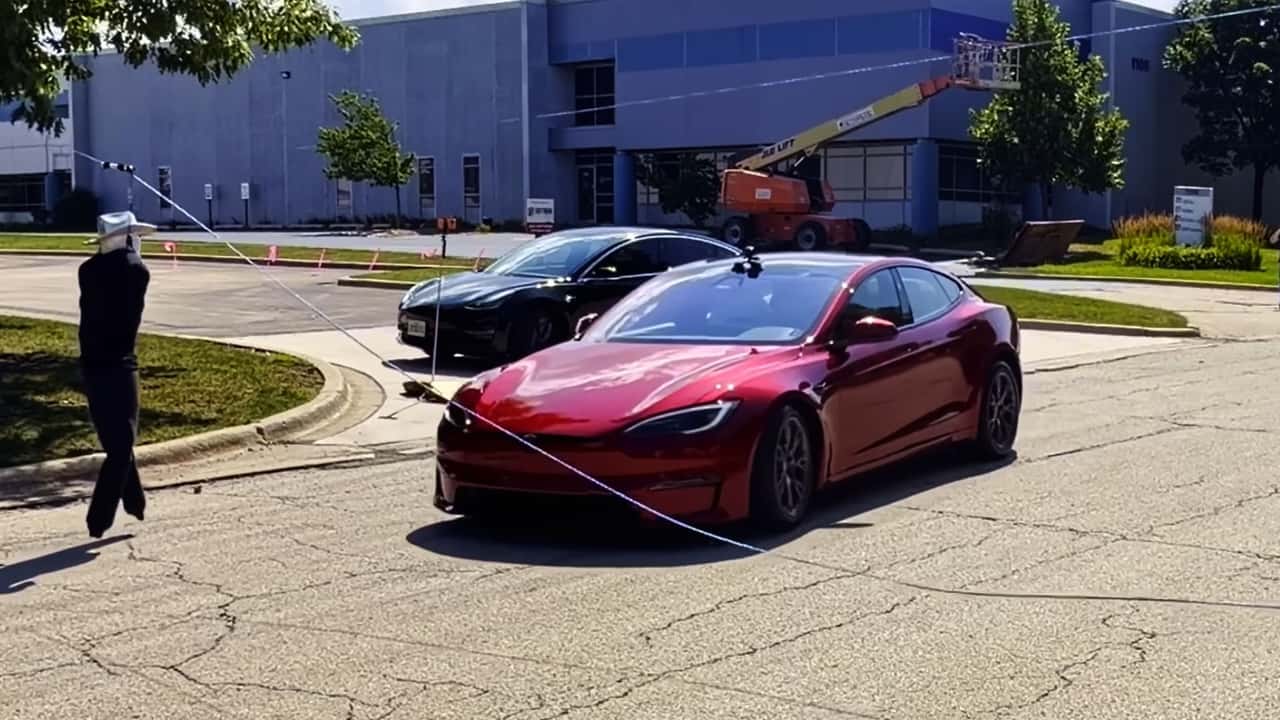

- A YouTuber measured how Tesla's FSD hardware and software versions affect reaction time.
- Hardware 4 outperformed the older Hardware 3, but the real kicker is how much quicker Tesla's new v14 Lite software was on HW3 than older software on the same computer.
- It shows that a mix of hardware and software is needed for best safety and performance.
How quickly does your car's automatic emergency braking work? The answer depends on both the car's physical hardware and its software stack.
YouTuber TechGeek Tesla decided to try out how quickly Tesla's vehicles react when they simulate a person walking in front of the car. Given how vocal Tesla is about the upgraded hardware and software that it puts into the car, it made sense to see if either affected how safe the car really is (at least in the pedestrian-crossing-the-road test).

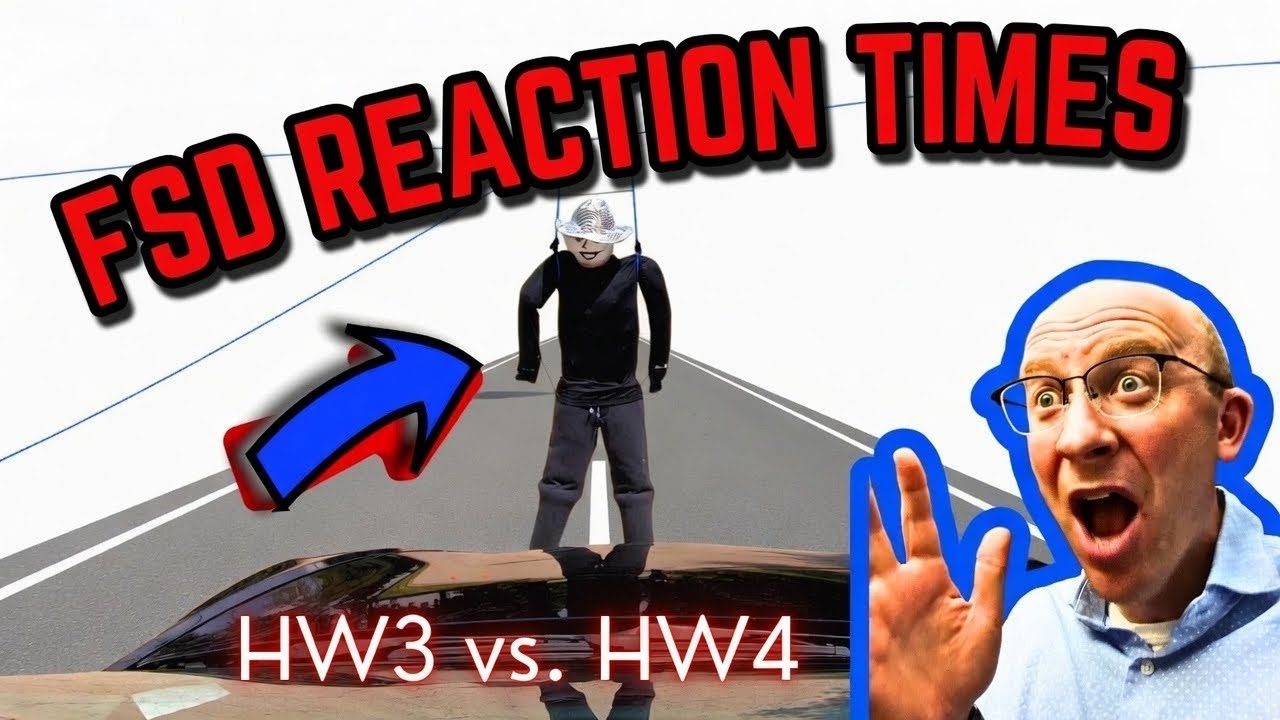
The test took three different cars and put them to the test. All of the cars were placed on the same route, at the same speed, and face the same dummy hoisted out in front of it to simulate an oblivious person running into the road.
What's different between the cars is the hardware and software that underpins the car's semi-autonomous driving features. Two cars were equipped with the older Hardware 3 computer and one car with the currently-deployed Hardware 4. One of the HW3 cars had Tesla's Full Self-Driving version v12.6.4, the other had v14 Lite installed, and the HW4 car had the full-fledged FSD v14.3.4.
To test the cars, the YouTuber built a pulley system across the road. He attached a human-looking dummy to the rig and as the cars approached a specific point in the road traveling at 23 MPH, he reeled the dummy into the road and measured the speed down to the fraction of a second that it took the cars to react. Here's what he found:
| Hardware | Software | Reaction Time (Seconds) | Delta From Baseline | Delta from v14 Lite |
| HW3 | 12.6.4 | 1.065 | Baseline | 57.8% Slower |
| HW3 | v14 Lite | 0.675 | 36.6% Faster | Baseline |
| HW4 | 14.3.4 | 0.450 | 57.8% Faster | 30.7% Faster |
Tesla's latest and greatest HW4 predictably performed the best. It outperformed HW3 on FSD v12 by 57.8% and HW3 on v14 Lite by 36.6%.
It's not all hardware, though. As the car with FSD v14 Lite shows, Tesla's software also plays a part in this. The software allowed the car to react 36.6% faster than HW3 on an older version of the software. Meanwhile, the car with HW3 on the older FSD v12.6.4 reacted 57.8% slower than the HW4 car which reaps the benefit of both software and more capable hardware.

While reaction time isn't the end-all in terms of self-driving performance, it's an important factor. If nothing else, it shows just how important these powerful computers are in modern cars.
Tesla's quest to put more and more compute in its cars isn't ending. The automaker has already said that it plans to double the amount of memory in new HW4, and that its upcoming AI5 chip is even more powerful. The powerful compute gives it the ability to run more intensive inference models, which is responsible for making the split-second driving decisions like what was measured in this test.
More Tesla FSD News
RECOMMENDED FOR YOU

Tesla Never Made An Electric Jet Boat, So This YouTuber Built One Himself
Subaru Is Spending Three Times More To Sell EVs Than Gas Cars. It's Not Working
Elon Musk Hurts Tesla More Than China Ties Hurt BYD, Survey Finds
Ford Fathom: Everything We Know About The Sub-$30,000 Affordable EV Truck
EVs Don’t Need This Gas Car Feature. So Why Do So Many Still Have It?
What To Know About California's $3,500 EV Rebate—And Which Teslas Qualify
Tesla Breaking Off Its China Business? Musk Calls It 'Absurdly Fake News'