
Battery Startup Raises $300 Million Promising 20% More EV Range
Sila says its silicon anodes could deliver 20% more range as it scales U.S. production for Mercedes, Panasonic and other automakers.

- Sila says its silicon-carbon anodes could give EVs 20% more range without larger battery packs.
- The startup raised $300 million to expand U.S. production at its Moses Lake factory.
- Sila plans to supply Mercedes and Panasonic as it targets an annual output of up to 250 GWh.
Electric vehicles could gain 20% more range without needing a bigger battery pack, according to U.S.-based battery materials startup Sila. The company says that instead of replacing the widespread lithium-ion battery altogether, it wants to improve one of its most important components: the anode.
Sila says its Titan Silicon silicon-carbon anode material, which it spent the last 15 years developing, could deliver the stated range gains over a normal graphite anode of the kind most lithium-ion batteries already use. It touts increases of between 20% and 40% in the battery’s energy density, and it also says this solution enables faster charging, but without saying how much faster.
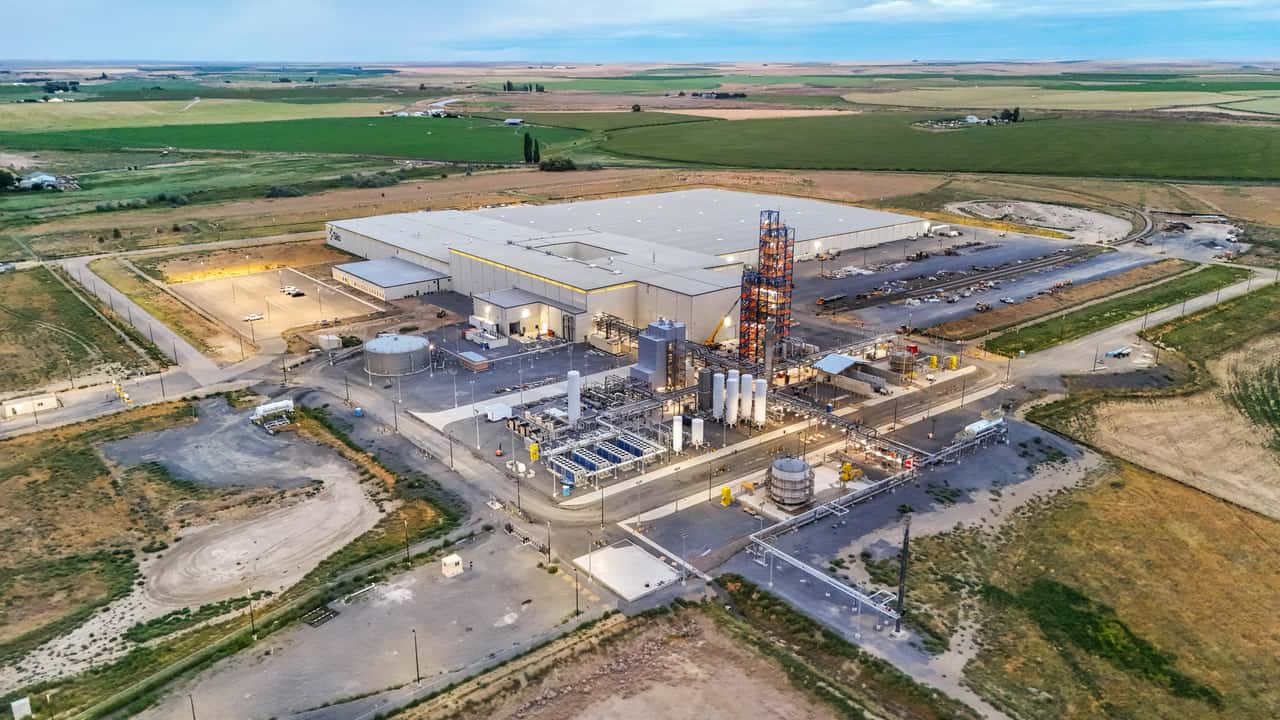
The startup says it has now secured $300 million in private funding to ramp up production at its factory in Moses Lake, Washington (pictured), as well as support a planned second phase of the site’s expansion.
Its 160-acre Moses Lake factory began operating in fall 2025. The company is now ramping production from an initial capacity of 2 gigawatt-hours and says the facility was designed to achieve an annual production capacity of 250 GWh within five years. That would make it the world’s largest anode production facility.
Sila already has contracts to supply its anode material to Mercedes-Benz and Panasonic Energy, along with other companies that were not named. Mercedes previously announced plans to use Titan Silicon in a future electric G-Class, while Panasonic intends to incorporate the material into next-generation EV battery cells.
While silicon can store more lithium than graphite, it also swells and contracts as a cell charges and discharges. That physical expansion can damage the anode, accelerating battery degradation, which is why most production batteries currently use only relatively small quantities of silicon blended with graphite.

But silicon-rich anodes are making their way into production cars. The Mercedes-AMG GT 4-Door EV has silicon in its battery anodes, which is part of the reason it has a claimed 10% to 80% charging time of 11 minutes and a peak charging power rating of 600 kW.
It’s unclear if its cells are supplied by Sila, but the car seems to demonstrate why automakers are increasingly interested in this anode material. General Motors also expects automakers to gradually increase the silicon content of their batteries. It says the technology could allow manufacturers to shrink battery packs, lower vehicle weight, and eventually reduce costs without waiting for an entirely new type of battery to reach production.
RECOMMENDED FOR YOU

The McLaren P1 Is Getting A Huge Battery Upgrade With 3X The Original Capacity
The 2027 Kia EV3 Is Almost Here—With 280 Miles Of Range For The AWD Models
Toyota’s Next Generation Hybrid Batteries Promise Lower Cost, Better Performance
GM Walks Away From $3.5B Battery Factory, Leaving Samsung SDI In Full Control
Factorial Taps Hyundai Supplier To Solve Solid-State Batteries’ Biggest Problem
Tesla Burned Through Its California EV Rebate Funds In Just Five Days
Inside BMW's Plan To Produce The iX5’s Gigantic Battery Pack In The U.S.