
This New EV Range Extender Skips Gas And Packs A New Kind Of Generator
The electric motor on Horse Powertrain’s D20 range extender is smaller and more powerful than conventional generators.
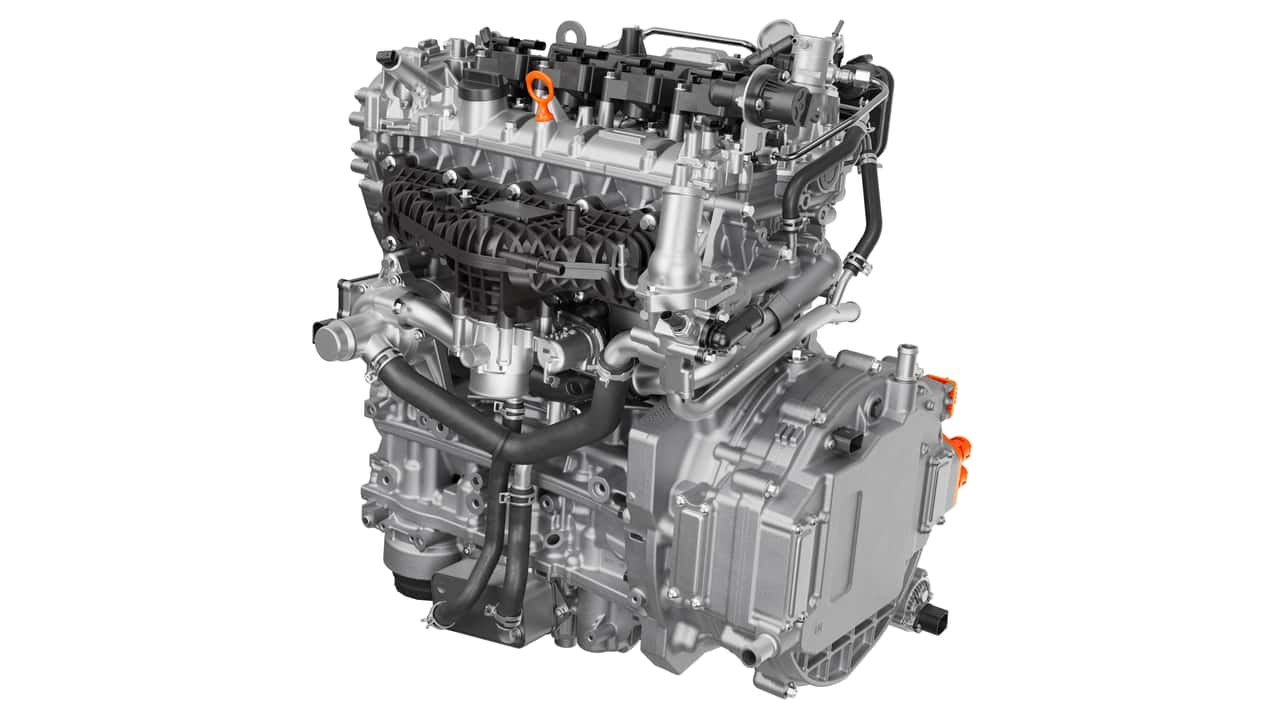

- Renault and Geely’s Horse Powertrain has unveiled a new type of range extender for electric vehicles.
- The D20 combines a 2.0-liter turbocharged four-cylinder engine with a new kind of electric motor.
- The combustion engine runs off 100% methanol fuel blends, while the generator is smaller and more powerful than conventional electric motors.
Extended-range EVs, or EREVs, promise to eliminate two of the biggest issues associated with conventional electric cars: range anxiety and charging anxiety. That’s great on paper, but they still burn gasoline to create energy.
Now, though, there’s a new type of range extender that claims to be more efficient and environmentally friendly than its predecessors.

Renault and Geely’s Horse Powertrain unveiled the new D20, which doesn’t need gasoline and uses a new type of electric motor that’s smaller and more powerful than conventional generators. The setup employs a 2.0-liter turbocharged four-cylinder engine that was designed to burn 100% methanol fuel, which produces lower carbon monoxide emissions.
An axial flux motor is mounted directly on the engine’s crankshaft, outputting up to 105 kilowatts in an enclosure that’s 46% shorter than conventional radial flux motors. Horse said that the new pancake-like generator produces 64% more power per unit of volume compared to a regular electric motor, while boasting an electrical efficiency of 96.4%, thanks to solutions like an embedded silicon carbide (SiC) power module to minimize losses.
The company claims it has embedded a range of cutting-edge technologies into the combustion engine, such as a high-energy ignition system that enables ultra-lean burns of methanol in the cylinders, which helps bring down fuel consumption. Additionally, the engine can do pure-methanol cold starts at temperatures as low as -31°F (-35°F) and is fully compliant with the Euro 7 standard, as well as China’s CN6b standard.
The powertrain tips the scales at 374 pounds (170 kilograms), including power electronics, making it a great fit for many EVs out there that may struggle to deliver impressive range figures.
According to Horse Powetrain, the D20 range extender achieves “unprecedented fuel economy,” with lab tests showing a 47% fuel-to-energy conversion ratio, with 1 kilowatt-hour of electrical energy produced for every 2.1 kWh of methanol burned. In practice, this means that a 40 kWh battery can be recharged by burning 5.1 gallons (19.6 liters) of fuel.
To put things into perspective, a dual-motor Tesla Model Y has an EPA-rated energy consumption of 27 kilowatt-hours/100 miles. So, if the Model Y were fitted with this range extender, it would need 3.49 gallons (13.23 L) of fuel to drive 100 miles, which comes out to an efficiency of 28.6 miles per gallon. That’s better than a comparable gas-powered Audi Q5, which has a combined EPA rating of 24 mpg, but is nowhere near the Model Y’s original 123 MPGe.
That said, EREVs are supposed to be used as EVs most of the time, with the combustion engine kicking in only when there’s no charging station in sight. Whether or not people will actually plug them in is another story altogether.
More Stuff Like This

RECOMMENDED FOR YOU
Chinese Regulators Recall Millions Of EVs Because Their Mechanical Door Handles Are Too Hard To Find
'Most Companies Are Struggling': Executive Shares An Uncomfortable Truth About Solid-State EV Batteries
Aptera Reveals The Secret To Building Its Solar EV: China
This New All-In-One Range Extender Is Ready To Go Into Any Electric Truck
Geely Is Testing A Solid-State Battery With Over 621 Miles Of Range. It Could End Up In A Volvo
Inside The $2 Billion Battery Factory Making Cells For Tesla And Toyota
The Lucid Air Air Sapphire Beats Genuine Mid-Engine Supercars From 0-200-0 MPH