
The 2027 BMW iX5’s Monster Battery Pack Dwarfs The Competition
The electric X5 is coming soon. Expect it to be a range king thanks to one of the biggest battery packs in the segment.
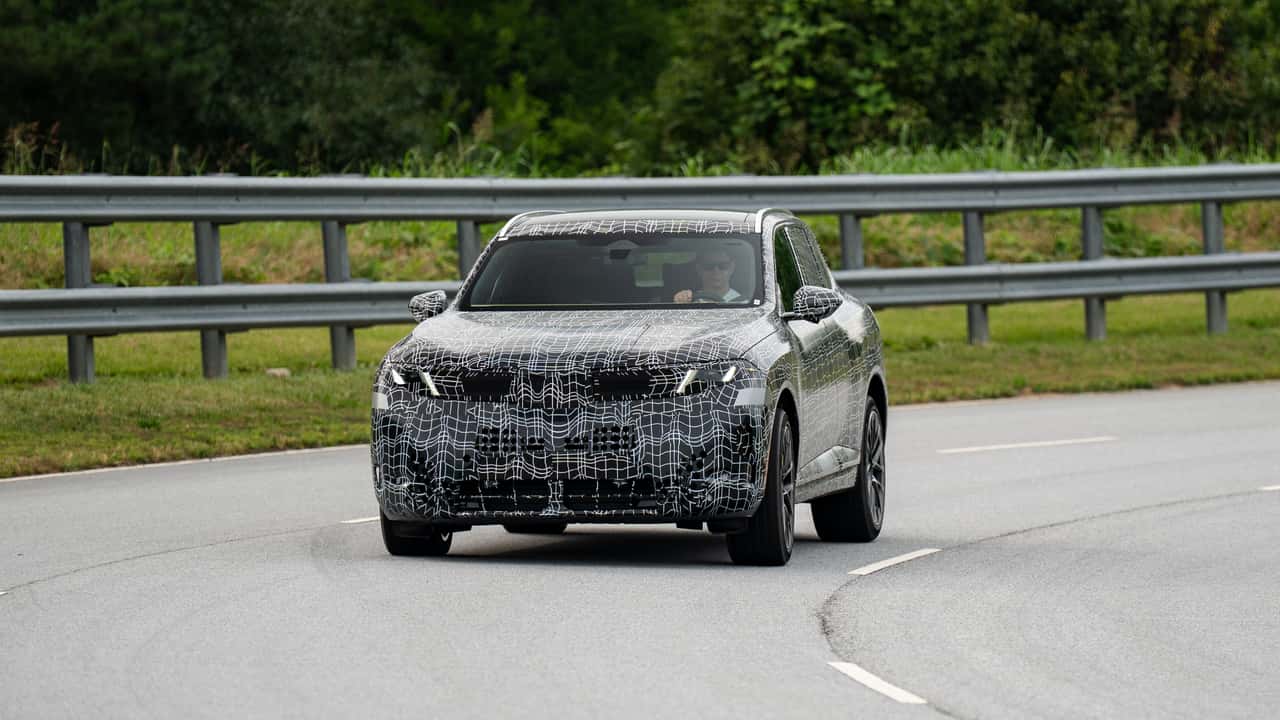

- The BMW iX5 is coming soon.
- It will pack one of the largest battery packs in its segment.
- The electric SUV will get some Neue Klasse technology like the new i7, but still ride on the aging Cluster Architecture.
BMW is going big with the new iX5 due out soon. Very big. The electric SUV will pack 144 kilowatt-hours of usable battery capacity for the U.S. market and 141 kWh for Europe, the automaker said Monday. That means the iX5 xDrive 60 will boast the largest battery ever installed in an electric BMW.
BMW hasn't officially confirmed range figures yet, but it's clearly swinging for the fences. The automaker's iX3 crossover and i3 sedan both promise well over 400 miles of EPA range from a 112 kWh (usable) battery pack. I'd expect the iX5 to join that small-but-growing club, given just how large its battery will be. That would make it one of the longest-range EVs on sale.

To put 144 kWh in context, the Porsche Cayenne Electric has about 113 kWh of gross battery capacity. While its EPA range figures aren't out yet, we expect it to deliver well over 300 miles of range. The Lucid Gravity Grand Touring packs 123 kWh gross and delivers over 400 miles of EPA range. And the Gravity is one of the most aerodynamically slippery SUVs ever built. The iX5 will out-battery both of those rivals by a significant margin.
The Rivian R1S comes closest. The optional Max battery pack offers a usable capacity of 140 kWh. All of those examples look puny in comparison to the 200-plus-kWh packs found in big General Motors trucks and SUVs, like the Chevy Silverado EV, GMC Hummer EV, and Cadillac Escalade IQ.
Going big on batteries isn't without tradeoffs, particularly for efficiency, ride, and handling. According to Autocar, the battery contributes to a curb weight of roughly 3,000 kilograms, or about 6,600 pounds, making the iX5 one of the heaviest EVs in its segment.
But BMW appears to have applied some clever technology to mask the weight. It has decoupled the suspension's springs and the dampers so that the air chamber’s internal volume is larger, giving it more room to compress the massive loads from the vehicle, per the outlet. The automaker also repositioned the adaptive dampers and anti-roll bars for a better balance between ride and handling.
Like the iX3, the iX5 uses cell-to-pack technology, eliminating the modules and structural layers that typically pile on the pounds. According to the outlet, BMW engineers shaved off “a millimeter here and a millimeter there” to keep the floor height low despite the sheer size of the pack.
It's worth noting that the iX5 pushes the boundaries of BMW's Cluster Architecture, a primarily combustion engine platform re-engineered to accommodate EVs. Unlike the iX3, which rides on the wholly new Neue Klasse platform, the iX5 sticks with the previous-gen underpinnings, but borrows key technologies from Neue Klasse, including sixth-generation cylindrical cells and an 800-volt architecture.
BMW said it's now completing final calibration drives of the X5 at its plant in Spartanburg. The SUV's launch will be worth watching for a couple of reasons. For one, the electric version could be a range monster and a worthy addition to America's EV landscape. Moreover, BMW plans to offer four additional powertrain options: mild hybrid gas and diesel versions, a plug-in hybrid, and the first-ever hydrogen fuel-cell X5.
Contact the author: suvrat.kothari@insideevs.com
Related Stories
RECOMMENDED FOR YOU
After 500 Hard Miles In A BMW iX3, Range Anxiety Feels Outdated
The Porsche Taycan’s Days May Be Numbered: Report
BMW Has Already Made 50,000 iX3s. Demand Is Nearly Double
Tesla’s ‘Flying Roadster’ May Debut This Month Alongside A Street Legal Version
Inside BMW's Plan To Produce The iX5’s Gigantic Battery Pack In The U.S.
Here's How Zoox's Robotaxi Safety Testing Will Work
China's BMW iX5 Has More Of Everything, Including A Huge TV In The Back