
After 500 Hard Miles In A BMW iX3, Range Anxiety Feels Outdated
A mix of highways, country roads, and swift mountain driving showed just how effortless long-distance travel is in BMW’s latest EV.
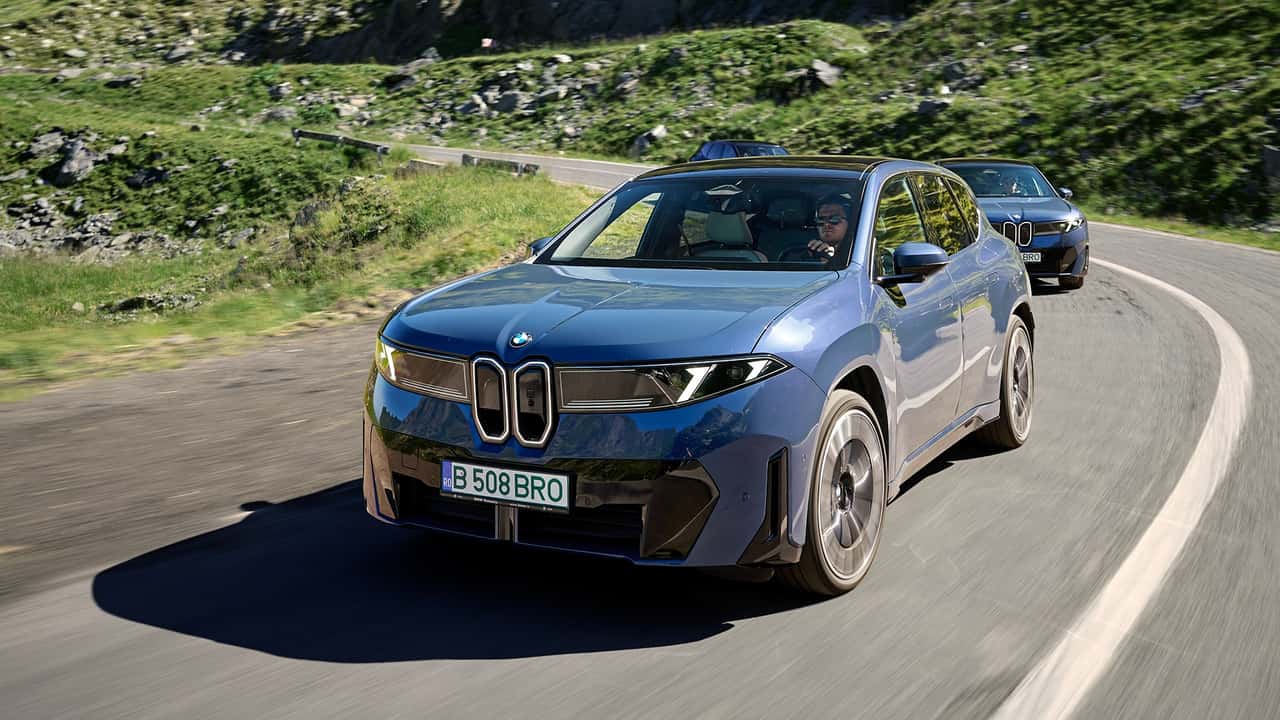

The itinerary sounded like the sort of journey that should still make an EV driver nervous: cross Romania, climb its highest mountains and drive the Transfăgărășan before returning to Bucharest. But I didn’t just want to see whether the iX3 could complete it—I knew it could. I wanted to see whether it could do so without forcing me to slow down, conserve energy, or plan the entire trip around charging stops.
BMW Romania asked me if I would like to drive an iX3 from Bucharest in the south of the country all the way to Șona, a tiny village in its center, the home of one of the country’s most famous contemporary painters and some ‘pyramids’. The trip involved driving around 220 miles on the first day and slightly more on the return leg, which also involved going over Romania’s most famous mountain road, the Transfăgărășan.

The starting point on day one.
This seemed like a fantastic opportunity to put BMW’s range and efficiency claims to the test, since it was a mixed route featuring only a limited amount of city driving and mostly open-road cruising on national roads and stretches of highway, as well as a mountain road blast on the second day of the trip.
As with any EV I test, I don’t try to adapt my driving style to eke out the most range possible. I drive the car as if it were a combustion car and not always with efficiency in mind. I therefore didn’t come close to matching BMW’s own range record with the iX3, which covered over 620 miles (1,000 km) on a single charge and still had range to spare driving from Hungary to Germany.
Driving on Romanian country roads.
We departed Bucharest early in the morning with 97% in the iX3 xDrive50’s big 108.7-kWh battery and an indicated range prediction of 353 miles (568 km). In Europe, this iX3 variant has a claimed WLTP range of 500 miles (805 km), while in the U.S., the EPA rates it at up to 434 miles (698 km).
The first leg of day one was mostly extra-urban driving at 62 mph (100 km/h), with a short highway stint at the start. By the midway point, I had covered 112 miles (180.4 km) with an average displayed efficiency of 3.31 miles/kWh (18.8 kWh/100 km).
Adding many narrower, slower country roads into the mix only improved matters. By the time I reached our overnight stop, the iX3 had covered 217.5 miles (350.1 km), averaged 3.53 miles/kWh (17.6 kWh/100 km) and still had 40% remaining. Its range estimate said it could still do another 173 miles (279 km)—enough to make me wonder whether I should refuse the overnight charge and attempt the return journey on the same battery.
A little off-roading to reach the Șona 'pyramids'.
It probably could have done it, but only if I behaved myself: lower speeds, gentle acceleration and perhaps no air conditioning. That sounded considerably less interesting than attacking an empty Transfăgărășan the following morning, so I abandoned the hypermiling experiment. The iX3 was returned to me in the morning with 98% and a newly optimistic 437-mile (703-km) prediction based on the previous day’s efficiency.
We left the pretty town of Sibiu and began making our way to the Transfăgărășan. On the slow-speed cruise up to where the twists begin, the iX3 proved exceptionally frugal, delivering an average efficiency of around 4.44 miles/kWh (14 kWh/100 km). That seems remarkable for a heavy, dual-motor SUV with a huge battery weighing over 5,000 pounds (2.3 tons), 463 hp, and the kind of acceleration that can give you whiplash.
BMW iX3 on the Transfăgrășan.
Sport mode turned my range test into something far less scientific, but still relevant. The iX3 feels like a proper BMW that hides its considerable mass well around the bends, resisting understeer and responding eagerly when you adjust its line with the accelerator. Its low-mounted battery also removes much of the top-heavy sensation that usually reminds you you’re hustling a 5,000-pound (2.3-ton) SUV.
Around the Transfăgărășan’s switchbacks, it felt planted, neutral and far more willing to play than something this large and family-oriented has any right to be. It's more pleasant to drive than its combustion equivalent, the BMW X3.

And one climb up to the summit wasn’t enough. After reaching Bâlea, I descended to Cârțișoara for lunch and then turned around and drove the entire road again, gaining approximately 5,200 feet (1,580 meters) for a second time. When I emerged onto the southern side—roughly 100 miles (160 km) into the day—the battery still showed a reassuring 57%.
At that point, the trip computer indicated an average consumption of 2.1 miles/kWh (29.6 kWh/100 km), after having briefly displayed 1.64 miles/kWh (37.8 kWh/100 km). That figure covered the drive from Sibiu, two energetic mountain ascents and the regenerative descent between them.
Brief stop at a scenic spot close to the summit.
I then continued driving the car down the other side of the mountain (by which time traffic was considerably heavier), and I was able to drive all the way back to Bucharest without charging, and I reached home with 16% remaining, with the return leg also including around 90 miles (150 km) of highway driving done at 87 mph (140 km/h).
That final number was perhaps the most convincing one of the entire trip for me. The iX3 had covered around 250 miles (400 km) on the second day, including a hard-driven ascent up the Transfăgărășan, yet arrived back home with a comfortable 16% remaining.
Gallery: BMW iX3 Romania Road Trip 2026



It didn’t require lowered speeds, switched-off climate control or any of the other compromises once associated with long-distance EV travel. Even after exploiting its plentiful performance and great chassis on one of Romania’s most demanding roads twice, there was still a meaningful energy buffer at the destination.
That is what makes the iX3 such a compelling road-trip EV. Its enormous battery certainly helps, but capacity alone isn’t the full story: the car combines strong real-world efficiency, a reliable, not overly optimistic range prediction, and effortless performance without constantly making the driver think about conserving energy.
It is quick and genuinely enjoyable when the road gets interesting, yet capable of settling back into an efficient long-distance cruise afterward. Range anxiety hasn’t disappeared everywhere, especially where charging infrastructure remains patchy, but in an EV capable of covering this kind of ground with this much range in reserve, it becomes increasingly difficult to keep finding excuses not to switch to electric.
RECOMMENDED FOR YOU
BMW Has Already Made 50,000 iX3s. Demand Is Nearly Double
Rivian Just Added The ‘Number One Most Requested Feature’ To The R1S
A BMW iX3 Charged For Just 15 Minutes. Here's How Far It Drove On The Highway
Ford Converts Louisville Plant For The $28,000 Fathom Electric Truck In Under A Year
Inside BMW's Plan To Produce The iX5’s Gigantic Battery Pack In The U.S.
Volvo Wants To Make You A Safer Driver—And Lower Your Insurance Bill
China's BMW iX5 Has More Of Everything, Including A Huge TV In The Back