
How Far Can Your EV Goes After It Says It’s Empty?
Journalists drove 15 EVs until they stopped. The Tesla Model Y went nearly 19 more miles, while another EV barely made it half a mile.

- All 15 EVs kept going after the dash showed empty. They averaged another 10 miles (16 km).
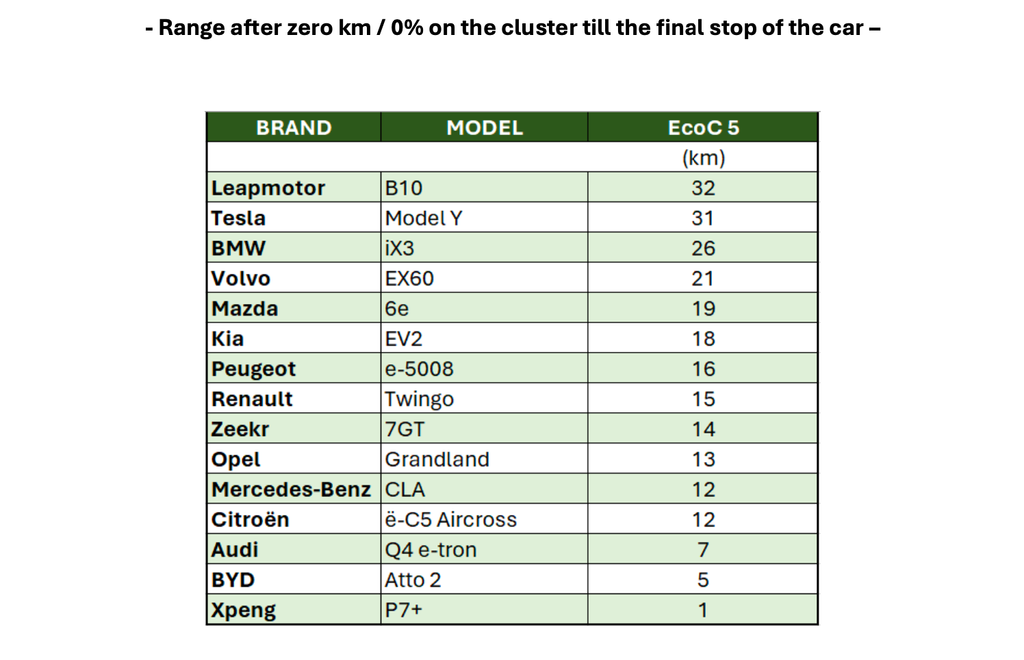
- The Leapmotor B10 went farthest at 19.9 miles (32 km), followed by the Tesla Model Y at 19.3 miles (31 km). The Xpeng P7+ stopped after just 0.6 miles (1 km).
- A car can show 0% charge while it still predicts some range; 0% and zero miles don't always coincide.
What do you do when your EV’s range prediction shows zero and the nearest charger is still a few miles away? Will you make it? In a Tesla Model Y Long Range, you’d pull in with miles to spare, while in an Xpeng P7+, you’d have been on the phone with roadside assistance, even if the Xpeng goes farther on a full charge.
That’s one of the more revealing findings from AUTOBEST’s 2026 ECOBEST Challenge. All 15 EVs that took part in the group test kept moving after their dashboards showed empty, averaging 10 miles (16 km) before they stopped. The Leapmotor B10 led with 19.9 miles (32 km), about a mile ahead of the Model Y. At the other end, the Xpeng barely managed 0.6 miles.
How They Ran The Cars Down
Car journalists drove these production-spec EVs in convoy near Milan, Italy, on a set route containing a mix of city streets, country roads and highways. A lead car set the pace, and drivers traded cars every 19 miles (30 km) to level out potential differences in driving style.
Only the driver was aboard each car; all vehicles were set to their standard (not Eco) mode, with climate control on and tires set to the recommended pressures. Temperatures ranged from 68–77°F (20–25°C).
The final stretch took place at Quattroruote’s Vairano proving ground. When a car’s dashboard showed either zero remaining range or 0% battery charge, its driver kept going until the car could no longer move under its own power. They measured the distance between those two points to see how far each EV could still go.
They used a Zeekr 7GT as a support vehicle to quickly reach drivers whose EVs had stopped. Using its vehicle-to-load (V2L) function, it drew electricity from its own battery pack to get the other vehicles moving again, eliminating the need for a dedicated EV road assistance van.
What ‘Empty’ Actually Means
When your EV says it’s empty, it means you’ve used up the range the car promised you. You may still have enough energy to drive a little farther, since all EVs have a buffer. As the state of charge goes down, the voltage in the battery cells also drops. Before it goes too low, which can damage the cells, the car cuts power to the motor.
So, even when an EV shows 0% and can’t move, some charge remains in the pack—the car won’t let it go completely flat.
Zero percent is the car’s estimate of its remaining usable charge. The range estimate approximates how far that energy will take you. Interestingly, those numbers don’t necessarily have to coincide; they can hit zero at different times. For instance, in one range test, the Tesla Model 3 still showed 2 miles (3.2 km) of range when the state of charge dropped to 0%. It went another 31 miles (50 km) after that point.
AUTOBEST published the distance each car covered after zero, but its results table doesn’t give the usable energy remaining at that moment or the speed each car maintained afterward. So we can say the Leapmotor drove 32 times as far as the Xpeng past empty, but that doesn’t mean its battery had 32 times the current reserve.
RECOMMENDED FOR YOU

The BMW iX3 Destroyed The Rivian R2 In A Highway Range Test
China’s Electric Supercar Slayer Just Did Something No Production Car Has Ever Done
2027 Volvo EX60 Blows Past EPA Rating In Real-World Range Test
Over A Quarter Of BMW, Mini, And Rolls-Royce Models Sold In Q3 Had A Plug
A BMW i3 EV Went 753 Miles On A Single Charge. Its Energy Consumption Was Astonishing
Tesla Is Killing The Cybertruck To Make Room For More Robotaxis
The Longest-Range EVs You Can Buy In 2026