Home
News
The BMW iX3 Destroyed The Rivian R2 In A Highway Range Test
The BMW went roughly 60% farther at 70 mph, thanks mostly to its huge battery.
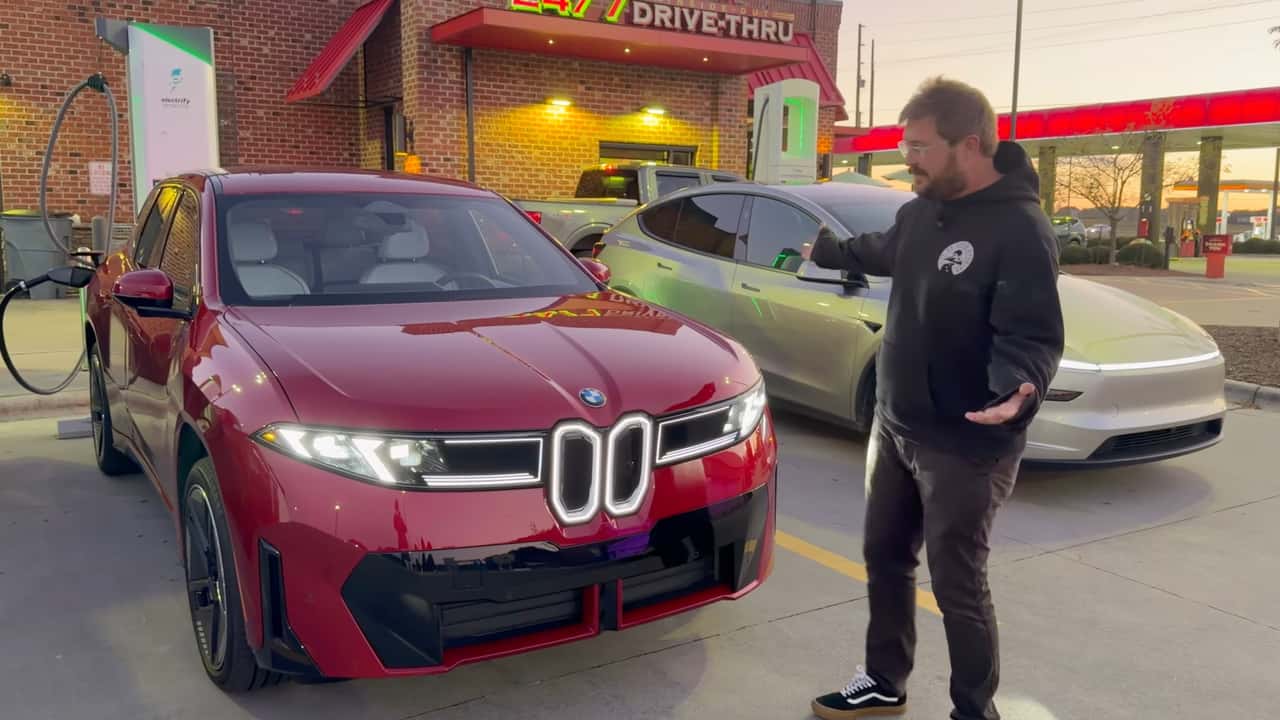
Photo by: Out of Spec Testing (YouTube)
Andrei Nedelea 
By: Andrei Nedelea
Oct 26, at 6:38am ET
Add InsideEVs as a preferred source in Google
- (https://twitter.com/intent/tweet?url=https%3A%2F%2Finsideevs.com%2Fnews%2F813217%2Fbmw-ix3-rivia-r2-highway%2F&text=The%20BMW%20iX3%20Destroyed%20The%20Rivian%20R2%20In%20A%20Highway%20Range%20Test&via=InsideEVs)
- copy
Share
Comment
- None of the four SUVs tested had the most range-friendly wheel and tire combo.
- The Tesla Model Y L was the most efficient, but BMW’s much larger battery gave it the range advantage.
- Cool weather and all-terrain tires hurt the R2, which managed 213 miles. The Lexus RZ finished last at 189 miles.
By the time the Rivian R2 finished this highway range test, the BMW iX3 still had enough driving left to make its driver reconsider volunteering. Nearly 127 miles separated them when the BMW finally called it quits.
Out of Spec Testing pitted the iX3 against the Rivian R2 Performance, Tesla Model Y L, and Lexus RZ450e. The BMW won by a significant margin, but that's largely thanks to its huge battery pack, not the best efficiency in the group.
All four started topped up to 100%, with warmed batteries, factory-recommended tire pressures, and climate control running. They followed the same highway loop along U.S. Route 64 in North Carolina at a GPS-verified 70 mph. They recorded the range number when each vehicle could no longer maintain that speed, so they didn’t drive them until they died.
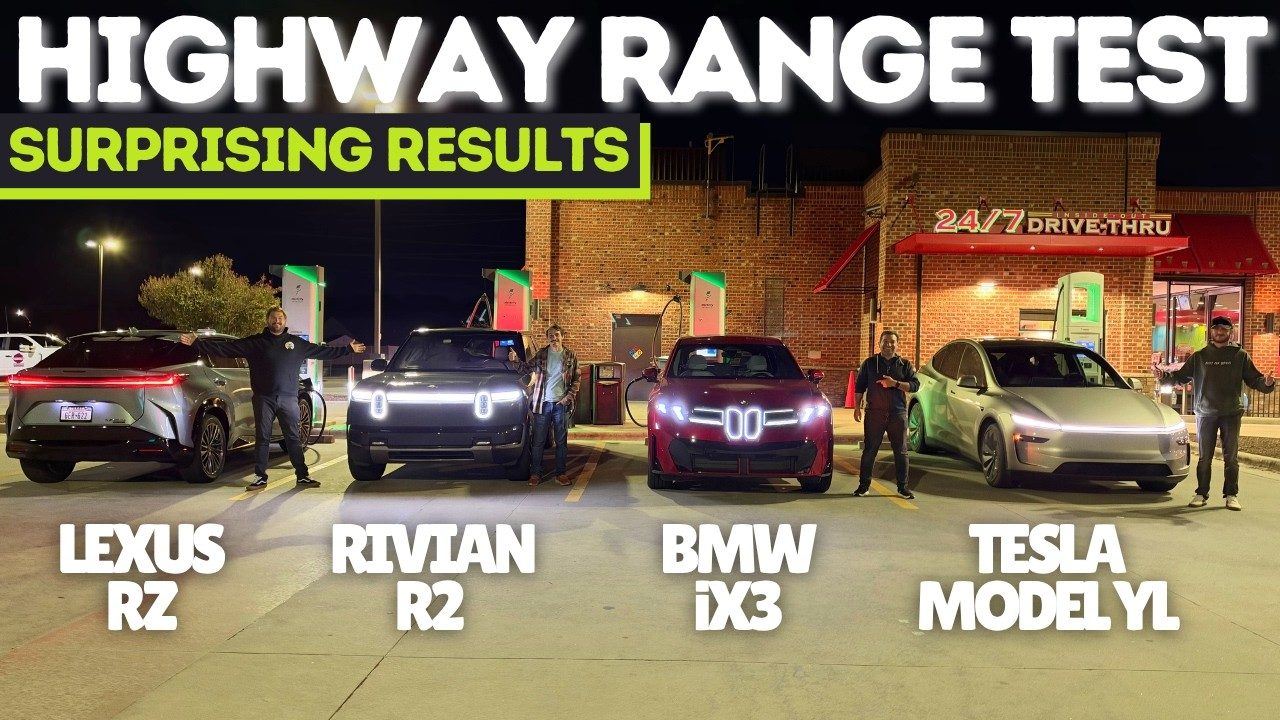
None of the vehicles wore their most range-friendly wheels. The BMW’s optional 21-inch wheels reduce its stated EPA range from 434 to 399 miles. The six-seat Model Y L had 20-inch wheels and a quoted 332-mile rating. The R2 had 20-inch wheels and aggressive all-terrain tires, with an official 307-mile rating (23 miles less than with 21-inch wheels on all-season rubber), while the Lexus had 20-inch wheels and a 257-mile rating.
The BMW had by far the largest battery. The testers quoted approximately 112 kilowatt-hours usable for the U.S.-spec iX3 (more than the European version rated at 108.7 kWh), versus roughly 88 kWh for Rivian and an estimated 84–85 kWh for Tesla. Lexus’s quoted 77-kWh capacity wasn’t directly comparable. It used just under 70 kWh before it could no longer maintain highway pace.
All four entrants cost $60,000-plus, with the well-optioned BMW being the most expensive at approximately $70,000.

Stay informed with our newsletter every weekday
back
Subscribe For more info, read our Privacy Policy & Terms of Use.
Predictably, the EV with the smallest battery bowed out first. The RZ450e dropped to 50% charge after just 100 miles, hit 0% at 187 miles, and could no longer maintain 70 mph at 189 miles. Its observed average consumption of 2.8 miles/kWh beat the Rivian’s, but its smaller energy reserve limited its range.
The R2 reached halfway at 109 miles and 10% at 195 miles. It eventually managed approximately 213 miles, using 86.8 kWh at roughly 2.45 miles/kWh. Cooler conditions and all-terrain tires hurt compared with a previous range test, where it managed about 253 corrected miles in warmer weather on road tires.
The Model Y L was impressively frugal. Despite its smaller battery and extra seating capacity, the Model Y L traveled 286 miles, using 81.1 kWh. Its displayed efficiency hovered around 3.5–3.6 miles/kWh, comfortably ahead of everyone else.
More Highway Range Tests
 The 2027 Chevy Bolt Can Drive Farther Than You Think At 60 MPH
The Jeep Recon EV Went Just 160 Miles In A Highway Range Test
Same Battery Size, Different Range: VW ID. Polo Takes On Renault 5
After 500 Hard Miles In A BMW iX3, Range Anxiety Feels Outdated
The BMW, meanwhile, still showed 42% remaining after 192 miles. It reached zero at approximately 333 miles, then continued until 339.7 miles before losing highway speed. It used 112.7 kWh at about 3 miles/kWh, finishing roughly 60% ahead of Rivian and 19% ahead of Tesla’s indicated result.
It was also the quickest to replenish range thanks to its 800-volt platform (the only one in the test). The depleted BMW immediately accepted 122 kW from the mobile charger, effectively everything the equipment could supply. The Tesla initially charged much more slowly after depletion. This wasn’t a true charging comparison, but BMW’s advantage went beyond how long it kept driving.
What do you think?
View
Comments
Other rivals could narrow the gap. In a separate iX3 range comparison against the Mercedes GLC Electric and Volvo EX60, consumption-based range calculations put BMW at 338 miles, Mercedes at 279, and the EX60 P10 at 260. The larger-battery EX60 P12 could theoretically have managed around 320 miles at the tested Volvo’s efficiency.
The BMW’s win here was decisive. The Model Y showed how far careful energy use can take you and reminded us how efficient Tesla’s EVs still are even compared to newer rivals with better hardware on paper. But the iX3 still had respectable efficiency, and its much bigger battery ensured a comfortable win.
We want your opinion!
What would you like to see on Insideevs.com?
Take our 3 minute survey.
- The InsideEVs team
Share this Story
- (https://twitter.com/intent/tweet?url=https%3A%2F%2Finsideevs.com%2Fnews%2F813217%2Fbmw-ix3-rivia-r2-highway%2F&text=The%20BMW%20iX3%20Destroyed%20The%20Rivian%20R2%20In%20A%20Highway%20Range%20Test&via=InsideEVs)
- copy
GO TO COMMENTS
(
)
Got a tip for us? Email: tips@insideevs.com
View all comments ( )
Trending
Diesel Prices Are Surging. This Electric Trucking Company Is Seeing More Interest
Tesla Opens Self-Driving Cybercab Orders To 'Select Customers' At $29,990
Solid-State Cells Can Make The U.S. Competitive In Batteries Again: CEO
I Took A Rivian R2 On A Camping Trip To The Middle Of The Desert
Latest Stories
- Diesel Prices Are Surging. This Electric Trucking Company Is Seeing More Interest Nov 14 - News -
- Tesla Opens Self-Driving Cybercab Orders To 'Select Customers' At $29,990 Nov 13 - News -
- Do EVs Wear Tires Faster? Here's What The Studies Show Nov 13 - Features -
- The VW ID. Buzz Is Getting A New Job As A Robotaxi Nov 13 - News -
- Audi A4 EV Delayed Amid VW Group Financial Troubles: Report Nov 13 - News -
- Tesla Just Killed Its Cheapest All-Wheel-Drive Model Y Nov 13 - News -
- A Record Number Of Uber Miles Are Happening In EVs Nov 13 - News -
RECOMMENDED FOR YOU
Tesla Just Killed Its Cheapest All-Wheel-Drive Model Y
Tesla Opens Self-Driving Cybercab Orders To 'Select Customers' At $29,990
America's Top 3 SUVs Are About To Be Hybrid Or Electric
Do EVs Wear Tires Faster? Here's What The Studies Show
The Tesla Model Y's Structural Battery Was Nearly Impossible To Repair. The Cybercab Fixes That
The VW ID. Buzz Is Getting A New Job As A Robotaxi
Diesel Prices Are Surging. This Electric Trucking Company Is Seeing More Interest