
'The Car Stopped Itself': Tesla Collision Avoidance Assist Lives Up To Its Name
A near-miss at an intersection was not a feat of Full Self-Driving or beta software wizardry.
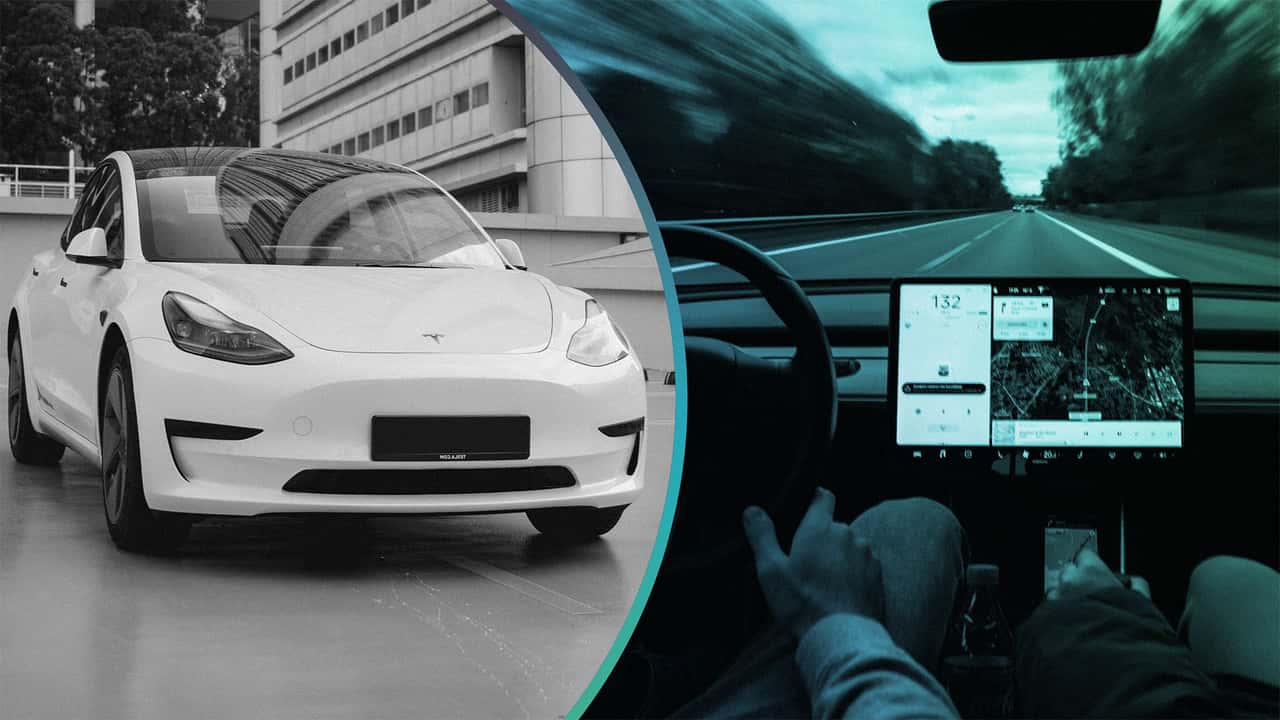


Just as she was easing into a left turn at one of the busiest intersections in her city, the driver of a 2023 Tesla Model Y felt her car jolt to a stop, unprompted. A moment later, another vehicle flew through the red light.
“The car stopped itself,” creator Brenda (@brendaharjala) later recalled in the caption from her viral TikTok, crediting her Tesla’s reflexes for avoiding a serious crash. But what exactly took control?
According to the caption and supporting comments from the driver, the incident involved a 2023 Tesla Model Y Long Range (7-seat) running Hardware 4, with no Full Self-Driving (FSD) package or Autopilot engaged. However, she confirmed that Collision Avoidance Assist was enabled. That’s a standard safety feature that comes with all new Tesla vehicles, regardless of optional autonomy packages.
When she began making a wide-angle left turn, her Tesla appeared to detect a rapidly approaching vehicle that had blown through a red light at a perpendicular angle. The Model Y then engaged emergency braking before the driver could react, which surprised her and saved her from potential injury.
Now Trending
Importantly, the intervention didn’t require any special software subscriptions. According to Tesla’s official support documentation, Automatic Emergency Braking (AEB) is a default safety system that is “automatically enabled when you start your vehicle” and is designed to “reduce the severity of an impact” or “help avoid the impact entirely.”
How Tesla’s Default Safety Tech Works
This near-miss was not a feat of Full Self-Driving or beta software wizardry. Instead, it was the result of Tesla’s built-in suite of active safety features, many of which operate independently of user input. AEB works in tandem with Forward Collision Warning, which uses a combination of cameras, radar, and neural-network-based prediction models to identify potential hazards.
FROM THE TRENDING NEWS DESK
Viral bits from across the social media landscape
Our team of experts tracks what's trending so you don't have to—from viral videos to online debates that have everyone talking.
Tesla’s vision-based system, known as Tesla Vision, has gradually replaced radar in most vehicles delivered since mid-2021. While early versions of Hardware 4 were rumored to reintroduce radar sensors, Tesla has remained focused on vision-based processing for both Autopilot and safety features. In the incident shown on TikTok, the vehicle likely relied entirely on its forward-facing cameras and computer vision algorithms to detect an imminent side-impact threat and respond with braking force.
While AEB is more commonly associated with avoiding rear-end collisions, Tesla notes in its Owner’s Manual that the system may also trigger for cross-traffic events, particularly when another vehicle suddenly enters the car’s path.
It’s easy to presume a save like the one shown in the video would require Autopilot or even the $12,000 FSD beta package. But Tesla equips all new vehicles with a core set of safety systems that do not require any subscription. These include:
- Automatic Emergency Braking
- Lane Departure Avoidance
- Obstacle-Aware Acceleration
- Blind Spot Monitoring (as of 2022)
- Collision Avoidance Assist
These features, especially AEB and Collision Avoidance Assist, are active in the background unless manually turned off in the vehicle’s settings. This makes them more like airbags or anti-lock brakes—essential safeguards—than anything resembling full autonomy.
In fact, FSD Beta software is not designed to handle emergencies like the one seen in the TikTok clip. According to recent NHTSA investigations and Tesla recall filings, Tesla's more advanced driving packages have been scrutinized for their limitations in complex or unexpected conditions.
FSD, Autopilot, Or Always-On Safety: What’s The Difference?
One of the most persistent points of confusion among Tesla owners and the general public is how Tesla’s autonomy stack is organized. Despite similar branding, FSD, Autopilot, and the company’s standard safety features operate independently and serve very different purposes.
Autopilot is Tesla’s standard driver-assist system, included on all new vehicles. It provides lane centering and adaptive cruise control, but only when actively engaged by the driver. FSD, available as a costly upgrade or subscription, adds features like automatic lane changes, Navigate on Autopilot, and traffic light/stop sign control. However, even FSD requires driver supervision, and Tesla explicitly states it does not make the car autonomous.
The distinction is key. In the TikTok incident, neither FSD nor Autopilot was activated, and yet the car intervened. That’s because features like AEB and Collision Avoidance Assist are part of Tesla’s default safety suite, which acts more like an invisible safety net.
While most drivers associate AEB with rear-end prevention, Tesla’s visual recognition system is capable of interpreting complex scenarios like vehicles entering from the side.
Tesla Vision uses a camera-only approach, without radar or LiDAR, to build a real-time understanding of the surrounding environment. Critics initially questioned its ability to detect cross-traffic or threats that enter from outside the forward field of view. But over time, Tesla has expanded its neural net training to include these edge cases.
In a 2022 software update, Tesla began expanding AEB functionality to work in reverse, showing the system’s evolving ability to handle more dynamic threats. Similarly, the 2023 Tesla safety report highlights the company’s focus on “real-world driving data” to improve the accuracy of threat detection during lateral and angled approaches similar to the one seen in the TikTok video.
Still, Tesla Vision has limitations. In low-light conditions, inclement weather, or high-speed cross-traffic scenarios, visual input may be insufficient. This is one reason why some competitors, including Mercedes-Benz and Lucid, continue to incorporate radar or LiDAR into their perception stacks.
InsideEVs reached out to Brenda via direct message.

RECOMMENDED FOR YOU

Tesla Waves Goodbye To Model S And Model X As The Last Cars Roll Off The Line
Lexus Just Solved One Of Its Biggest EV Headaches
The Longest-Range EVs You Can Buy In 2026
How Much Range Does A BYD Seal Battery Lose After 31,000 Miles?
Tesla Semi Official Battery Specs Are Out, And They’re Impressive
VW’s Hottest Electric GTI Will Have Fake Gears
Tesla Wants To Vacuum The Hot Air Out Of Cars To Improve Range