
Tesla Wants To Vacuum The Hot Air Out Of Cars To Improve Range
Tesla's new patent proposes sucking hot air out of the cabin to improve cooling efficiency and range on hot summer days.
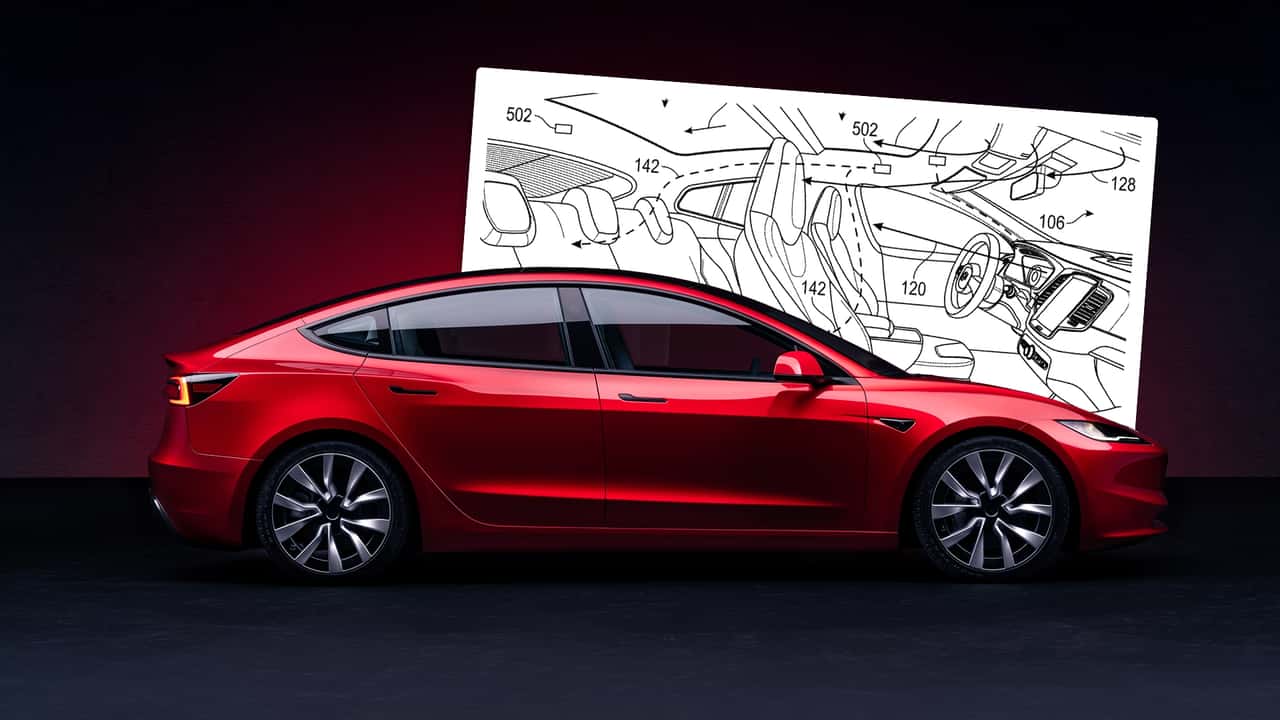

- Tesla patented a new way of cooling down your EV's cabin in the summer heat.
- Its new method involves using vacuums to suck up hot air and put it directly into the car's HVAC system.
- This would make cooling hot spots inside of cars much easier, potentially unlocking more range.
Car interiors get hot, and conditioning them (whether it be preconditioning before you get in, or just keeping it at the right temperature while scooting down the road) saps up a significant amount of juice that could have been translated into mileage instead.
That's what makes one of Tesla's latest patents so interesting. Its invention proposes a new way of cooling down a car's interior by targeting "hot air pockets" in the cabin. Here's how it's done.

According to the patent, Tesla's method involves installing a suction unit into the car's HVAC system. This creates negative pressure (aka: vacuum) that can be applied to specific vents in the car near these pockets of hot air. The hot air is then sucked into the car's HVAC system and conditioned with the rest of the cabin air before being recirculated back into the car.
A good example of this would be solar radiation. The sun beating down on the car's glass roof is an easy way to heat up the cabin—I'm sure you've felt this before when getting into a car on a hot day, or even when feeling the sun hitting your arm or leg for an extended time while driving down the road. The larger the vehicle and its interior space (Think Model X compared to a Model 3), the more surface area and ambient cabin space that requires conditioning.
But Tesla's idea is that this thermal conditioning can be a done a bit more efficiently. The goal, according to the patent, is to "maximize thermal comfort and minimize energy consumption"—basically, pull air from spaces that need to be cooled and more evenly distribute the temperature in the cabin.
Based on the data in the patent, Tesla shows that the tech could lower the power draw by as much as 7.4%. That might not seem like a lot, however, that's a savings of around 127 watts when it's 104 degrees outside. That cuts the peak power consumed by the HVAC down from 1,720 watts to just 1,593.
Tesla's patent goes further by noting that the suction can be conditionally activated by sensing the temperature in the cabin and activating the suction only in areas that need to be conditioned.

The idea is admittedly pretty innovative. Of course, this is just a patent, so it may never actually make it into an actual production car. But this is a clever way of improving range without boosting battery capacity, playing with aerodynamics, or doing anything special to the powertrain.
On a 100-degree day, for example, air conditioner use contributes to a range loss of up to 18%, a study from Recurrent found. If Tesla's method is able to squeeze a bit more range out of its cars while also improving passenger comfort, that's a win-win.
RECOMMENDED FOR YOU
Tesla’s Mainstream Model Y Gets A Feature Hyundai EVs Have Had For Years
Who Needs Leather? Bentley's First EV Will Offer Merino Wool Seats
This Tesla Model Y Lost 9% Of Its Range In One Year. Its Owner Isn’t Worried
Is Telo Trucks The Real Deal? I Interviewed The Founders To Find Out
Tesla’s ‘Flying Roadster’ May Debut This Month Alongside A Street Legal Version
The Results Are In: Scrapping Your Gas Car For An EV Is Better For The Climate
Used Tesla Model S Prices Have Fallen Dramatically. But Their Batteries Are Holding Up Great