
Owning An EV Is Way Better: My 2-Year Chevy Blazer EV Owner Review
The Blazer EV isn't the most efficient or advanced EV, but it's been perfect for my lifestyle. I don't want to give it back.
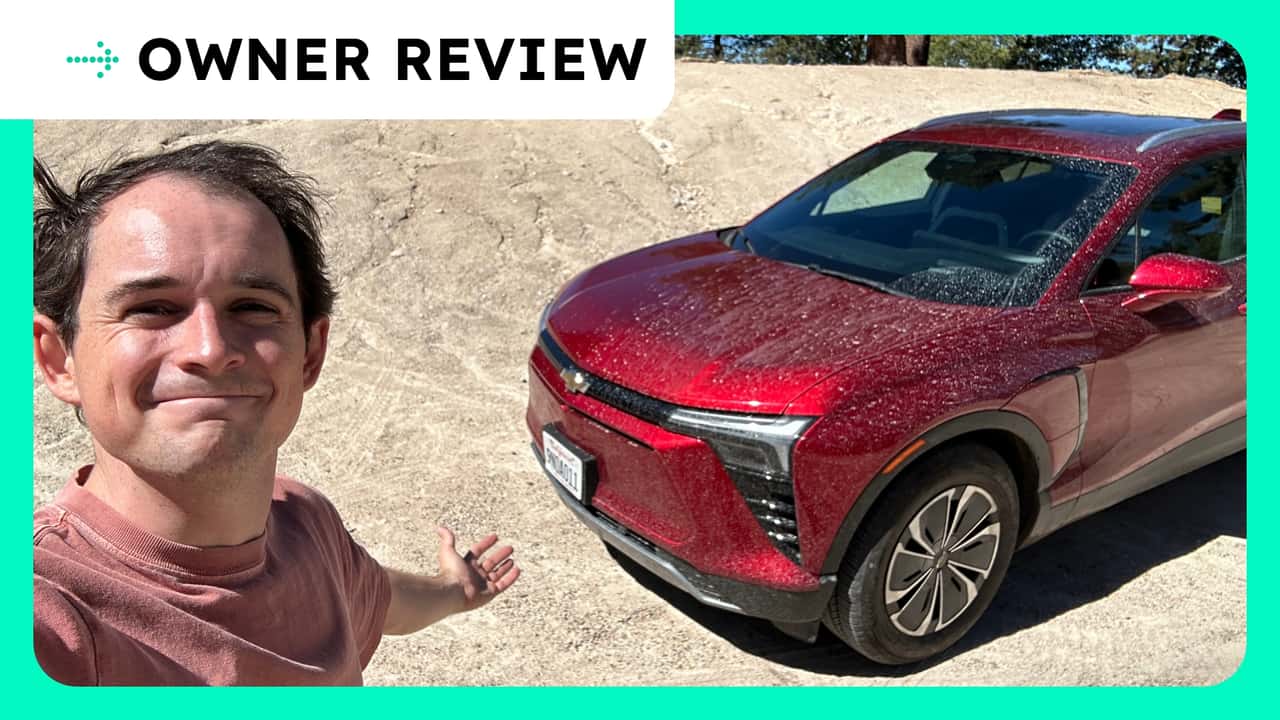

I didn’t expect to feel this sad. My 2024 Chevy Blazer EV lease was supposed to be a two-year stopgap, a good-enough electric solution while I waited for my true love to arrive (and depreciate). But here I am, at the end of that lease, and I don’t want to hand the keys back.
Here’s why.
A Compromise Solution
I didn’t end up with a Blazer EV because I wanted a Blazer EV. When it came out, I was frankly shocked to see it win MotorTrend’s SUV Of Year award, because it scanned to me as a relatively middle of the road electric crossover. An LT AWD model weighs an absurd 5,337 pounds, charges from 10-80% slower than a Ford Mustang Mach-E, Volkswagen ID.4, or Tesla Model Y, and is less efficient than those cars. So before June 2024, it just wasn’t on my radar.
Gallery: 2024 Chevy Blazer EV Long-Term Owner Review


At the time, I was looking for an EV that could truly replace my beat-up old Chevy Tahoe, which I used for camping excursions throughout California. I didn’t need Jeep-like capability, just the electric equivalent to a Subaru Outback. So when my friend Alex from Auto Buyers Guide posted a video about finding a Blazer EV LT2 AWD two-year lease for under $6,000 altogether, I looked up a few key specs. (Watch his two-year wrap-up here.)
With 7.9 inches of ground clearance, the Blazer EV had better approach (19º) and departure (23º) angles than a standard 2024 Outback. It sat only 0.5 inches lower than my Tahoe. Despite it having far less articulation and tires optimized for range over all-terrain performance, I figured I could make it work.
I didn't qualify for all of the incentives that Alex took advantage of, but after a few phone calls to dealers, I was able to find a Blazer EV LT2 AWD for about $8,500 all in, structured as $2,000 due-at-signing payment with $273 a month. They were willing to go as low as $8,000 for a true base model, but I wanted the panoramic roof and Radiant Red Tintcoat paint. I don't regret splurging there: I love driving with all of my windows down and the sunroof open, and after owning 14-ish cars, I know that I always remember the brightly colored rides most.
It may be a surprising choice for any adventuring, but the Blazer EV has better and approach and departure angles than a Subaru Outback. That means it can climb and descend steeper obstacles without scraping its nose or booty.
Those were the only options I needed, though, as every 2024 Blazer EV came standard with faux-leather seats, heated seats, a heated steering wheel, adaptive cruise control, a 360-degree camera, a 17.7-inch main display, a full digital gauge cluster, and automatic climate control. It was a knockout deal for a car that checked every box.
I didn’t think I’d love it. But I thought it’d be good enough. I was wrong.
Why I Ended Up Loving It
My Blazer EV—nicknamed Gordo for its fat butt, which eventually morphed into “Gorbo” because it’s more fun to say—grew on me like an arranged marriage. Its 40-ish-minute 10-80% charge time wasn’t impressive. But like most first-time EV owners, I learned quickly that I rarely do the sort of road trips that require frequent fast charging. Most of my necessary stops were on the 265-ish mile round trip to Northern Los Angeles County and back, a six-hour sojourn during which I tend to stop for a snack and to decompress from LA traffic anyway.
A 1,500-mile trip to Utah and back had some snags, but ultimately I returned more confident than ever that I could go wherever I wanted in this thing. And I did. I took it down dirt trails near Lake Arrowhead, California, across the desert landscapes of Anza-Borrego State Park, and to dispersed camping sites in Cleveland National Forest. I certainly scraped my battery tray once or twice, but never felt too limited by the Blazer. Its heavily front-biased AWD system certainly isn’t the best at climbing steep grades, but it’s more than capable enough to meet your Subaru-owning friends at a local trailhead.
The Blazer EV isn't the best at climbing steep grades, but it's plenty capable for light off-roading.
Each one of those adventures made me more fond of the Blazer. But what really stole my heart was the process of living every day with a modern EV. I loved its seamless Google Maps integration and built-in Spotify app. I loved one-pedal driving around town. I loved zipping up the hills in my neighborhood on a silent wave of pure torque, and never missing a merge.
I loved all of the little quality-of-life choices Chevy made with it. I loved never having to turn it on or off when I got in or out. But I loved having a “leave on for 60 minutes” software button so I could leave my dog, Flip, air conditioned inside as I ran into a store, and a "force off" software button so I could kill the car without getting out. I loved that I got the airy, bright feeling of a glass-roofed EV, but with a physical sunshade so I didn't get roasted. From the sunshade and the physical controls for primary functions to the manual vent controls and physical door handles, the Blazer EV gave me a great EV experiences without forcing quite as many usability trade-offs as you get in a Tesla, Rivian, or even Ford or VW EV.
Mostly, though, I just loved driving an EV every day. I still do.
More Blazer EV Updates
I got more and more used to the quiet, more and more used to the responsiveness, more and more used to joy of sitting parked and enjoying A/C and music without having to run a noisy engine. The more I drove it, the more repulsed I felt behind the wheel of any gas car. Driving my soon to be mother-in-law's Audi Q5 suddenly felt like sitting in a post-war steel mill, with all the clanking and shaking.
I loved watching it get better. When I took delivery, the car had a few software bugs. A few months later, they were gone, and haven’t returned. In the time since, my car has gotten faster at charging, gotten access to new apps, and even gotten Google’s Gemini AI assistant added over the air. So now when we need to find restaurants along our route that can accommodate dietary restrictions, I don’t have to pull over.
I loved spending time in my Blazer EV. From its comfortable seats to its polished, capable software suite, it felt like a thoroughly modern EV.
I loved never having any mechanical issue, or anything to worry about. The powertrain of my Blazer has been faultless, and I haven’t needed an oil change or anything of the sort. There won’t be spark plugs to change in a few years, or transmission fluid to flush. It just works.
Most of the time, at least. There were still a few pain points in my experience, most of which I've covered before. My headliner developed a rattle that I tried to fix twice before giving up. Now, it’s mostly better, though it occasionally comes back. I had a warning light in the first week, too, likely due to a low 12-volt battery after sitting on the dealer lot for so long.
None of those really stuck with me. There was only one thing that still bothered me as I prepared to return the Blazer.
A Frustrating Software Strategy.
I loved watching my car get better over time. But it also drove me nuts, because it was so unpredictable and poorly communicated. I’d see people in the Blazer EV subreddit or Facebook page post that they got a new update allowing them to stream YouTube videos and HBO while charging. I’d expect it to come imminently to my car. Then I’d wait. And wait. And wait.
I’m still waiting.
My Blazer recently got access to Google Gemini, which I've found more useful than I expected. But I still haven't been told when I'll get video streaming capability or the Apple Music app, which is frustrating.
When the car goes back to the dealership, it still won’t have this capability. That’s hard to accept when I saw 2024 Blazer EV owners get it in fall of 2025, and some even before that. It launched on the Blazer EV in spring 2025. I’ve received no communication from General Motors on when to expect it through normal customer channels.
The same is true for Apple Music support, which is frankly far more important to me. I’m an Apple Music user, and if that app was on my 2024 Blazer EV, I’d be 100% fine with not having access to Apple CarPlay or Android Auto. But because I’m stuck in purgatory waiting for an ETA, I have to rely on either bluetooth audio or my secondary YouTube Music subscription, all while 2025 and 2026 Blazer EV owners drive by blasting their favorite Apple Music playlists.
Most owners likely aren’t reading forums or aware of features they don’t have access to, so this isn’t a terrible experience. But it feels like a fundamental weakness in the era of software-defined vehicles. When Tesla launches a new software feature, it comes to the Model S, Model Y, Cybertruck, and Model 3 pretty much all at once. There’s not a bunch of corporate bellyaching about slightly different hardware slowing them down; they just deliver.
General Motors isn’t quite there yet. Despite “Ultium” originally being branded as delivering a unified software experience, the customer experience hasn’t proved that out. Every GM EV I drive tends to have slightly different software features, with newer models often having the best stuff. That’s not the promise of a software-defined EV; the idea is that your car gets all of the software features it can reasonably support.
It doesn’t help that multiple dealers I’ve been to seem to have no awareness of GM’s software approach, how to get updates, or even how to service EVs on a reasonable timeline. At multiple times I’ve been told to bring my car into Kearney Mesa Chevrolet at a specific time, often days or weeks out, to make sure an EV-certified tech is available. Then I’ve arrived, and they’ve told me they can’t squeeze me in for days still. Other dealers are similarly understaffed when it comes to EV techs, and it’s made the process of getting even extraordinarily routine services—like a tire rotation and a firmware update—unnecessarily arduous.
I have found that the Chevy dealers in Southern California all have long waits for EV service, with only a few EV-certified work bays each. I hope Chevy fixes that as its EV sales grow.
So GM is making great EVs. But the supporting infrastructure—including software support, clear communication about feature timelines, and dealer prep for EVs—is still lagging behind dedicated EV brands.
Owning An EV Is Just Better
I don’t think the Chevy Blazer EV is the best EV on sale. But that’s the beauty of EVs: Even a middle-pack option is just incredible to own. It’s smoother, quieter, quicker and less maintenance-intensive than any comparable gas car, with better software and zero tailpipe emissions. It’s on when you want it to be, off when it should be, and fueled for pennies in your driveway.
It’s just better than any gas car. Despite my service snags, despite my terrible extension-cord-based level 1 charging setup, despite the knowledge that all of these problems will be wholly solved in the future, the EV experience today is already lightyears ahead of any gas-car experience I’ve had.
So when I drop off the Blazer, and get back in my fiancé’s Ford Escape, I know I’ll be sad. But not for long. My future is electric, and I bet yours is, too.
Contact the author: Mack.Hogan@insideevs.com
Click here to see all articles with lists of the best EVsRECOMMENDED FOR YOU
2027 Chevy Bolt Review: Do Americans Really Want Cheap EVs?
'Most Companies Are Struggling': Executive Shares An Uncomfortable Truth About Solid-State EV Batteries
2027 Kia Telluride Hybrid Review: Outclassed By The EV9?
This New All-In-One Range Extender Is Ready To Go Into Any Electric Truck
I Drove An Original Tesla Model S To See If It's Still Worth Buying In 2026
Chinese Regulators Recall Millions Of EVs Because Their Mechanical Door Handles Are Too Hard To Find
I Think The Hyundai Ioniq 9 Is The Best Three-Row EV Value. But That Might Not Be Enough