Home
Reviews
Car Reviews
I Tried The Future Of EV Camping In The Pebble Flow
The Pebble Flow is an all-electric RV made by former Apple and Tesla engineers. It has solar and can be driven like a giant RC car.
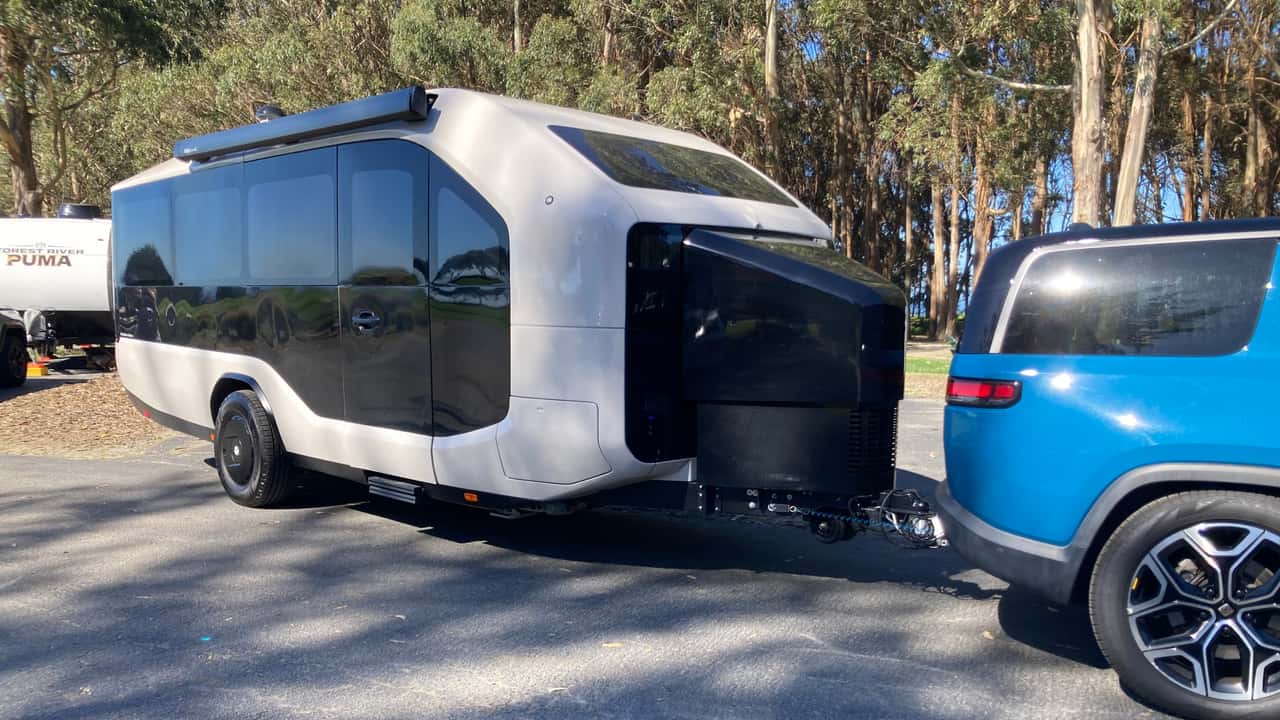
Photo by: Tim Levin/InsideEVs
Tim Levin 
By: Tim Levin
May 26, at 4:19am ET
Add InsideEVs as a preferred source in Google
- (https://twitter.com/intent/tweet?url=https%3A%2F%2Finsideevs.com%2Freviews%2F796924%2Fpebble-flow-electric-rv-review%2F&text=I%20Tried%20The%20Future%20Of%20EV%20Camping%20In%20The%20Pebble%20Flow&via=InsideEVs)
- copy
Share
Comment
Within a few minutes of arriving at our campground for the weekend, I got the feeling my wife and I were about to be very popular. I’ve driven all sorts of weird and wonderful cars over the years. None got as much attention or sparked as many conversations as the RV I was towing, the Pebble Flow.
“Does that thing really park itself?” one guy yelled from his G-Wagen as we pulled up to the check-in kiosk. Yes, yes it does, I assured him.
In truth, I hadn’t tried that feature yet, but I’d soon experience all of this futuristic camper’s best party tricks. Over the course of the weekend, I’d also learn what happens when Apple and Tesla veterans join forces to design a new kind of RV. And I’d learn that RV-ing—especially in all-electric fashion—is a surprisingly awesome way to vacation.
[Full Disclosure: Pebble loaned me its camper and a Rivian R1S to tow it for a weekend. The company also booked a campsite at a fancy campground near Pescadero, California.]
Pebble Flow: What is it?
Pebble came out of stealth in 2023, touting a mission to bring more tech and convenience to the camping world by creating a “hassle-free RV.” The result of that is the Flow, which looks like a spaceship, can help propel itself on the highway via in-wheel motors, and is fully controlled by an iPad.
Gallery: Pebble Flow camper

25

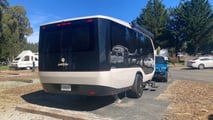
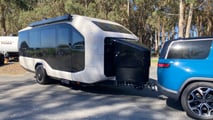
Source: Tim Levin/InsideEVs
The California-based startup began shipping the Founder’s Edition Flow last summer, with a $179,000 price tag. That fully-loaded version, featuring extras like auto-tinting windows, integrated solar, a motorized awning, and upgraded levelers is the one I sampled for two nights on the Northern California coast.
The Magic Pack trim recently started shipping for a starting price of $139,500. Most of the add-ons in the Founder’s Edition can be optioned on that one for a lower total price, except for lifetime roadside assistance and an exclusive color. A base model that costs $113,500 is planned for late 2026 or early 2027.
Pebble Flow
Photo by: Tim Levin/InsideEVs
I had zero experience RV-ing before taking the Flow for a spin, and I found everything pretty straightforward. So the early verdict is that Pebble nailed its founding assignment.
Towing the Pebble Flow
I hadn’t ever towed before, so the idea of pulling a 25-foot trailer that weighs several thousand pounds was daunting, to say the least. But it ended up fine. I could chalk that up to my skills as a seasoned vehicle reviewer, but I think it has more to do with other drivers. When they see your bulky ass coming up the highway onramp, they tend to clear out of the way. I do the same thing whenever I see someone driving a U-Haul. You just know those people are clueless.
The rear-view mirror of the Rivian R1S I was using was rendered useless. The Flow does have cameras all around it, but they were still a software update away from working at the time of my test in March. A live feed of what’s going on behind the trailer would be nice. But the Flow helps out during towing in other ways.
Pebble Flow
Photo by: Tim Levin/InsideEVs
For starters, using the included iPad and app, you raise up a wedge-shaped fairing in the front before setting off. Pebble says that it helps the camper cut through the air more effectively. And by making it raise and lower, the designers could add more windows at the front of the vehicle.
There are a few different towing modes to choose from. Easy Tow switches on the camper’s drivetrain, so it helps push itself along with the goal of upping EV-towing efficiency. There’s also a coast option and a high-regen mode aimed at replenishing the Pebble’s 45-kilowatt-hour lithium iron phosphate battery pack. That can supplement charging the Pebble up the old-fashioned way. (Or replace charging entirely, I suppose, provided you’re on a long enough drive.) That battery pack not only supplies power to the drivetrain, it also runs all of the camper’s comforts, from the lights to the induction cooktop.
More EV Stories
I Saw Ferrari’s First EV In The Flesh. Here’s My Honest Take.
Forget Range Anxiety. EV Drivers Are Apparently Facing 'Hot Dog Anxiety’
Setting Up The Pebble Flow
One of the best parts of the Flow is how quick it is to set up. We went from pulling up to camping in a matter of minutes. There were people at the campsite deftly backing their enormous fifth-wheel campers into just the right spot. But I don’t have those skills. Luckily for me, the Flow doesn’t require them.
Upon arrival, I hopped out of the R1S and whipped out the included iPad Mini. After unplugging the electronic connectors for the turn signals and brake lights, I instructed the Pebble to deploy its front wheel, which pushes the whole trailer up off of the ground and releases it from the hitch. From there, the Pebble functions like the biggest RC car ever. I used the iPad like a video game controller to remotely reverse the camper into our parking spot for the weekend.
Pebble Flow
Photo by: Tim Levin/InsideEVs
It’s bizarre to watch such a huge vehicle move all on its own, much less to control it yourself, and you can make it move pretty fast too if you dial up the speed setting. It’ll only move for a few seconds at a time before prompting you to take your thumb off and press again. So you can’t just sit inside and, say, take it to the store, which popped into my head when I saw the thing move for the first time.
Pebble also bills this feature as something that can help with charging on a road trip. The idea is you can pull up to a charging station, disconnect the Flow, and set it up to charge in its own parking spot.
When it was in the right spot, I hit the InstaCamp button. The Pebble then deployed its stabilizer jacks and leveled itself. Others at the campsite fussed with manual jacks and plastic shims. We were ready to kick back and crack a cold one within about 5 minutes of showing up.
Pebble Flow
Photo by: Tim Levin/InsideEVs
To set off again, you do everything in reverse. The levelers and stabilizers retract, allowing the Flow to move freely. You then pilot it to within a few feet of your vehicle’s rear end, hit a button, and the Flow automatically guides itself onto the hitch using cameras. That last part was the stickiest in my experience. Both when embarking from Pebble’s headquarters in Fremont and from the campsite a couple of days later, the automatic hitching process was halting and slow. But both times, the trailer eventually found its way. And it sure beat reversing the R1S into just the right spot manually—at least for someone like me who, again, lacks those skills.
Living In The Pebble Flow
Neither my wife nor I knew what to expect from spending a weekend in a camper. We both grew up in Manhattan, where this just wasn’t a thing. It didn’t take long for her attitude to go from uncertain to “How much does this thing cost again?”
The location, walking distance from the beach and with a view of the Pacific, helped. And did you know some campsites have bar carts you can order cocktails from? I did not. I admit that calling this “camping” is pushing the term, but I was having fun. On top of that, the Flow was just a nice, surprisingly functional place to spend a weekend.
Pebble Flow
Photo by: Tim Levin/InsideEVs
The inside has the vibe of a swanky hotel room, but shrunken down to the minimum footprint required. To the right of the front door is a dining nook that can also convert into a small second bed. To the left is a compact kitchen complete with an induction cooktop, sink, and combination air fryer/microwave. Across from the kitchen counter is a full bath, which, I’m loath to admit, was substantially nicer than what we have at home. Sure, the shower stall was a bit cramped, but the water pressure was great. Like the rest of the living quarters, it came off stylish and classy, with some compromises you’d expect from a little home that also needs to be mobile.
The back section has a Murphy bed of sorts. When it’s upright, that area functions as an office with a built-in desk. One nice touch: The desk is attached to the bottom of the bed on hinges, so when the bed folds down on top of it, it drops down out of the way without your stuff rolling off. I had the most glorious mid-day nap on that bed, with a cool breeze provided by the huge awning-style window in the back of the camper. I only got woken up a few times by exclamations like “What the hell is that?”
Pebble Flow
Photo by: Tim Levin/InsideEVs
You control pretty much everything about the camper through the iPad and companion app. You can carry it around with you (like to remote control the trailer) or leave it in a dedicated charging dock by the Pebble's front door. (Pebble recently introduced an iPhone app too that does some of the same stuff.)
That includes the lights for the different areas, the HVAC system, the locks, and more. One nifty feature was electrochromatic windows. With the tap of a button, all the windows in the camper can turn opaque for a little extra privacy. The iPad app is also the portal to all the camper’s core systems; you can view the level of your various water and waste tanks, check out power consumption and battery state of charge, and see how much power is being generated by the roof-mounted solar panels.
Pebble Flow
Photo by: Tim Levin/InsideEVs
The large battery and water tanks, plus solar capability, make this thing remarkably self-sustaining. But you can also plug it into shore power and water and live that way.
There were times when using the iPad for everything got a little old, especially when I had to dig through menus to find the right function. Some more dedicated light switches would be nice. There’s only one for a specific part of the Pebble, and it’s in the bathroom. It would also be great if you didn’t have to specifically unlock the exterior storage cubbies through the iPad. But then again, the whole place isn’t exactly palatial, so the device should always be close at hand. In general, the app was pretty slick and easy to use.
Pebble Flow
Photo by: Tim Levin/InsideEVs
A couple more gripes. There are two windows that open in the Pebble: one above the bed and one above the kitchen counter. They’re both huge and swing out and up. It would be nice if there were a way to crack open a smaller window for just a little airflow. Also, all the cookware, plates, and silverware just kind of get dumped into drawers. It’s a missed opportunity not to have a nice cork insert with dishes and cutlery that fit snugly inside.
Verdict
I went into my weekend with the Pebble Flow with a good bit of skepticism and nerves. I wasn’t sure about towing, or living in an RV, and I was sure I’d make a fool of myself somehow at the campsite. But everything pretty much went off without a hitch. All I really had to do was drive carefully, press some buttons on an iPad, and enjoy.
What do you think?
View
Comments
My one word of caution: This isn’t the camper for introverts. I was fielding questions from other campers pretty much constantly over the course of the weekend. So if you want to be left alone, maybe settle on something a little more boring.
Contact the author: Tim.Levin@InsideEVs.com
More EV Stories
Critics Claimed PHEVs Don’t Make Sense. Toyota Just Proved Them Wrong
This Could Be Lucid’s Affordable Crossover Next To A Tesla Model Y
Legacy Automakers Show Us That They’re Fighting Back In China
Is A $130 Fee For EV Drivers Really Fair? Plus, We Review The Volvo EX60
Click here to see all articles with lists of the best EVs
We want your opinion!
What would you like to see on Insideevs.com?
Take our 3 minute survey.
- The InsideEVs team
Share this Story
- (https://twitter.com/intent/tweet?url=https%3A%2F%2Finsideevs.com%2Freviews%2F796924%2Fpebble-flow-electric-rv-review%2F&text=I%20Tried%20The%20Future%20Of%20EV%20Camping%20In%20The%20Pebble%20Flow&via=InsideEVs)
- copy
GO TO COMMENTS
(
)
Got a tip for us? Email: tips@insideevs.com
View all comments ( )
Trending
GM's Next-Generation EV Platform Has 30% Less Wiring And 20% Less Battery
Can The BMW iX3 Take Down The Tesla Model Y L And Rivian R2?
GM's OnStar AI Assistant Debuts In The Cadillac Lyriq
Electrify America’s Largest EV Charging Station Is Missing One Big Thing
latest articles
- The Midterms Won't Mean Much For EV Policy, Analysts Say Oct 21 - News -
- General Motors Isn't 'Walking Away' From EVs, Top Exec Says Oct 21 - News -
- GM Is Adding Its Own Version Of Tesla's Sentry Mode To Cars Oct 21 - News -
- Rivian Was The Second Best-Selling EV Brand In Q3 2026, But Still Far Behind Tesla Oct 21 - News -
- Chinese Cars Cost Way Less To Build Than European Ones. Here’s Why Oct 21 - China -
- GM's Next-Generation EV Platform Has 30% Less Wiring And 20% Less Battery Oct 21 - News -
- GM's OnStar AI Assistant Debuts In The 2027 Cadillac Lyriq Oct 21 - Software -
RECOMMENDED FOR YOU
I Drove Mercedes’ New EV With A Silicon Anode Battery. The Future Is Here
General Motors Isn't 'Walking Away' From EVs: Exec
This YouTuber Got Burned By His Lucid Air And Elon Musk. So He Bought A Mustang Mach-E GT
GM Is Adding Its Own Version Of Tesla's Sentry Mode To Cars
VW’s Electric Polo Is Expensive. But After Driving It, It's Not Hard To See Why
Rivian Was The Second Best-Selling EV Brand In Q3 2026, But Still Far Behind Tesla
2027 Mercedes GLC 400 Electric Review: The Best Mercedes EV Ever, And It’s Not Close