
Are Walmart And Ionna Starting An EV Fast Charging Price War? It Sure Looks Like It
How do you disrupt established networks like Tesla and Electrify America? Beat them on price.
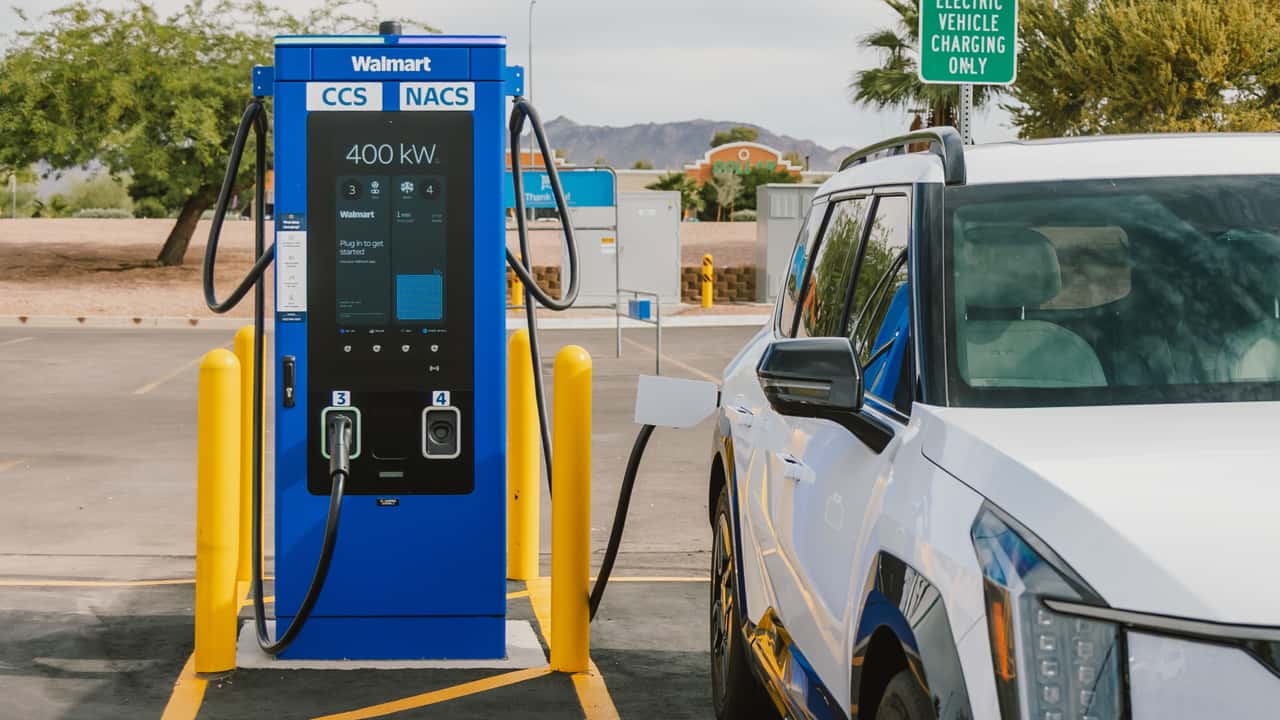

- Ionna and Walmart are both aggressively expanding their EV charging networks.
- Both are offering lower-than-average prices, data from Chargenomics shows.
- This could be the start of an EV fast charging price war.
First EV fast charging options had to get out there. Then, they had to get more reliable and more common. Now, they can start to get cheaper. Ionna and Walmart appear to be leading the charge.
Both companies are rapidly expanding their EV charging network. Walmart had an early partnership with Electrify America to provide charging in many of its store parking lots. The company clearly liked what it did for store traffic and loyalty, so it’s now expanding its own home-grown charging network.
The new stations get 400-kW Alpitronic chargers with both NACS and CCS plugs, plus a 10% discount for Walmart+ customers. The rollout has been aggressive, with hundreds of chargers installed in the past few months.

Walmart uses ABB E-mobility A400 DC fast chargers. They offer 400 kW speeds and both NACS and CCS plugs.
Yet Ionna has even grander ambitions. It’s backed by a group of eight automakers: BMW, General Motors, Honda, Hyundai, Kia, Mercedes-Benz, Stellantis and Toyota. In order to ensure that these brands can sell EVs to customers who are anxious about charging availability, Ionna has promised to build 30,000 fast chargers across the U.S. and Canada by 2030. Many of its stations feature gas-station-like amenities such as convenience stores and restrooms, plus CCS and NACS plugs. Ionna, too, has been deploying stations by the bucketload.
These companies are using a similar, time-honored tactic to pull traffic away from established giants like Tesla, Electrify America, and EVGo. They’re offering lower prices, as data from Chargenomics shows.
Ionna aims to install 30,000 EV fast charging ports in the U.S. and Canada by 2030.
Ionna charges an average of $0.37 per kWh for electricity, giving it the lowest rate among the 17 networks analysed by Chargenomics. Walmart was the fourth cheapest—beat out by Shell Recharge and Rocky Mountain Power—with an average per kWh price of $0.43.
Tesla and Electrify America, for reference, charge an average of $.056 per kWh. A driver charging at Ionna would save around 40% compared to one charging at an Electrify America station. According to Loren McDonald, CEO and chief analyst at Chargenomics, that’s the sort of aggressive pricing you need to overcome the inertia of big giants.
EA and Tesla stations may be automatically programmed into your car’s route planning software or navigation system. You may have gotten free credits when you bought the car, or be hooked on Tesla’s plug-and-charge seamlessness. If a company wants you to change your habit and choose them instead, it needs to offer a good incentive.
“They’re the new kid on the block. You and me and the everybody on LinkedIn in the EV industry know who Ionna is. But your average new driver who goes down to the Hyundai dealer or Ford dealer and gets an EV, they have no idea what an ‘Ionna’ is. They’ve heard of Tesla. They’ve probably heard of Electrify America, maybe EVGo,” McDonald told me.
McDonald also noted that Ionna has offered aggressive holiday and new-station discounts that put pricing in the $0.20 per kWh range for a limited time. That’s cheaper than I pay at home. You can tell they’re hungry for new customers and brand awareness. So is Walmart, albeit with a different goal in mind.
“Walmart, obviously, is in the business for a very different reason,” McDonald said.
He noted that they have thousands of stores in the U.S., and they learned a lot from their early efforts with Electrify America. The company’s massive scale means it can negotiate hard with equipment suppliers and utilities to lower costs, and their massive parking lots mean that the real estate is effectively free. Installing chargers is cheaper for them than for many others, and quicker, too. Most importantly, the chargers don’t just provide direct revenue. They get people inside the stores.
Upstarts like Rove are offering giant charging hubs with premium markets attached, hoping to win customers over with a higher-quality experience.
“The stereotypical demographic and psychographic of EV drivers is not like, Walmart customers, right? So they can attract a new customer base and then, the key for them obviously is getting people inside the store for 40 minutes, spending $50 or $100, not just the $22 out front,” he said.
So what does this all mean for the EV charging industry? It means that we’re slowly moving into a new phase with EV fast-charging networks. The main goal for years has been to build out the networks to alleviate range anxiety. This meant scale won, and if you had the only good charging location around, you could charge out the wazoo without losing customers. Those build-outs were expensive, and so are utility demand charges, so chargepoint operators have charged high prices for the privilege of fast charging.
At $0.56 per kWh, completely filling up my 2024 Chevy Blazer EV costs $47.60 and gets me 279 miles of EPA range. To cover the same distance in a gas-powered 2024 Chevy Blazer AWD, you’d use 12.68 gallons of gas, which costs $51.61 at today’s U.S. average of $4.07 a gallon. The EV is cheaper, but only just.
But if I were to top off at the most expensive Tesla Supercharger around, I’d be paying a brutal $0.74 per kWh. A full charge would cost me $62.90. To be sure, I’m in an area with high electricity prices, and gas here is $5.68 on average, but the point is that EV fast charging prices vary more than gas prices and aren’t all that low.
This isn’t a terrible thing. DC fast charging is rare; over 90% of charging happens at home, where electricity is far cheaper. Electricity costs $0.18 per kWh at the average American home, making home-charged EVs far cheaper to run than any gas car. And level 2 public chargers are becoming far more common. Because they don’t require expensive, high-output AC-to-DC converters and don’t incur extreme demand charges, they tend to be far, far cheaper than fast chargers.
Pilot, General Motors, and EVGo are also expanding charging options at rest stops.
But that’s only part of why DC fast charging is expensive. Another huge component is that, as the industry focused on scale and availability, they were burning cash and didn’t need to compete on price. Now, as we’re turning the page on that era, the space is getting a lot more competitive.
Mercedes-Benz High Power Charging is focusing on providing amenities and reservations. BP is targeting big charging hubs. Upstarts like Rove are aiming to be premium providers. Tesla, Electrify America, and EVGo are pushing memberships and still growing. Walmart and Ionna are expanding rapidly and attempting to poach customers with low prices.
Which of these companies will win out in the end? I don’t know. But with more competition pushing providers to offer more amenities and lower prices, it’s clear that the next era of EV charging is going to be a lot better for EV owners.
More EV Charging News
RECOMMENDED FOR YOU
Study: DC Fast Charging Satisfaction Is Up, And Ionna Takes The Top Spot
The Results Are In: Scrapping Your Gas Car For An EV Is Better For The Climate
Voltpost’s Lamppost EV Chargers Are Now Live In New York State
Self-Driving Trucks Are Already Hitting The Road In California
EVgo And GM's Gas Station-Like Flagship Charging Network Is Growing Fast
Critics Slammed Ferrari's Luce EV. Someone Just Paid $40 Million For The First One
This EV Never Hit Peak Power. But It Still Beat Its Charging Claim