
This Suzuki’s Engine Blew Up. The Owner Converted It Into An EV In Just Five Days
The parts for the conversion cost less than a nice e-bike, and it took less than a week to make it all happen.
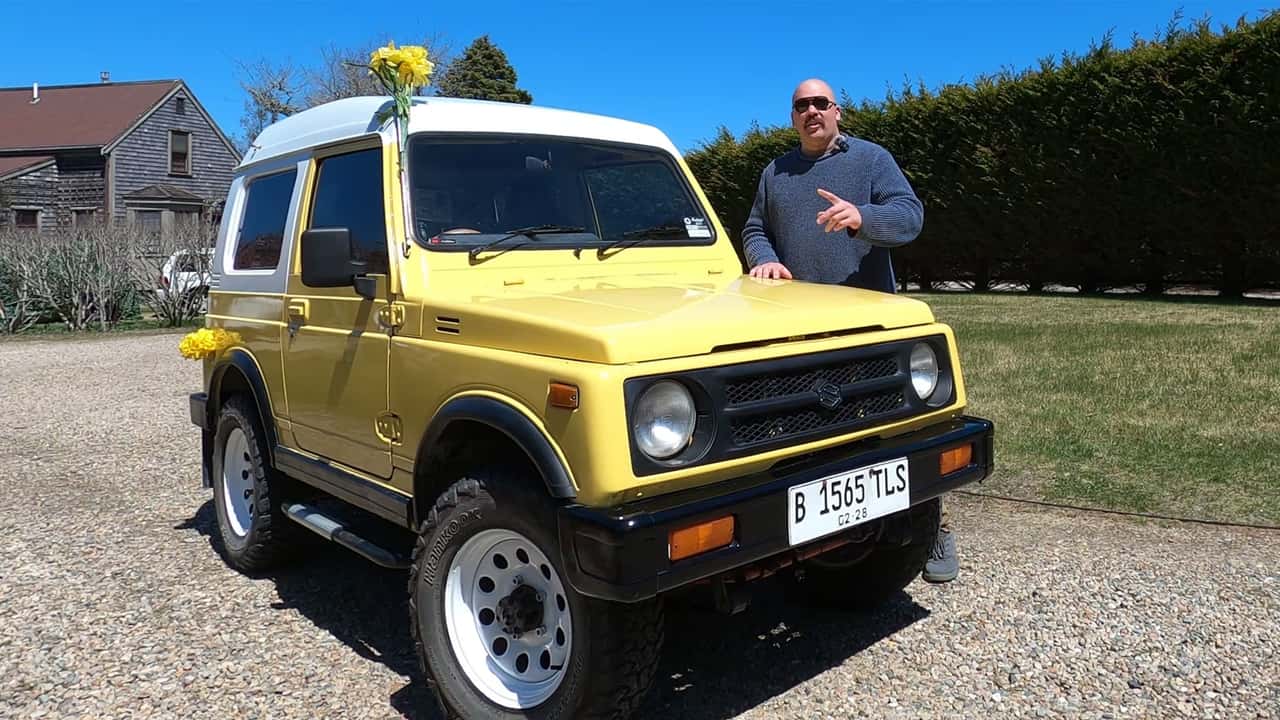

- EV conversions are often reserved for the ultra-rich, but there’s a growing number of enthusiasts who make it happen on a strict budget.
- With a few off-the-shelf parts and some elbow grease, an old Suzuki off-roader got the EV treatment.
- It cost less than $5,000 and took less than a week to complete.
Converting an old car to electric has become easier than ever, thanks to a multitude of ready-made parts that can be made to work together with a little effort.
Sure, there are specialist companies out there that charge hundreds of thousands or even millions of dollars for luxurious conversions, but there’s also a growing number of enthusiasts who have an old car lying around that costs too much to repair, so they start looking at conversion parts.

That’s what YouTuber Life of Troy did with his 1996 Suzuki Jimny—a car that was briefly sold in the United States as the Suzuki Samurai. He imported it from Indonesia last year, and around Christmas, the head gasket on the 1.0-liter four-cylinder lump blew. It was the second time that happened during Troy’s ownership of the car, so it was beginning to feel like more trouble than pleasure owning the car.
But then the EV conversion idea came out of nowhere, and the car is now running and driving again under electric power, after less than $5,000 spent and just five days of work.
Before I get into the details, you should know that this is not a fancy build. In fact, as Troy put it in one of his videos, it’s one of the simplest and cheapest conversions out there, and that was on purpose. He just wanted to drive the car at low speeds and around town, and it fulfills these requirements perfectly.

The original 1.0-liter engine made roughly 45 horsepower, which is not a lot. The lump was taken out, and a 72-volt direct current motor from D&D Motor was bolted directly to the original five-speed manual transmission via an adapter plate. The motor makes just nine horsepower, but makes up for the lack of power with a relatively healthy 65 pound-feet of torque. The fact that it retails for just $929 makes it even better.
A 500-amp controller, which goes for $815, was also fitted under the hood, alongside a DC-to-DC converter from eBay. Powering it all is a 105-amp-hour lithium-iron-phosphate battery that was originally designed for golf carts. It sits at the rear, where the original gas tank used to be, and enables a realistic driving range of around 20 to 30 miles on a full charge.
The battery is priced at around $1,900, and it’s currently the only thing that keeps this car from being more usable. The owner notes that he can always add more capacity. Charging the battery is done through a simple 120V outlet, and it takes about five hours to get a full charge.
There’s no clutch, but all the gears are still there, and the car didn’t have vacuum-assisted brakes, making the conversion job that much easier because it eliminates the need for a vacuum pump. As for speed, the owner said he reached about 50 miles per hour, which isn’t that far off the car’s original quoted maximum speed.
It’s one of those projects that just makes sense, and Life of Troy isn’t the only one going down this route. The comments section on his videos is filled with people who said they did similar conversions to old ATVs or golf carts, and that the vehicles are now much more usable than before.
More Stuff Like This
RECOMMENDED FOR YOU

Japan Just Showed Off The Future Of Cars—Minus One Crucial Detail
The Xpeng L03 Aims To Take On Europe And Undercut Tesla
China's BYD Will Strike At The Heart Of Japan's Car Market
Toyota Is Paying EV Drivers $3,000 To Switch To A bZ
Suzuki Boss Says Making The Jimny An EV Would “Ruin” It. But Would It?
California's EV Rebate Won't Apply To All Cars. These 13 Automakers Qualify
The First Suzuki EV Will Be Built In India Alongside A Toyota Sister Model