
Recharging Your EV's A/C? It's Not Quite As Simple As You May Think
Understanding how your car works can save you from a costly repair.

- Electric and PHEV vehicles often use the A/C system in some form or fashion to manage battery temperatures.
- High-voltage A/C compressors need special dielectric lubricants that do not conduct electricity.
- A non-functional A/C system may lock a vehicle out of some features, like DC fast charging.
If you’re in the Northern Hemisphere, then you’re likely in the throes of summer. In short, it’s hot as heck, and you’re likely doing any driving with the air-conditioning blasting. But sometimes, if you own an old car, your A/C being on doesn’t always mean cold air is coming out. Believe me, I’ve owned over sixty cars in my lifetime, and I think maybe a third of them needed A/C repairs, some of which were just too much of a hassle to fix. Sometimes it was just easier to roll around with the windows down and just tough it out until the end of the season.
But, if you’re driving an electrified car, you should know that A/C problems are affect more than just your hot-weather comfort. If you’re driving an electrified car, chances are that any sort of A/C problem needs to be rectified as soon as possible, lest your car shut down entirely, limit your power, or limit your charging speed.
Pure EV and PHEV models often use the vehicle’s A/C system as part of its thermal management program, and when it isn’t working, it could cause the car to lock itself out of things like DC fast charging, in order to preserve the life of the vehicle. Batteries aren’t as complicated as the average anti-EV pundit may make them seem, but the vast majority of EV batteries do require cooling to perform as designed. Even regular hybrid vehicles, which may not be in so much danger for nonfunctional A/C, use special oils in their AC system that require special attention when you’re performing a repair.
None of this was that obvious before I set out on my mission. I’m no stranger to the car-fixing game. In my spare time, I buy and sell broken cars. For years, my cars have mostly been small Japanese compact sedans, but as electrified vehicles age, they’re starting to fall within my price range for broken-yet-fixable vehicles.
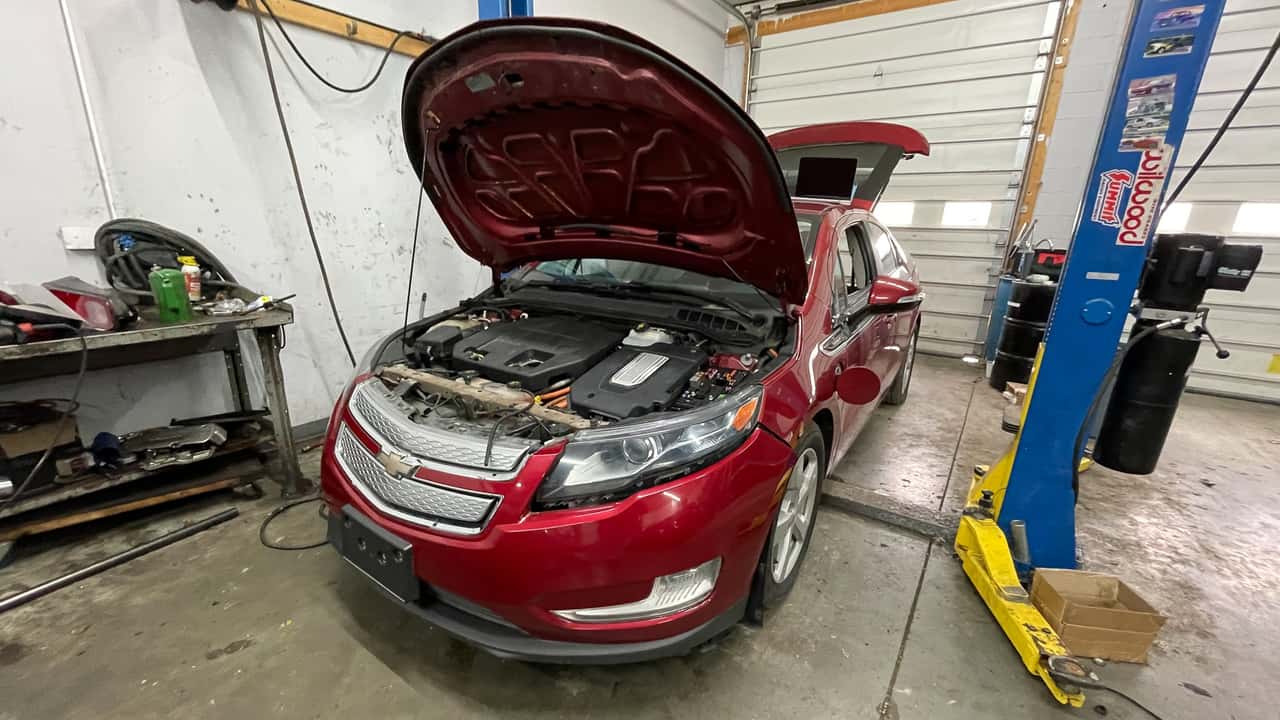
So, about two years ago, I had a 2015 Chevrolet Volt. The car was purchased with a fully missing ICE engine and plenty of other broken or missing parts, all of which I paid to have repaired or replaced myself. For the first week of driving, the car was fine. Everything worked OK, it charged, stopped, and accelerated fine, and there were no issues.

After the first week, though, the Volt’s check engine light came on, with the code P0534: Air Conditioner (A/C) Refrigerant Charge Loss. “Hm, that’s odd; usually a car’s computer or diagnostic system doesn’t really care if the air conditioning refrigerant is at the right level,” I thought to myself. Most cars only throw lights for safety issues or things that can impair the core functions of the car, like engine issues or brake problems. An A/C issue is neither, so I was surprised to see a light for what I’d consider a secondary problem.

Well, it's actually a really big deal. The Volt is a plug-in hybrid (PHEV), with a substantial 17.1 kWh battery that runs through the middle of the car. Because it’s not a small battery, Chevrolet opted to have a true thermal management system, not an air-cooled one like what you’d find on, say, a Toyota Prius or Honda Insight, both of which are non-plug-in hybrids with battery packs that sit inside the vehicle’s cabin. This means that the Volt’s battery pack has both coolant and A/C refrigerant lines that traverse through it, cooling (or warming) the battery pack.
Chevrolet recommends the Volt stay plugged in when not in use, since it’ll run its battery cooling or warming procedures if necessary. It’s better if the car does this drawing from the grid, rather than using the energy it has stored in its battery pack. Although the Volt isn’t unique in this way of thermal management, nearly all EVs and many PHEV models (save for, say, an air-cooled first- or second-generation Nissan Leaf, or Mitsubishi i-MiEV) use an A/C compressor in some form or fashion to manage temperatures of the battery.
If you’re not driving a plug-in car, a regular hybrid will often still use a high-voltage A/C compressor, so some of this advice is still very much relevant. If you pop your hood and see a big orange cable plugged into your A/C compressor, then congratulations, you’ve got a high-voltage A/C compressor and must take special care.
In 2012, when the Volt was introduced, this may have seemed like a crazy novel concept. These days, many modern EV and PHEV models operate in a similar manner, especially in an era of DC fast charging, which tends to generate heat that needs to be managed to preserve the length of the life of the battery. For cars like the Chevrolet Volt, there are refrigerant lines that pass right through the battery case that manage temperatures. Other electrified cars may use other methods, like cooling down a special coolant or fluid that passes through channels or lines in the battery’s case, or even straight up blowing cool air from the A/C itself, as if it’s just another part of the car’s interior.
Thus, being able to repair low refrigerant or a broken A/C system is imperative to preserving the life of an electrified car. That A/C needs to work to cool the car’s battery down, and that’s the case for most EVs and many PHEV models. It’s not something I would ignore. Thus, when I became aware of it, I made sure it was taken care of promptly.
You don’t have to take my word for it, either. I reached out to Electrified Garage, the EV specialist chain of shops affiliated with notable Tesla-rebuild and EV enthusiast YouTuber Rich Rebuilds. They seconded my findings and warnings, noting that A/C problems could lead to driveability issues if not fixed quickly.
“Tesla uses a heat exchanger between the battery coolant and the AC refrigerant. Everything is thermally controlled to either cool or heat up. If temperatures start to climb, then the vehicle will shut itself down and not allow it to overheat,” wrote the representative of Electrified Garage’s Amesbury, MA location. Although they said they’ve never seen a drastic battery issue caused by a lack of A/C refrigerant, if it were low, the car will limit hard acceleration or DC fast charging in order not to harm its battery or drive components.
General Motors’ public relations office seconded Electrified Garage’s observations. “All cooling systems have lines and connections that can potentially leak. Typically, as is the case with the Equinox EV, the cooling system supports several systems including battery, cabin HVAC and power electronics. Every leak would be case-by-case, and diagnostic codes are designed to trigger protective measures. If a battery is not heating and cooling properly, performance and charging are limited to protect the battery and encourage a more immediate service visit to a dealer,” wrote the representative.
Now, when it came to servicing my Volt, I’m no stranger to A/C repair. A/C lines are closed systems, so if there’s low refrigerant, then it’s leaked out somewhere. My broken Volt’s case was a little different, since the engine was literally missing and disassembled; it was safe to say that whoever last touched the car had just let all the refrigerant vent into the atmosphere. (Which is illegal and bad for the environment, please don’t do that.) I figured I just needed a can of R134a, and I’d be on my way. The recharge port on a Volt and the procedure weren’t much different than any other car.
Or, so I thought. Although the refrigerant type itself between an ICE car and an electrified car is the same, A/C systems that run on high-voltage systems need to use a special A/C lubricant oil that is dielectric, meaning that it can’t conduct electricity. Remember that big orange cable I talked about earlier? This means it’s a high-voltage A/C compressor and must use dielectric lubricant, or it could short out the A/C compressor. At the time, I didn’t know that, but research set me on the right path.
Most A/C top-up kits, they include the lubricating oil or other stop-leak solvents already integrated into the refrigerant, no matter if it's R134a in my old Volt, or the newer R1234yf found in most newer vehicles, including EVs and PHEV models. Typically, the vehicle’s refrigerant type will be listed on a sticker or placard under the hood.
But if those non-dielectric oils enter an EV’s A/C system, it could be devastating. Vehicles that use high-voltage-style A/C compressors are very sensitive, and if non-dielectric material gets into the vehicle’s A/C system, including its compressor, it could set off what’s known as a “loss of isolation” fault, also known as a short, where the vehicle essentially is seeing electricity and current in places that it shouldn’t. Electrified Garage also acknowledged this, too, explaining that Teslas also use dielectric oil for its A/C components to make sure they don’t short out internally. It wouldn’t be fun to repair an A/C problem, only for it to need replacement again due to using the wrong oil or refrigerant.
I realized that recharging the A/C was a little more out of my depth than I initially thought, so I outsourced it to a qualified mechanic familiar with electrified vehicles. I could have
recharged the R134a just fine, but I’d rather be safe than sorry. Knowing my luck, I’d accidentally end up adding refrigerant with oil, even if the can said it didn’t have any oil on its label.
Most modern EVs are likely still under warranty, and therefore, most owners likely won’t need to know this information anytime soon. However, I think it’s useful for drivers to understand the bits and bobs that go into fixing and maintaining their EVs. Inevitably, as these cars age and make their way to second and third owners (and get repaired by those who aren’t dealership service departments), being armed with knowledge, I think, can save you from a simple A/C recharge mistake becoming a major, costly problem.
Contact the author: Kevin.williams@insideevs.com.
Related Articles
RECOMMENDED FOR YOU
Aptera Won't Build A Service Network. Here's What Owners Will Get Instead
Volvo Could Bring An Electric Sedan And Wagon To U.S. By 2028: Report
This Sub-$20,000 Volkswagen ID.4 Proves Used EVs Are The Ultimate Bargain
The Chip Is A $15,000 25-MPH EV That Makes Driving Optional
Hyundai Is Launching A Mobile Service Fleet To Fix Your EV At Home
Someone Is Already Trying To Flip One Of The Last Tesla Model S's Built. The Price Is... Ambitious
Rivian Hits 100 Service Centers Ahead Of R2 Rollout