
I’ve Seen More Improvement In Two Years Of Reviewing EVs Than I Did In A Decade Testing Gas Cars
As EVs rapidly improve in every key area, it's getting harder and harder to imagine a future for gasoline engines. They just can't keep up.

When I left Road & Track to join InsideEVs, my car enthusiast friends were surprised. I was trading in the glamorous world of six-figure supercars and earth-shaking monster trucks for the practical business of charging infrastructure and battery chemistry. Why would I bother, they asked, when even the mightiest EV was less exciting and heavier than a run-of-the-mill sports car?
The answer was hard to explain in the present tense. I was tired of living in a world where the past was celebrated as somehow pure, and the future tinged with anxiety about emissions and regulation. I wanted to get excited about the future again, and as I saw gas cars stagnate, I knew that I had to turn the page.
So I did. In the two and a half years since, I can say with certainty that I've seen more exciting progress in the EV sector than I have in the last ten years of internal-combustion development. And the party's just getting started.
The Best Gas Car Has Already Been Built
I started reviewing cars professionally in 2017. The first car I reviewed for CNBC was the then-new Volvo S90, part of a new generation of Volvos meant to herald a new era for the automaker now under Chinese ownership. It was powered by a 2.0-liter inline-four with either a turbocharger or a turbocharger and a supercharger.
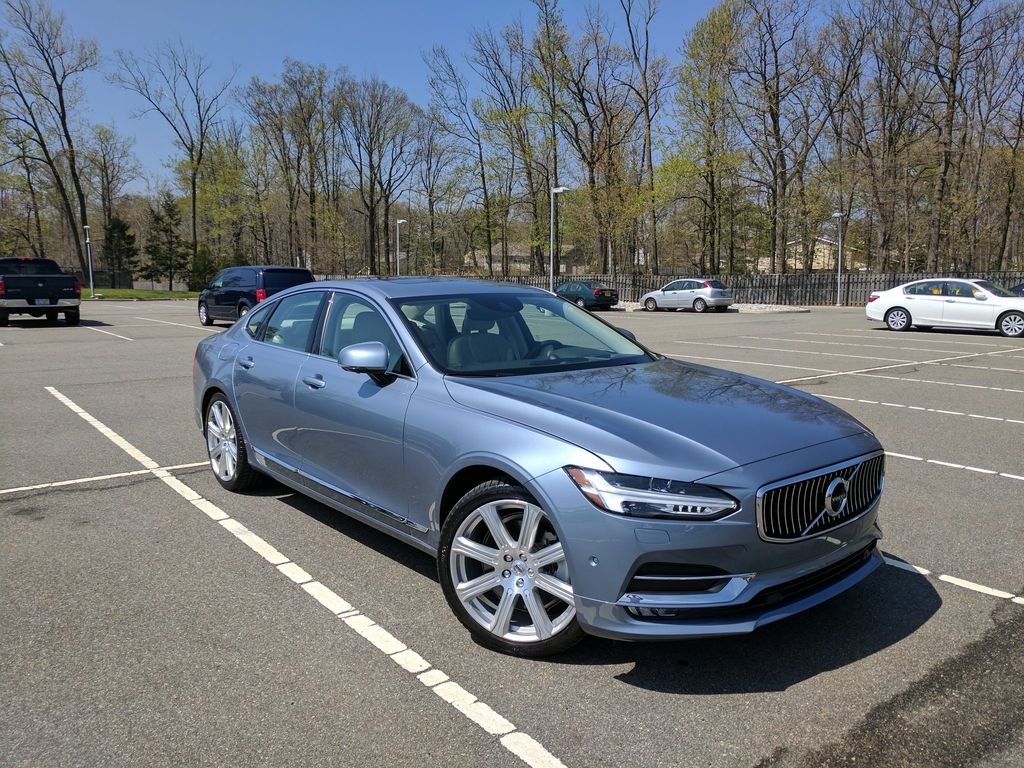
Today, the S90 is gone for our market, but its SUV sibling, the XC90, remains. It comes with better cabin technology than the 2017 version, better tuning, and a better plug-in hybrid variant. But the engine/transmission combo is much the same. It gets only 1 mpg better, thanks not to improvements in gasoline engine design, but because of the inclusion of a mild 48-volt hybrid system that helps make up for the inherent inefficiency of a gas engine.
Back then, the best-selling vehicle in America was the Ford F-150. It offered 2.7-liter and 3.5-liter turbocharged V-6s along with a more traditional 5.0-liter V-8. Today, a decade on, the standard F-150 has... the same engines, plus a hybrid option. The 10-speed automatic has spread from just the 3.5-liter EcoBoost engine to the rest of the lineup, but not before a long and painful teething period with widespread reliability issues.

The biggest improvement to the F-150 since 2017: The addition of a hybrid model. Even the best gas products are better with a bit of electric assistance.
Chevy trucks fared no better, suffering from transmission problems on both 8- and 10-speed models. And even though the company used the same basic 5.3-liter V-8 design for over 20 years, only phasing it out for 2027 models, the inclusion of cylinder-deactivation technology has been a catastrophe. Introduced in 2007, the technology allowed the V-8s to run on four cylinders under light load to gain an MPG or two on the highway. But the technology dinged the ironclad reliability reputation of the 5.3.
It all shows how trying to make engines a hair more efficient often involves introducing a lot more complexity, leading to terrible reliability tradeoffs. At some point, you're putting a hat on a hat.
Toyota learned this lesson the hard way, too. The previous-generation Tundra had a bulletproof reputation for unmatched reliability, with multiple examples going 1,000,000 miles on their original engines. But customers got a bit sick of getting 13 mpg in the city. Toyota introduced an all-new V-6, with all of the fancy turbocharging and direct injection you'd expect in a thoroughly modern engine. The result was an unmitigated disaster, with over 100,000 recalled trucks and countless engine failures.
Toyota has had to recall over 100,000 Tundras due to engine issues.
When even the automotive titan of reliability cannot design a clean-sheet engine without years of catastrophic failures, it's a sign that modern engines are being pushed past their limits. Most traditional enthusiasts are skeptical of turbochargers and cylinder deactivation, for good reasons mentioned above. But as the former owner of a 2001 Chevy Tahoe, equipped with the gold-standard LS V-8 that lacks any complex efficiency tech, I can say that getting 13 mpg city isn't great either.
Consumers want to spend less on fuel. They don't want more complexity, or more repair bills, and they don't want to give up power or capability. So there's one clear solution: electrification. After years of stalled progress in pure gas designs, it's the only thing dramatically improving automotive powertrain technology.
EV & Hybrid Tech Saves The Day
The F-150 may have been the best-selling vehicle in America back in 2017, but it isn't anymore. The Toyota RAV4 unseated it last year, thanks in no small part to its fantastic hybrid-only redesign. While many technologies have decreased reliability for marginal increases in efficiency, going hybrid tends to improve longevity and majorly boost efficiency. Thank the natural efficiency of electric propulsion and the incredible robustness of modern batteries and motors.
The Toyota Rav4 went hybrid-only for its latest generation, and it's all the better for the change.
When I started here in early 2024, the RAV4 came standard with a totally unremarkable four-cylinder. But its hybrid-only approach has put it far ahead of gas-guzzling competitors. Hybrid options for Toyota trucks and Lexus SUVs have also improved significantly, and Ford expanding the hybrid powertrain to the all-wheel-drive Maverick has expanded its lead over its purely gas competitor, the Hyundai Santa Cruz. From longer-range Volvo PHEVs to awesome Ferrari hybrids, the most innovative new gas products tend to have electric assistance.
But the pace of improvement in the pure EV space is even more dramatic. When I started here, the quickest-charging EVs on sale in America charged from 10-80% in 18 or 19 minutes. Mercedes just launched a car that can do it in 11.
The day I started at InsideEVs, Chevy's cheapest electric SUV was the Blazer EV. At the time, it started at $58,590.
Now, the Blazer EV starts at around $45,000, and the Equinox EV—with over 300 miles of range—starts at just $35,000.
The longest-range EV is still the Lucid Air Grand Touring, with a staggering 516 miles of range. That may not have improved—who on Earth needs more, after all?—but its starting price has dropped by over $10,000. The number of cars nipping at its heels has also increased dramatically, with new models from Chevy, Cadillac, BMW, Volvo, and Lucid itself all exceeding 400 miles of EPA range in the last two years.
Even that is overkill, as above 300 miles of range is the sweet spot. Luckily, options in that range have exploded. At the end of 2023, only 21 EV variants exceeded 300 miles of EPA range. By the end of this year, there will be around 60 models with that much range, as Tim Levin broke down in his excellent story on EV range.
As the list of EVs with bladder-busting ranges has grown, though, the need for marathon runs between chargers has dropped. America's fast-charging network is gigantic, and still expanding rapidly. In the two years since I leased my Blazer EV, dozens of new fast-charging ports have come online within 15 minutes of my house. Even ignoring new chargers, Tesla opening its expansive fast-charging network to other EVs starting in 2023 was a total game-changer, ensuring I never really worry about range.
Meanwhile more and more data has shown that modern EV batteries degrade slowly and rarely fail. Reliability is improving, and automakers are turning away from the screen-only control schemes they once forced into every EV.
The BMW iX3 is far more sophisticated than any EV the company offered in 2024, with an 800-volt, software-defined architecture and over 400 miles of EPA range.
Software reliability is improving at a rapid clip, too. When I joined in early 2024, GM's only Ultium cars—the Chevy Blazer EV and Cadillac Lyriq—were buggy messes. But I've now daily driven a Blazer EV for two years, and haven't had a meaningful software bug in at least 21 months. In fact, just this week I got access to Google's Gemini AI assistant added over-the-air.
The most important improvement, though, hasn't been range, or charging specs, or infrastructure. It's choice. Back in 2024, there were not many EV options, and many of them weren't compelling. Today, though, you can get a polished electric option from almost any automaker.
Toyota is expanding its choices through its Subaru partnership, leading to the electric Outback I wanted back in 2024. GM makes a smattering of EVs in most categories, with an exceptional $35,000 long-range SUV that we love. Rivian has finally launched a mass-market option. Meanwhile BMW, Mercedes, and Volvo are launching software-defined, 800-volt EVs with giant ranges and prices that make them a better buy than their gasoline-slurping counterparts.
Compelling affordable options are finally arriving, too. Slate's $25,000 EV pickup is about to launch, with a sub-$30,000 Ford alternative right around the corner. And existing options are far better than they were a few years back. The 2027 Chevy Bolt charges from 10-80% in about half the time as its predecessor and costs the same amount, while the base version of the Nissan Leaf gets double the range of its 2024 counterpart.
The new Nissan Leaf starts at roughly the same price it did back in 2024, but with double the range, a Tesla-style charging port, way better charging specs, and a cooler design.
It'll only get better from here. As the North American battery supply chain gears up, prices are falling quickly, and automakers are iterating constantly. Battery breakthroughs like high-silicon anodes, lithium-manganese rich chemistry, and solid-state technology promise to further drive down costs while improving range and longevity. Meanwhile, EVs are getting simpler due to the proliferation of software-defined vehicle architectures, which make them cheaper to build, easier to service, and simple to update.
There are no equivalent gasoline breakthroughs on the horizon. After 150-odd years of iteration, we have already taken the easy money off the table. You're not going to double MPG without adding a battery, and you're not going to drive down costs far below today's figures without major sacrifices. The technology is nearing the end of the line.
Lucky for us, EV technology is just getting started.
Contact the author: Mack.Hogan@insideevs.com
More EV Progress News
RECOMMENDED FOR YOU
People Are Mad About The Jeep Recon's 222-Mile Range. Here's What They're Missing
‘Propulsion-Agnostic’: GM Wants To Bring Tesla-Style Software Features To Its Gas SUVs, Too
Genesis' First Few EVs Didn't Blow Me Away. The GV90 Flagship Did
Want The Best Range Rover? Get The Electric One: First Drive
EV Reveals Have Gotten Way, Way Too Drawn Out. The Ford Fathom Proves It
I Drove The Electric And Gas-Powered BMW X5. I Know Which One I'd Pick.
EVs Don’t Need This Gas Car Feature. So Why Do So Many Still Have It?