
Full Tesla Cybercab Specs: EPA Documents Confirm Battery Size, Weight, Power, And Preliminary Range
The first front-wheel-drive Tesla will weigh way less than a Model 3 but still offer plenty of range.


- The Tesla Cybercab will have 219 horsepower and a 48 kWh battery, new EPA filings confirm.
- It'll weigh 3,113 lbs, making it the lightest EV on the U.S. market right now.
- It looks like it'll have around 293 miles of range, based on preliminary testing figures adjusted by InsideEVs.
The Tesla Cybercab just got one step closer to mass production. The company has filed official documents with the environmental protection agency (EPA) that are required to make it a full production vehicle. Thanks to the documents, which were first spotted by Car and Driver on Monday, we now know the official weight, power output, and battery size of the two-door robotaxi. And while the number hasn't been adjusted yet, we also know the max tested range of the Cybercab.
Let's start from the top.
The documents confirm that the Cybercab will weigh 3,113 pounds, a good 700 pounds less than the lightest Model 3. That puts the Cybercab on roughly equal footing with cars like the Honda Civic Touring, which is pretty impressive for an EV, as electric cars tend to be far heavier. A Chevy Bolt, for instance, weighs nearly 3,800 lbs.
Gallery: Tesla Cybercab





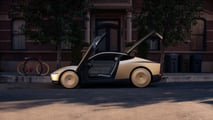
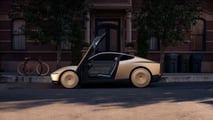
The Cybercab will also have a gross vehicle weight rating (GVWR) of 3,730 lbs. Given that GVWR is the maximum combined weight of the car, its passengers, cargo, and fuel (not a factor here), we can do basic subtraction to learn that the Cybercab will have 617 lbs of payload capacity. That's certainly on the low end for any passenger vehicle—a typical compact like a Civic usually has between 800 to 1,000 lbs of payload—but makes a lot more sense for a two-door car. With two average Americans and their carry-on suitcases, the Cybercab should still be well under max capacity.
It shoulnd't be too slouchy, either. The EPA documents confirm that the robotaxi will use a single, front-mounted permanent magnet motor with 219 horsepower (163 kW) on tap. That'll be plenty punchy if you floor it, though you may not have the option to; Tesla originally promised that the supposedly autonomous cab will not come with a steering wheel or pedals, before later fitting both to test units.
Tesla says Cybercab production has already begun, but it's unclear how many the company has built.
Regardless of who's driving, though, a cab needs to have plenty of endurance. To make sure it's got enough, Tesla will use a 146 amp-hour battery running at 326 volts. Multiply those together and you get 47,596 wH of energy, or 48 kWh to keep it simple.
How much range does that provide? Here, the answer is a bit murkier. In the testing described in the documents, using the EPA test cycle, the Cybercab delivered 418.226 miles of combined (calculated) range. But don't get too excited, there. These are under ideal, lab-test conditions, and to turn them into the real-world figure you see on your window sticker the EPA requires manufacturers to adjust their range.

"Although the regulations allow some optional approaches, the most common approach is to use a factor of 0.7 to adjust all the test parameters, including range," the official EPA testing explainer says. I'm not familiar with the "optional approaches," so let's keep it simple: 418.2 times 0.7 gets us to 292.7 miles of EPA range. One Tesla executive claimed that it would have "close to 300 miles of range," so that sounds about bang-on.
These figures certainly answer some of the major questions I have about the Cybercab. But like all Tesla projects, we're kept guessing on the two biggest questions: When will it (actually) go on sale, and what will it (actually) cost?
(Correction 6/17/25 at 1:20 PM ET: An earlier version of this story misstated the horsepower figure. The Cybercab will have 219 hp, not 169 hp.)
Related Stories
The last we heard, it's supposed to launch "before 2027" at a price under $30,000. But a true robotaxi requires truly autonomous driving software. Tesla is testing that in a few cities, but we're still far from the nationwide rollout that head honcho Elon Musk has promised for years. Whether he can finally deliver it, and the Cybercab, before 2027 remains an open question. But with these filings, we just got one step closer.
Contact the author: Mack.Hogan@insideevs.com.
RECOMMENDED FOR YOU
Tesla’s ‘Flying Roadster’ May Debut This Month Alongside A Street Legal Version
The Porsche Taycan’s Days May Be Numbered: Report
Used Tesla Model S Prices Have Fallen Dramatically. But Their Batteries Are Holding Up Great
Here's How Zoox's Robotaxi Safety Testing Will Work
Critics Slam Tesla's Gamification Of FSD As Driver Hits 25,000-Mile Streak
This Is The World's Largest Electric Aircraft—And Its First Flight Cost Just $5
They Bought A 78,000-Mile Tesla With An Unknown Past. Then They Tested The Battery