
The Rivian R2 Costs Half As Much To Build As The R1S. Here's How Rivian Did It.
From shorter wires to fewer parts, Rivian found lots of clever ways to make its most important vehicle yet a lot cheaper to build.
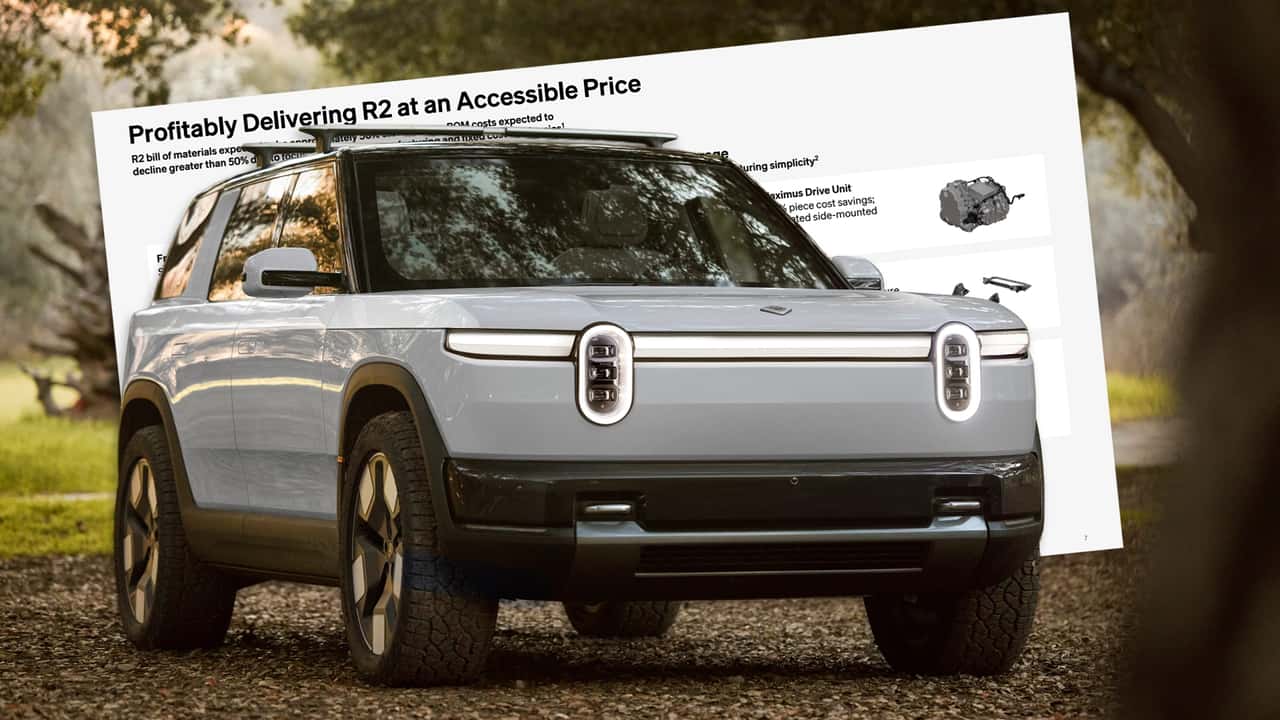

- Rivian says its R2 costs 50% less to build than its flagship R1.
- The automaker outlined its cost savings during its quarterly earnings call, revealing that some areas of manufacturing have up to 90% fewer parts.
- Reservation holders are expected to be able to configure their R2s in the coming weeks.
Rivian's central mission for the R2 crossover was to take everything people love about the more expensive R1 series and make it cheaper—both to build and to buy. By all accounts—including our own prototype test drive—the startup has managed to do just that.
Rivian says it was able to slice the R2's input costs in half as compared to the flagship R1S and R1, bringing the SUV's price to $45,000. (Eventually. The R2 Performance will kick things off at around $58,000 when customer deliveries begin in the coming weeks.)
We've heard the story of Rivian making the R2 cheaper before. But as part of the startup's latest earnings release, it explained in more detail than ever how managed to squeeze some extra pennies out of the R2 construction. Some of the methods are quite clever.

Let's take the wiring harness as an example. Thanks to a new, more consolidated zonal compiting architecture, the brand was able to reduce 2.3 miles in overall harness length. Moreover, it reduced the number of connectors needed by 60%. Rivian was also able to reduce its expensive high-voltage cabling by 70% since it consolidated the power conversion module from five separate units to just one.
Its new Maximus Drive has 41% fewer parts compared to the existing Enduro drive units in the R1. Rivian mounted the inverter on the drive unit itself so that it could lengthen the bus bars for efficiency and share coolant routing with the drive unit's heat exchanger. It even uses the inverter lid to act as the drive unit mount, which cuts down on total number of parts and manufacturing time. Replacing ultrasonic sensors with corner radars on R2 each achieved 50% cost savings compared to the cost of R1.
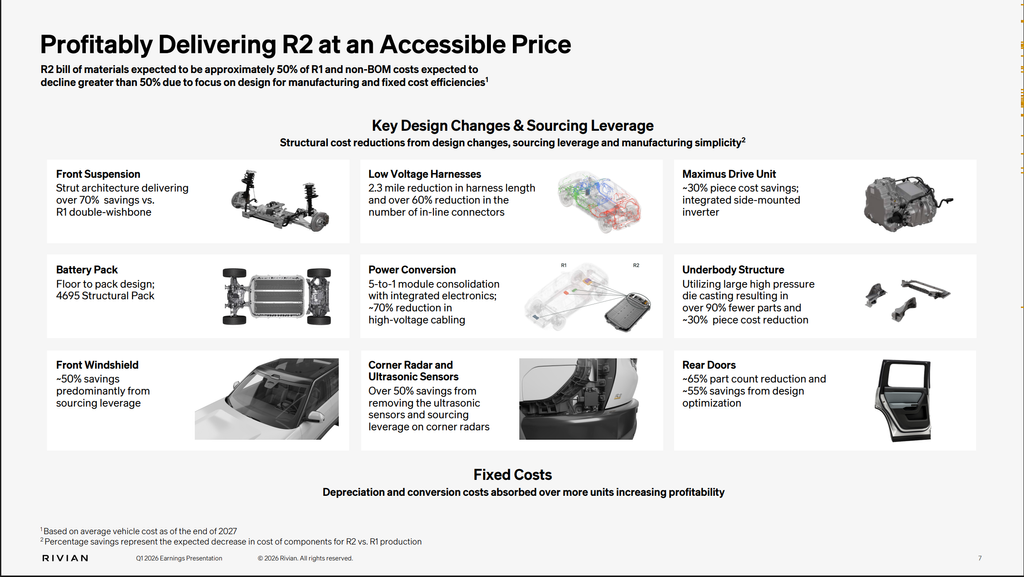
The mechanical side of R2 also got the same Colin Chapman "simplify, then add lightness" treatment. Its front suspension achieved 70% cost savings by ditching double wishbone for a MacPherson setup. Large die castings mean that the underbody structure uses 90% fewer parts (equivalent to cost savings of 30%). And even the R2's rear doors are reduced in complexity by ditching 65% of the part count.
"[W]e expect to see a reduction of more than 50%, resulting from a focus on design for manufacturing and leveraging fixed cost efficiencies through higher production volumes," said Scaringe during the earnings call. "This is how we expect to profitably deliver R2 at an accessible price point at scale without compromising the performance and utility customers love about Rivian."
The CEO also says that Rivian was able to leverage its sourcing power to achieve lower costs. When Rivian was just starting up, it was an unknown company making high-end, low-volume vehicles. Now, as a more established company eyeing real manufacturing scale, it can negotiate for better deals. For example, Rivian says the R2's front windshield costs about half as much as the R1's, and those savings come "predominantly from sourcing leverage."

Of course, the R2 is also a smaller vehicle, plain and simple. So its overall material needs are inherently lower. All of this adds up to more than just cheaper parts and lower manufacturing overhead costs. It helps unlock the mass-market, Tesla Model Y moment Rivian has been working towards. Now it's all about whether it can stick the landing.
More Rivian News
RECOMMENDED FOR YOU
What Rivian And Lucid's Latest Earnings Say About The EV Startup Race
Tesla Burned Through Its California EV Rebate Funds In Just Five Days
Rivian Is Adding A Second Shift To The R2 Assembly Line. Here’s Why It Matters
The Ford Fathom Will Get a $25,000 Hybrid Crossover Sibling: Report
EVs Don’t Need This Gas Car Feature. So Why Do So Many Still Have It?
Ford’s New AI Assistant Can Read Your Car’s Manual And Diagnostics
The Ferrari Luce EV Proves The Haters Wrong