
‘That’s Pretty Cool’: Road Tripper Stops At EV Charging Station In Ohio. Then She Sees It Has An Unprecedented Feature
A new charger design might offer a compromise between fast charging and headaches for utilities.
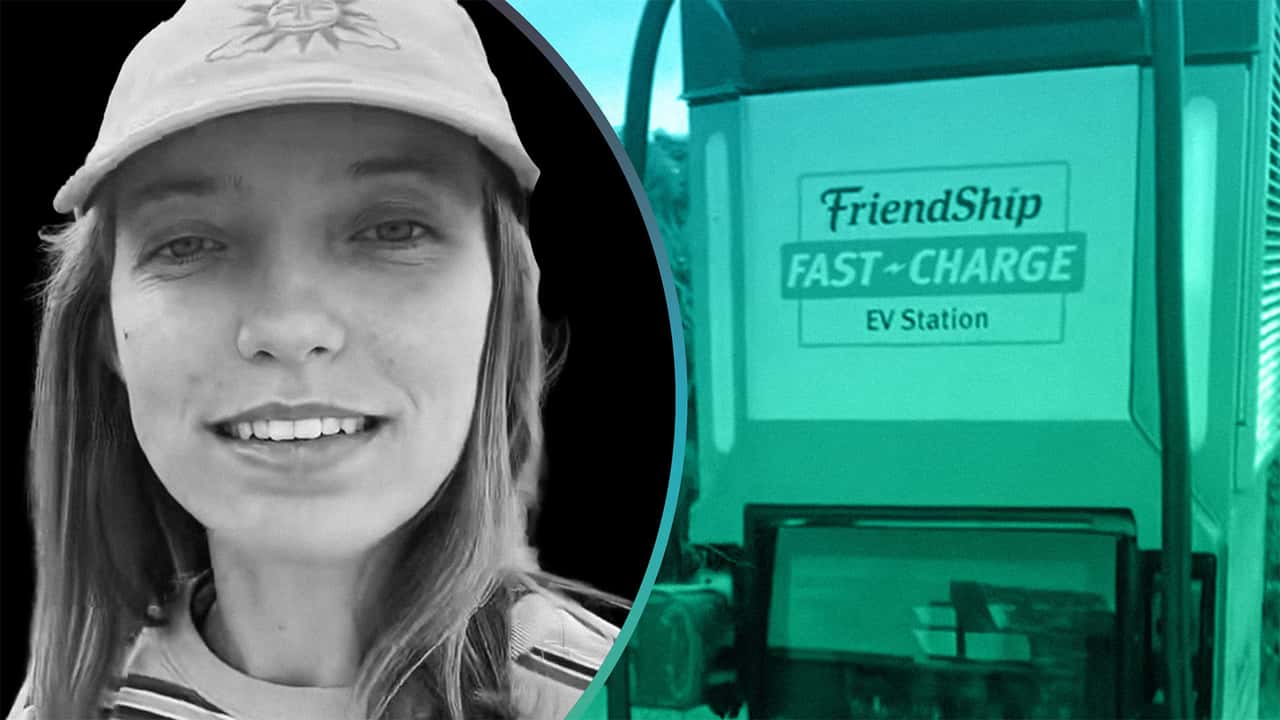

Fast chargers give drivers speed but utilities headaches. A new design spotted in Ohio might offer a compromise: fast for the car, steady for the grid and a glimpse at how EV adoption could spread to more volatile power networks.
In a clip that’s been viewed more than 6,000 times, roadtripper Taylor (@taylorandzervan) is a big supporter after her first time charging with a novel technology known as a battery-buffered charger.
“It's a cool alternative for electric vehicle charging in places that maybe have a little bit more of a vital power grid,” she said. “We've never seen this before, but it's really cool that Ohio's installing chargers like these.”
Taylor’s video captures what seems at first glance like an ordinary DC fast charger installed along a highway corridor in Ohio. However, the twist lies in what she describes: a “Level 3 charger with a battery inside” that is itself charged more slowly via Level 2 standards, allowing an EV to draw high power of around 150 kW when it plugs in without inducing a sudden demand spike on the local grid.
Battery-Buffered Chargers, Explained
The idea is simple but powerful: The charger holds a battery reservoir, gradually filled over time, which can then release that stored energy quickly. In effect, the charger decouples the instantaneous load on the EV from the instantaneous stress on the grid. This is sometimes referred to as battery-buffered fast charging or battery-integrated EV charging, where a battery energy storage system is directly paired with the charging station.
Now Trending
This architecture is already being explored in pilot projects and commercial deployments by companies such as FreeWire Technologies. Their “Boost Charger” line is designed to draw modest power from the grid even while delivering fast-charging output, thereby reducing the need for costly substation upgrades or extreme demand charges. In one FreeWire-subsidized project, the integrated battery was charged during off-peak hours, helping to reduce the system’s peak demand burden.
FROM THE TRENDING NEWS DESK
Viral bits from across the social media landscape
Our team of experts tracks what's trending so you don't have to—from viral videos to online debates that have everyone talking.
The U.S. Department of Energy’s Battery Energy Storage for Electric Vehicle Charging Stations primer outlines the trade-offs: A battery-buffered DC fast-charging station draws a relatively steady, moderate load from the grid, then rapidly discharges stored energy when vehicles charge. In doing so, it can reduce or even eliminate the need for major grid infrastructure upgrades, such as new transformers and distribution feeders, at stations located in grid-constrained or remote areas.
That said, battery-buffered systems aren’t silver bullets. If undersized or poorly managed, the battery can become fully depleted, causing the charger to revert to slower speeds.
Helping Power Grid Resilience
In Ohio’s case, this charger may represent an early deployment in a region where grid resilience varies widely across urban, suburban and rural zones. The Ohio EPA, through its Trust Fund, supports some of these installations to accelerate the shift away from diesel and toward clean energy infrastructure. This aligns with how many states have channeled Volkswagen Dieselgate settlement funds toward EV infrastructure.
In public infrastructure planning, one of the most significant cost drivers for fast charging is accommodating huge peak loads. A 150 kW DC fast charger can demand as much instantaneous power as an entire small neighborhood, but by smoothing that demand, battery-buffered designs can lower both utility interconnection costs and operational demand charges.
According to a comparative analysis cited by industry players, deploying energy storage in lieu of full substation upgrades can reduce project costs from approximately $4 million to $1.2-1.5 million, a 65% decrease in grid-side infrastructure costs.
Buffered systems offer some resilience advantages: During short outages or voltage disturbances, the battery may maintain charging capability until it is depleted. In essence, the charger functions as a microgrid node for as long as its battery lasts.
From the EV driver’s perspective, the appeal is obvious: fast charging without waiting for the grid to catch up. And from a system viewpoint, this type of setup is especially attractive in locales with volatile grids, subject to demand peaks, constrained feeder capacity or a limited ability to support high instantaneous loads. In such places, battery-buffered chargers can function as “load-levelers,” absorbing energy when demand is low and releasing it when vehicles need fast juice.
Private firms like Jule already market battery-buffered DC fast chargers intended to reduce the burden of make-ready costs and enable faster deployment in grid-constrained regions. Some jurisdictions explicitly reference “battery buffering and battery backup” as part of their planned EV charging strategies.
Still, the field is in its early days. Technical challenges remain around battery sizing, cycle life, cost trade-offs and software management of charge-discharge cycles. Meanwhile, Tesla’s Supercharger network generally relies on direct grid interconnection and bulk power procurement. Tesla sometimes pairs Supercharger sites with energy storage or solar panels to reduce costs, but the core design remains grid-dependent. The rise of battery-buffered alternatives suggests that “greener charging” can come not just from clean generation but also from more innovative demand management.
Taylor’s reaction in her video hints at the emotional force behind such innovations: She describes the charger as “never seen before” She praises the Ohio deployment, signaling that EV drivers are ready to notice and celebrate infrastructure advancements as much as vehicle performance.
InsideEVs reached out to Taylor via direct message. We’ll be sure to update this if they respond.

RECOMMENDED FOR YOU

Woman Buys Cadillac EV. Then They Offer Her A Deal On EVgo
Telo's Tiny Electric Truck For Cities Has Surprisingly High-Powered Charging
"The Motor Is Supposed To Last 1 Million Miles": Man Hits 360,000 Miles On His Model 3. Is That The Norm?
The 2027 Porsche Taycan Gets Fake Gear Shifts And A Bigger Standard Battery
"Dealerships Are Shady": Man Says Texas Toyota Dealership Agreed To Sell Highlander Hybrid For $26,900, Then Jacked Up The Price
Uber, Stellantis, And Wayve Want To Blanket The World In Robotaxis
Can Waze Still Track The Police?