Home
News
BYD Is Stepping Up Its Game In Japan. Here's What It's Really After
The Chinese EV giant targets the world's toughest new car market. Plus: America's auto sector has a warning for the broader economy.
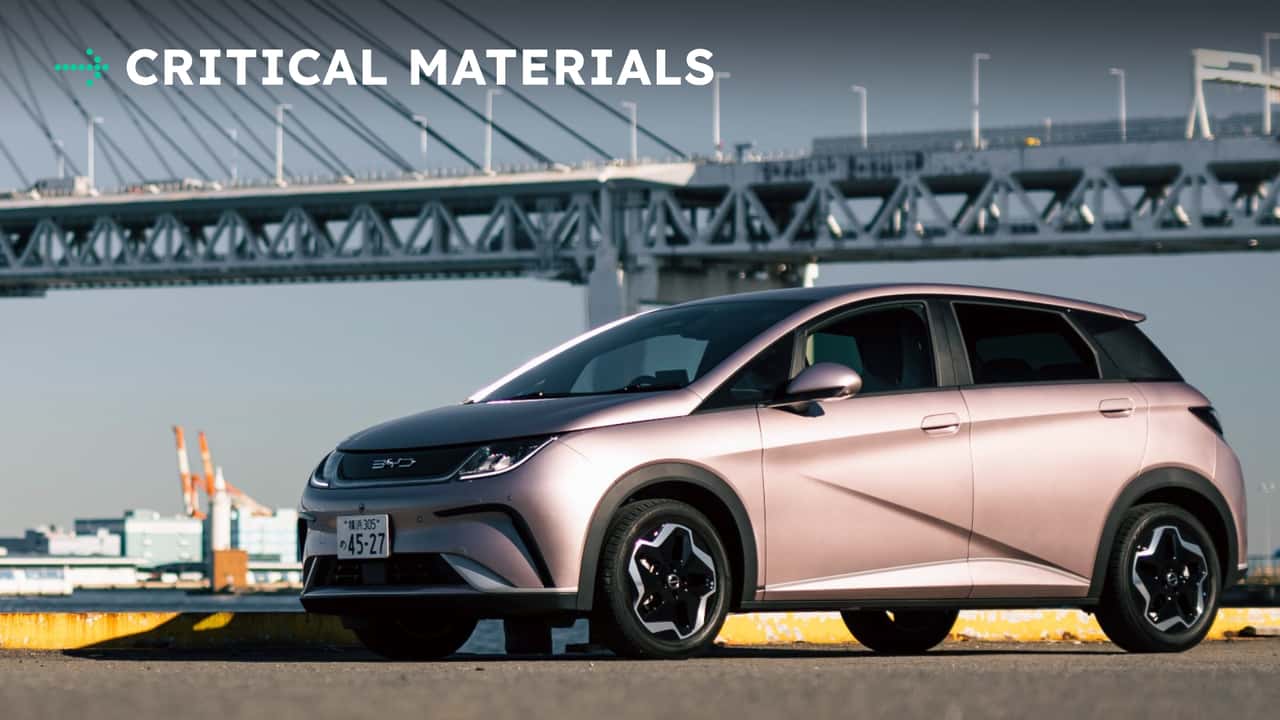
Photo by: BYD
Patrick George 
By: Patrick George
Sep 29, 2025 at 9:24am ET
Add InsideEVs as a preferred source in Google
- (https://twitter.com/intent/tweet?url=https%3A%2F%2Finsideevs.com%2Fnews%2F774030%2Fbyd-japan-critical-materials%2F&text=BYD%20Is%20Stepping%20Up%20Its%20Game%20In%20Japan.%20Here%27s%20What%20It%27s%20Really%20After&via=InsideEVs)
- copy
Share
Comment
Japan's new car market is an infamously tough nut to crack. While you may see the occasional Mini Cooper or Renault in a tight Tokyo parking space, or a well-heeled businessman in a BMW or a Mercedes-Benz, or the supercar set coming out to play at night, Japanese car buyers overwhelmingly favor their domestic brands.
That's why so many people watched Chinese giant BYD's entry into the Japanese market with such interest. BYD is making rapid gains in Europe, Latin America and other parts of Asia; can it do the unprecedented and conquer Japan too? So far, not yet. But there's reason to believe BYD is just getting started there.

Stay informed with our newsletter every weekday
back
Subscribe For more info, read our Privacy Policy & Terms of Use.
That kicks off today's edition of Critical Materials, your daily digest of must-read industry and technology news. Also on deck today: The auto sector in the United States flashes warning signs for the broader economy, and Mercedes explores novel ways to cut its carbon footprint. Let's dig in.
30%: BYD Brings A Familiar Playbook To Japan

BYD Mount Fuji
Photo by: BYD
The people of Japan have very specific tastes when it comes to cars. Small-engined kei cars rule the day, and due to persistent challenges around natural resources and power generation, plug-in cars have never really caught on over there. And when buyers go "foreign," they go with premium luxury brands, usually European ones.
But compact size, fuel economy, affordability and reliability rule the day, and few outsider brands have been able to meet those needs. And most EVs you see there are overwhelmingly Teslas, punctuated by the occasional Nissan Leaf. (I've been to the country twice, and I've never once seen a domestic-market Toyota bZ4X, for example.)
The thinking was that if any EV or plug-in hybrid newcomer could break into Japan, it'd be BYD. But Bloomberg's progress report on BYD's two years of sales in that country indicates things aren't going so hot. So now, BYD is pulling a familiar move to drive up sales: fire-sale price cuts.
The automaker sold just 5,300 vehicles between January 2023 and June this year despite opening its 45th sales location in Japan, introducing a fourth EV model and touting plans to debut an electric ‘kei’ car in late 2026.
The moves have done little to ignite demand and BYD is now turning to discounts—a practice that’s put it front and center of an industry crackdown in China—to try and boost sales. The company is offering discounts of up to ¥1 million ($6,700) that, in addition to government subsidies, can slash sticker prices by as much as 50%. Its Atto 3 retails for just under ¥4.2 million.
It has a decent little lineup there: the Sealion 7 and Atto 3 crossovers, the Seal sport sedan and the Dolphin compact. But the upcoming kei car-sized EV will certainly be the missing piece. And even then, it's hard to say if BYD can pull people away from their proven Hondas, Daihatsus and Suzukis.
But then again, the Japanese new car market is relatively small. About 4.5 million new cars were sold there last year, compared to about 16 million in the U.S. So why does BYD care so much?
According to that story, it's about sending a message:
“Winning Japan isn’t the point; leaving a mark is. Earning even a sliver of recognition from the most demanding customers in the world matters for BYD,” [Bloomberg Intelligence senior auto analyst Tatsuo Yoshida] said. “What they really want is to have a track record of doing business in Japan with the world’s most discerning, quality-conscious customers, even if it’s not economically rational.”
This isn't just about sales, in other words. It's about BYD's rise in the world, wanting to be taken seriously as a global giant on par with General Motors and Toyota and the Volkswagen Group. (This is also why I think U.S. sales of Chinese cars are inevitable, and will probably be led by BYD.)
But as that story points out, the price-slashing carries serious risks. It hurts resale values and profits, as well as dealers and suppliers. The Chinese government has had to crack down hard on those practices. BYD may move the needle in Japan a bit by doing this, but the costs of doing so are abundantly clear.
60%: Why Car Sales Are An Economic Warning In America
I had a professor in college, a longtime former Wall Street Journal editor, who said that cars and houses are a good barometer for any economy. If people aren't buying cars and they aren't buying houses, your economy is kind of cooked.
The third quarter of 2025 ends in a few days and car sales look to be strong during that period. Scores of buyers rushed out to seize the EV tax credit while they could, while others took advantage of other aggressive deals on new cars of all sorts.
But I'm not alone in wondering what happens in Q4, when those deals are gone, and buyers are left with average new car prices hovering around $50,000 still. Here's the Wall Street Journal with more:
CarMax, the biggest seller of used cars, said Thursday that its sales and profit plunged in the latest quarter. The company’s results, which sent its stock tumbling 20%, is the latest in a series of unsettling developments in an industry under strain from President Trump’s tariffs and carmakers’ recalibration of expensive electrification strategies.
“The consumer has been distressed for a little while. I think there’s some angst,” CarMax Chief Executive Bill Nash told analysts on a call Thursday. Consumers with better credit profiles “seem to be sitting on the sidelines,” Nash said.
Ford said this week it was offering lower interest rates to buyers with the weakest acceptable credit histories as it tries to unload unsold F-150 pickups, its bestselling model. Honda said it was scrapping an electric Acura SUV after just one model year. Other brands are offering steep discounts on EVs to capture buyers before a federal tax credit expires next week.
The EV sales surge driven by the end of the tax credit, the WSJ writes, is "masking weakness in the overall market." But tariffs, still-high interest rates, general uncertainty and high prices across the board may portend bigger issues than we all yet realize.
90%: Mercedes Develops Low-Carbon Aluminum
2025 Mercedes-Benz CLA First Drive
Photo by: Andrei Nedelea
It might be back to gas here in America, but automakers are under the gun in Europe to cut their carbon footprints and go net-zero emissions in the coming decades. That doesn't just mean zero-emission cars—it means cutting the CO2 output through the entire supply chain. (We have more about that this week on InsideEVs, too.)
Here's a cool development from Mercedes-Benz, via Reuters:
Aluminium made with renewable power and from recycling is helping luxury automaker Mercedes-Benz cut CO2 emissions in the production of its new line of electric vehicles, part of a wider effort to decarbonise operations, executives told Reuters. Mercedes uses the low-carbon aluminium, developed in partnership with Norwegian metals producer Norsk Hydro, opens new tab, to make its new electric CLA model.
The collaboration is an example of how makers of premium consumer products may pay extra for raw materials in return for a more environmentally friendly profile, executives of both companies said.
"There are, of course, extra costs from using an especially low-carbon steel or aluminium," said Gunnar Guthenke, vice president of Mercedes-Benz's procurement and supplier quality. "Sustainability and desirable products, such as the ones we produce, simply go hand in hand," he said.
While these technologies do represent a cost premium at the outset, they are expected to decline in price over time.
100%: What's Your Prediction For New Car Sales Through The End Of 2025?
2026 Ford F-150 Lightning STX
Photo by: Ford
I do think that in many cases, buyers in America went for EVs because that's where the best deals were, and not so much because of their desire to break up with gasoline. (Realizing those benefits usually comes later.) So what happens in Q4 if the tax credits are gone, fewer EV models are on sale and deals on cars of all sorts are harder to find? Or maybe automakers will keep incentives strong through the end of the year, and the "real" results will be seen in January 2026.
What do you think?
View
Comments
In any case, share your thoughts on what's next in the comments below.
Contact the author: patrick.george@insideevs.com
More EV News
Used Nissan Ariya Prices Are Dropping Like Crazy
Why The Volvo EX60 Will Take Volvo's Battery Game To The Next Level
Don’t Miss These EV Lease Bargains Before They’re Gone
I Saw The Affordable Slate Truck In Person. Now I’m Worried
We want your opinion!
What would you like to see on Insideevs.com?
Take our 3 minute survey.
- The InsideEVs team
Share this Story
- (https://twitter.com/intent/tweet?url=https%3A%2F%2Finsideevs.com%2Fnews%2F774030%2Fbyd-japan-critical-materials%2F&text=BYD%20Is%20Stepping%20Up%20Its%20Game%20In%20Japan.%20Here%27s%20What%20It%27s%20Really%20After&via=InsideEVs)
- copy
GO TO COMMENTS
(
)
Got a tip for us? Email: tips@insideevs.com
View all comments ( )
Trending
A Tesla Model Y Without A Steering Wheel Is Coming: Musk
Rivian’s Also Spinoff Pauses Deliveries Of Its $3,500 E-Bike After Months Of Delays
Genesis Is Finally Getting Into The U.S. Hybrid Market
Americans Bought More Used EVs In October. Fewer Of Them Were Teslas
Latest Stories
- Aptera Finally Built Its First Car For Customer Delivery Nov 19 - News -
- Tesla's Driverless Cybercab Is Now Available In Dallas Nov 19 - Autonomous Vehicles -
- The Next Generation Of U.S.-Made EV Batteries Is Getting Closer To Reality Nov 19 - News -
- Genesis Is Finally Getting Into The U.S. Hybrid Market Nov 19 - News -
- This Hedley Studios Porsche 550 J Is A Shrunken Electric Replica Track Toy Nov 19 - News -
- Americans Bought More Used EVs In October. Fewer Of Them Were Teslas Nov 19 - News -
- Nearly 1 In 5 Tesla Model Ys Failed Their First German Inspection Nov 19 - News -
RECOMMENDED FOR YOU
BYD Is Winning Over Japan With A Very Japanese Kind Of EV
Aptera Finally Built Its First Car For Customer Delivery
BYD's Futuristic EV Charger Can Run On Sunshine And Batteries
Tesla's Driverless Cybercab Is Now Available In Dallas
Land Rover Is Going After BYD Over This Alleged Defender Lookalike: Report
The Next Generation Of U.S.-Made EV Batteries Is Getting Closer To Reality
China's Rolls-Royce Rival Can Do Tank Turns And Charge In 5 Minutes