Home
News
News
China’s EV Market Is Eating Its Own Tail
Years of hefty government subsidies and a brutal price war have put China’s EV industry in a tough spot.
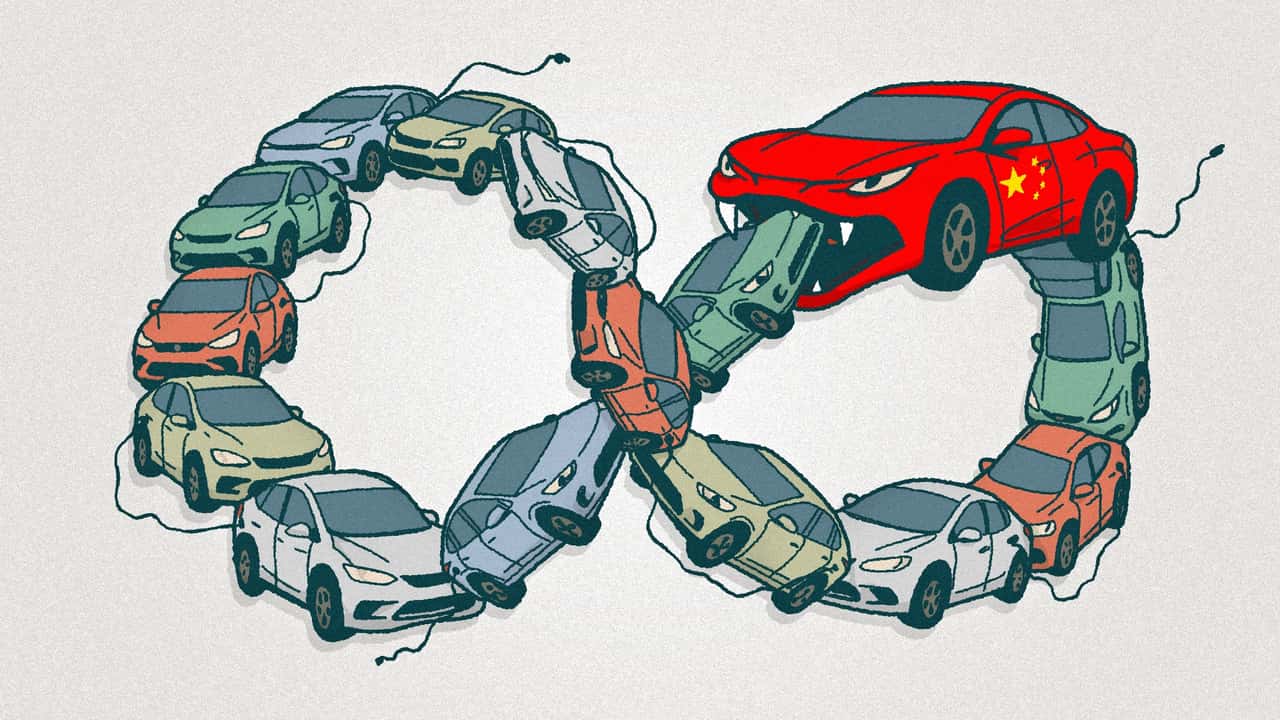
Photo by: Illustration by Sam Woolley
Andrei Nedelea 
By: Andrei Nedelea
Sep 19, 2025 at 12:43pm ET
Add InsideEVs as a preferred source in Google
- (https://twitter.com/intent/tweet?url=https%3A%2F%2Finsideevs.com%2Fnews%2F772659%2Fchina-ev-overcapacity-byd-government-subsidies%2F&text=China%E2%80%99s%20EV%20Market%20Is%20Eating%20Its%20Own%20Tail&via=InsideEVs)
- copy
Share
Comment
- China is building more EVs than it can sell, leaving cars piling up and prices slashed.
- The combination of a price war, "zero-mile used cars" and lots full of new cars that nobody wants to buy shows a broken system.
- Many carmakers in China could die but are propped up by government subsidies, which require them to meet production quotas.
While China’s EV industry looks like an unstoppable and ever-growing juggernaut, there are deep issues bubbling below the surface. Sure, the country's automakers are building a colossal number of very good and very well priced vehicles that are winning over buyers abroad. But these cars are also piling up at dealerships because of overproduction that far exceeds the real demand.
There definitely is appetite for EVs in China, but it’s nowhere near enough to find homes for all the cars being produced. As a result, some local manufacturers are bleeding cash and trying all sorts of shady tactics to get rid of their unsold inventory, like selling zero-mile used cars abroad or just letting them rot in mass car graveyards, Reuters highlighted in a deep-dive report on the issue.
The outlet found that you can buy a brand new locally-manufactured Audi vehicle for 50% off, or a car made by FAW for 60% off its intended list price. There’s a company called Zcar that’s buying these unsold cars in bulk and selling them at huge discounts. You can even buy brand new, heavily discounted cars in TikTok livestream fire sales in China, the outlet notes.
The bargain bin prices are a symptom of a much larger problem: After years of hefty government subsidies and ambitious production targets, Chinese companies now have the capacity to churn out double the 27.5 million cars they produced in 2024, according to a consulting firm cited by the outlet.

Stay informed with our newsletter every weekday
back
Subscribe For more info, read our Privacy Policy & Terms of Use.
That, and the cutthroat competitive environment it's created, has led to a brutal, years-long price war between manufacturers. Analysts project that only a fraction of China's roughly 130 plug-in vehicle manufacturers from China will survive into the next decade, Reuters says.
Chinese officials are reluctant to car brands die en masse, though, the outlet explains. That is why the government continues to heavily subsidize production (which abroad is seen as unfair competition, hence the hefty import duties that Chinese EVs face in many places). It would mean lost jobs and it would make the country look bad on the global stage, where it’s trying to portray itself as both a production and an EV technology powerhouse. It is exactly that, although its EV industry may not be on as sure footing as most people think.
Even the biggest names like BYD also seem to be wobbling and it's reportedly resorted to taking people who speak negatively about the brand to court. BYD lowered its sales projection for 2025 from 5.5 million vehicles to 4.6 million, and even that may be optimistic. Reuters noted in its very extensive investigation that it found 5,100 auction notices for brand-new BYD vehicles on Alibaba, all of which had been registered and insured, so they essentially counted as vehicles sold and delivered.
 China’s Xpeng Is Now Building EVs In Europe
All Current And Upcoming U.S. EVs With LFP Batteries
'This Is Game-Changing': BYD Brings EV Production, Megawatt Charging To Europe
This Chinese Brand Just Resurrected Its Most Infamous Car As An EV
Forget Xiaomi, A Chinese Vacuum Maker Wants To Take On Bugatti
China Is In Love With This Smartphone Company's EVs. Its Next Stop: Europe
Because of the fierce competition back home, Chinese automakers are now, for the first time ever, spending more abroad than they do at home. Several big car brands from China are setting up production facilities in places like Europe, where they hope to build and sell cars while avoiding tariffs. BYD, China's biggest EV maker, recently announced that its first European-built car will be the bargain-bin Dolphin Surf. It goes into production in Hungary later this year.
This idea of meeting often unrealistically large government-imposed production quotas regardless of whether there is or isn’t a market for all the products being made sounds all too familiar. Even if China tries to portray itself as a special kind of communist-capitalist hybrid that works so well it has succeeded in dominating the global market, this practice has nothing to do with capitalism. It’s also unsustainable long-term, bad for the economy and bad for the environment.
What do you think?
View
Comments
Officials may have finally realized the scale of the issue and are now calling for an end to the price wars and EV overinvestment. And yet, as Reuters reports, as recently as June one province offered up hundreds of millions of dollars over time to automakers who could ultimately boost the region's annual EV and hybrid production by 1.5 million vehicles.
If things really are as bad as Reuters says, then something's got to give—and soon.
We want your opinion!
What would you like to see on Insideevs.com?
Take our 3 minute survey.
- The InsideEVs team
Share this Story
- (https://twitter.com/intent/tweet?url=https%3A%2F%2Finsideevs.com%2Fnews%2F772659%2Fchina-ev-overcapacity-byd-government-subsidies%2F&text=China%E2%80%99s%20EV%20Market%20Is%20Eating%20Its%20Own%20Tail&via=InsideEVs)
- copy
GO TO COMMENTS
(
)
Got a tip for us? Email: tips@insideevs.com
View all comments ( )
Trending
I Tried Mercedes' Answer To Tesla FSD. Here's How It Went
Driven: BMW's Electric M3 Is The Real Deal
Tesla Opens Self-Driving Cybercab Orders To 'Select Customers' At $29,990
Tesla Model 3 Maintenance Guide: What Needs Servicing And What Doesn't
Latest Stories
- The Electric Baby Land Rover Defender And Range Rover GT Will Begin Production Next Year Nov 16 - News -
- Mercedes Is Bringing Hands-Free Driving To Certain U.S. Highways In 2027 Nov 16 - News -
- Tesla Keeps Killing Cars. Now It Wants To Build Cybercabs In Germany Nov 16 - News -
- Tesla Model 3 Maintenance Guide: What Needs Servicing And What Doesn't Nov 16 - Repair / Maintenance -
- Audi A2 e-tron First Drive: Does The Iconic Nameplate Live Up To The Hype? Nov 16 - First Drives -
- I Tried Mercedes' Answer To Tesla FSD. Here's How It Went Nov 16 - Tech Review -
- BMW Just Started Making EV Batteries In America. The New iX5 Will Be First In Line Nov 16 - Manufacturing / Production -
RECOMMENDED FOR YOU
The Electric Baby Land Rover Defender And Range Rover GT Will Begin Production Next Year
Tesla Model 3 Maintenance Guide: What Needs Servicing And What Doesn't
Mercedes Is Bringing Hands-Free Driving To Certain U.S. Highways In 2027
Audi A2 e-tron First Drive: Does The Iconic Nameplate Live Up To The Hype?
Tesla Keeps Killing Cars. Now It Wants To Build Cybercabs In Germany
I Tried Mercedes' Answer To Tesla FSD. Here's How It Went
Diesel Prices Are Surging. This Electric Trucking Company Is Seeing More Interest