
Toyota Is Using Old EV Batteries To Power Mazda’s Car Factory
The system integrates whole battery packs, including inverters, as a buffer in the factory’s energy supply.


- Used battery packs from electric and hybrid cars are being repurposed by Toyota in Japan.
- Toyota’s Sweep Energy Storage System, which uses high-voltage car batteries, was implemented at Mazda’s Hiroshima plant.
- The modular system was designed to act as a buffer between the factory’s power supplies and the assembly line.
Handling high-voltage batteries from hybrid and all-electric vehicles is never easy. If a car was totaled in a crash, but the battery is still in good shape, it can still be used for years without having to take a trip to a recycling facility–or worse, to a landfill.
One way to manage old EV batteries is to repurpose them into stationary storage. And that’s exactly what Toyota has done in Japan, where its Sweep Energy Storage System was installed at Mazda’s car factory in Hiroshima.
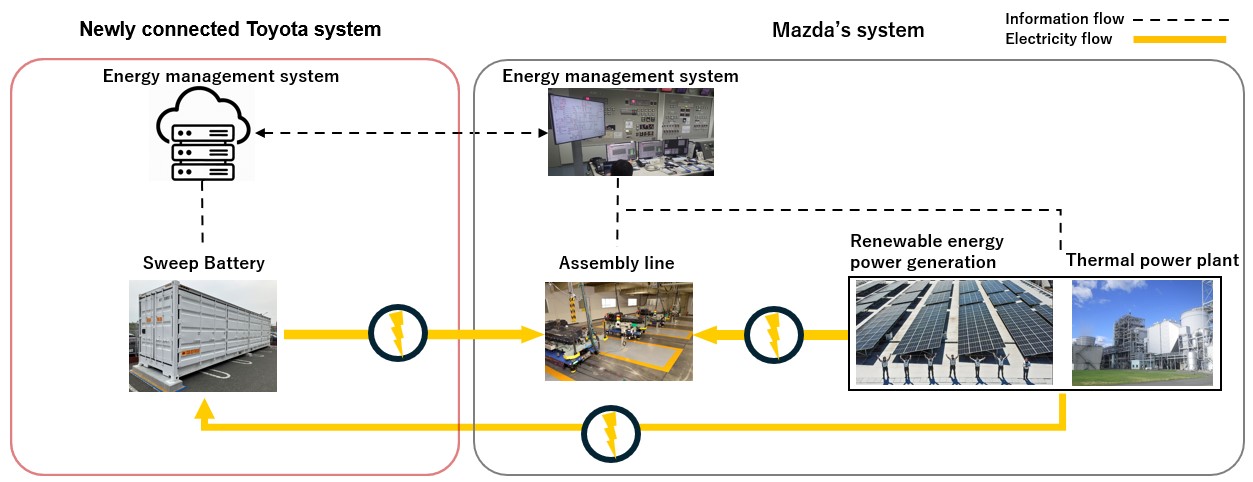
The Sweep Battery, which uses packs from electrified vehicles, is still in its testing phase at Mazda, where the stability of charging and discharging cycles is being monitored to see if it’s up to the task of powering the factory–or at least part of it.
In the future, though, the modular battery will act as a buffer between the factory’s solar plant and the assembly line, much like a home battery pack works. The big difference between the two, however, is that Toyota found a way to integrate the cars’ original inverters, eliminating the need for a separate unit that manages the entire pack. The system also uses batteries of different capacities, chemistries and states of health.
More Stories Like This
The first Sweep Energy Storage System was built in 2022 in collaboration with Jera, Japan’s largest power generation company and one of the largest liquefied natural gas (LNG) buyers in the world.
Jera’s modular battery pack could output 485 kilowatts and had a storage capacity of 1,260 kilowatt-hours from several types of batteries, including lithium-ion, nickel-metal-hydride and lead-acid.
To handle all the different types of batteries that also have different capacities, Toyota’s proprietary “sweep” device can control the energy discharge of the whole pack by switching the electricity flow on and off through series-connected batteries in microseconds. As a result, some batteries can be bypassed, while others remain online, depending on the energy draw.

RECOMMENDED FOR YOU

Why Do So Many EVs Still Have On Buttons?
Telo Says Its Tiny EV Truck Can Tow More Than A Base Ford F-150
Toyota Is Paying EV Drivers $3,000 To Switch To A bZ
Volvo's New EX50 Will Be A Sub-$50,000 Tesla Model Y Fighter: Report
Toyota And BMW Are Testing Renewable Gas As An Alternative To EVs
Ford Recalls 86,000 Mustang Mach-E EVs Over Flying Window Trim Risk
The 16 Cheapest Electric Cars In 2026