
Here’s What A Zero Star EV Crash Test Looks Like
Lacking basic safety equipment like seatbelt pre-tensioners and load limiters, the Neta V is becoming famous for all the wrong reasons.


- Neta V scored zero out of five stars after being crash-tested in Malaysia.
- The entry-level EV got zero points for the frontal offset crash test, as well as the motorcycle safety test.
New cars are supposed to be much safer than their predecessors. With cutting-edge development and manufacturing techniques, you’re more likely to walk away from a car crash today than you were a decade ago. Sure, the car might be totaled, but that’s just metal, it can be replaced–your life can’t.
That’s the idea, at least. But not all cars are created equal. Enter the Neta V, a Chinese-made relatively affordable electric car that’s also sold in Malaysia, Brunei, Indonesia and Thailand. It’s a front-wheel drive subcompact crossover with a theoretical range of up to 249 miles and basic amenities.
Priced between the equivalent of about $18,000 and $22,000, depending on the market, it’s billed as a “Stylish and Intelligent SUV for Young.” It’s also one of the least safe new cars on sale in the world today.
More EV Safety
After being crash tested by the New Car Assessment Program for Southeast Asian Countries (ASEAN NCAP), the Neta V received a total safety score of zero stars out of five. Similar performances–or rather, disappointing results–were scored by the venerable Renault Zoe EV, as well as another Chinese-made EV, the JAC E10x.
According to ASEAN NCAP, the Neta V got zero points for the frontal offset crash test, where the driver dummy had “poor protection on the head, neck, chest and lower leg.” The Motorcycle Safety score was also zero. For what it’s worth, the EV got some points for adult occupant protection, child occupant protection and safety assist systems for a grand total of 28.55 points out of 100 possible.

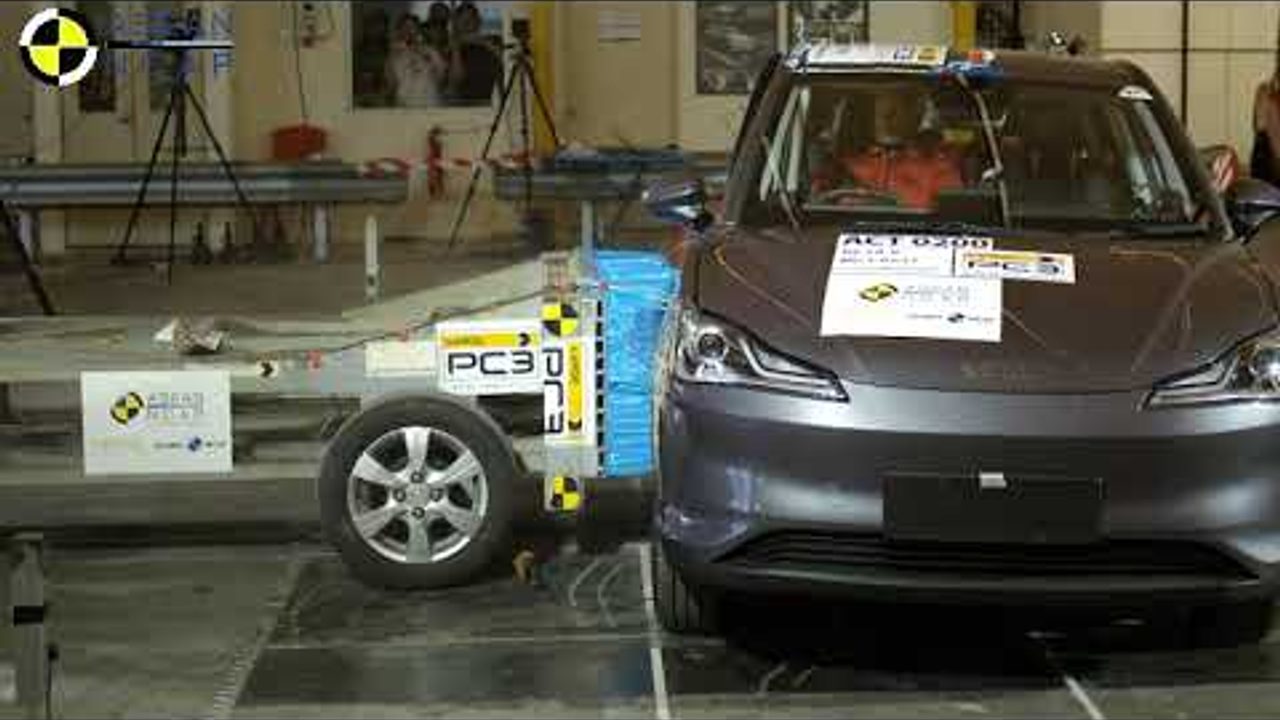
Gallery: Neta V ASEAN NCAP Zero Star Crash Test


After the frontal offset crash test, where the car moves at 40 miles per hour before slamming into a barrier, the A-pillar and steering wheel were displaced from their original position. ASEAN NCAP noted that the EV has a “weak body structure” and “compromised restraint system” that greatly endangers occupant safety.
The Neta V comes as standard with just two front airbags, a seatbelt reminder for the driver, ABS and stability control. There are no advanced driver assistance systems (ADAS), no seatbelt retractor pre-tensioners and no seatbelt load limiters.

RECOMMENDED FOR YOU
Tesla Fire Destroys 17 Vehicles In Rome: What We Know So Far
This 100-Year-Old EV Came With More Range Than The First Nissan Leaf
This Dodge Charger Daytona Is Already Wrecked. No One Knows Why
Xiaomi's First EV Just Hit A Massive Milestone
Whoops: Someone Already Crashed A 1,526-HP Xiaomi SU7
LG Energy Solution's Newest Battery Megafactory Just Kicked Off Production
Why You're Less Likely To Get Rear-Ended By An Electric Car