Home
News
Range / Efficiency
It’s Time To Criticize MPGe, Again
Amidst faulty range claims and brewing scandal, the EPA’s own EV efficiency metric could use an overhaul.
Kevin Williams 
By: Kevin Williams
Aug 2, 2023 at 4:42pm ET
Add InsideEVs as a preferred source in Google
- (https://twitter.com/intent/tweet?url=https%3A%2F%2Finsideevs.com%2Fnews%2F679972%2Fmiles-per-gallon-equivalent-needs-to-change%2F&text=It%E2%80%99s%20Time%20To%20Criticize%20MPGe%2C%20Again&via=InsideEVs)
- copy
Share
Comment
Recent reporting from Reuters, Consumer Reports, and other independent research has exposed flaws in how Tesla calculates the “official” range figures that are messaged to customers. Now, like any large corporation that uses questionable business practices, Tesla deserves the full brunt of whatever comes its way.
But, the Reuters report et al highlight a huge issue we have with electric vehicle communication – we don’t know how to talk about electric vehicle range, or consumption. How do we calculate the range of an EV anyways?
Reuters Reveals Tesla's Secret Range Complaint Team
 Tesla Set Up Secret Team To Stifle Thousands Of Range Complaints: Report
Calculating the cruising range of a gas-powered vehicle is simple. The Environmental Protection Agency (EPA) takes the combined fuel economy rating, and multiplies that by the number of gallons the tank is capable of holding. For example, the 2023 Ford Mustang 2.3-liter Ecoboost is good for 24 miles per gallon combined, highway and city. It has a 15.5-gallon tank, making the Mustang capable of a 372-mile range, on gas.
In theory, calculating the range of an electric vehicle should be easy. Range is simply the function of average energy consumption, divided by the maximum usable battery capacity, similar to a fuel-powered vehicle. But, in practice, the calculation is more complicated.
Like any fuel-powered vehicle, an EV’s power consumption numbers are generated via a test on essentially what is a large treadmill. Because the testing is performed indoors with only the wheels moving, the resultant economy numbers are run through a formula that compensates for the lack of wind resistance and other factors not present in the indoor testing environment. That number generates a miles per gallon equivalent, or MPGe, where the vehicle’s power efficiency is equated to that of a gasoline-powered vehicle.
One gallon of gas is equivalent to 33.7 kilowatt hours of electrical energy. It can be hard to conceptualize, but essentially cars like Chevy Bolt EUV can go more than 200 miles on the equivalent of about two gallons of gas. That efficiency results in a fantastic MPGe number, often well into the hundreds.
Yet, those fantastically large numbers don’t really mean much when examined closely. At least from the EPA calculations, MPGe is a borderline useless metric.
MPGe Explained
Electric Vehicle Efficiency Explained: What Is MPGe?
For starters, MPGe may be a useful metric for calculating an EV’s efficiency against an internal combustion engine car, but comparing the power consumption amongst EV models is hazier. How much more efficient is a car that achieves 121 MPGe compared to one that gets 98 MPGe? It’s hard to conceptualize how to equate electricity to gallons. An EV didn’t fill up with liquid fuel at a gas station, it doesn’t travel 98 miles on one gallon of electrojuice. EVs consume energy measured in kilowatt-hours over the distance they travel.
Secondly, unlike ICE cars, recharging an EV isn’t the same as simply pouring gasoline from one container into another. Electric vehicles will experience charging losses. Whether it's from the vehicle’s energy management software, outside temperature, or the charging station itself, electric vehicles will consume more than their battery can hold when taking into account the energy needed to replenish the battery.
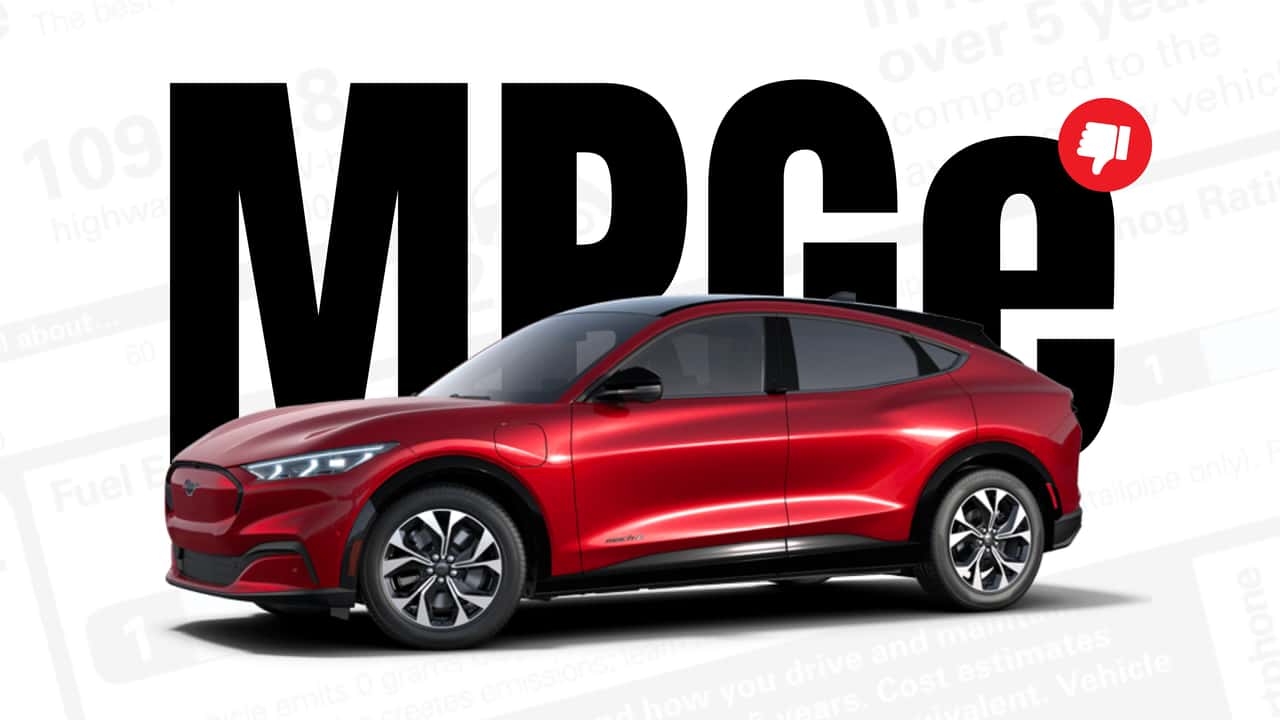
For example, the standard-range Ford Mustang Mach-E may have 68 kWh of usable battery capacity, but it could take 80 kWh worth of energy to completely charge itself. The EPA factors those lost electrons into the total MPGe rating, skewing the numbers for real-world use. Although that system can be quite helpful in calculating the vehicle’s overall power consumption (including charging), it’s not a great way to figure out what the on-the-road power consumption actually is.
Arguably worst of all, the MPGe numbers on the vehicle’s window sticker don’t correlate to the on-the-road range. Some brands are worse than others; The Tesla Model 3 would need to average 4.77 miles per kWh to reach its 358-mile range from its 75 kWh battery. Yet, its MPGe score says the Model 3 can only achieve 3.88 miles per kWh, which would only be 291 miles of range.
Consumer Reports Tests Tesla's Range Claims
Tesla Model Y Fails To Meet Range Claims Year Round: Consumer Reports
Reuters found that EV manufacturers can choose to calculate the range the EPA’s way, or it can do additional testing to generate a new range rating. So really, none of the EV efficiency ratings on a vehicle Monroney sticker mean diddly squat to the average driver. The EV range can’t be calculated with a simple consumption vs battery capacity model, because the numbers do not reflect what the car is actually consuming in real-time.
This is confusing for consumers, who need accurate mile per kWh consumption figures to gauge what the car can do on the road. An electric vehicle’s power consumption can increase with faster driving speeds, and during cold weather. Understanding that consumption rate is necessary to calculate a vehicle’s range. Without it, the driver is left to sort of ascertain the range from the dwindling number on a car’s dashboard, with no real understanding as to how that figure is being generated.
What do you think?
View
Comments
The vast majority of modern electric cars use the standard miles per kWh metric as a gauge of power consumption, (except Tesla, which uses watt hours per mile), accurately calculating said number whilst on the move. However, the power consumption numbers displayed on an EV’s dashboard, won’t be found on a vehicle’s Monroney sticker. Consumers are seduced by amazing range numbers, but there’s no real understanding as to what it takes to get there. Thus, when the car doesn’t (or can’t) live up to range claims, customers are disappointed.
No manufacturer should be let off the hook for intentionally inflated range claims.. But, knowledge is power – if consumers understand how their EV works, then they’ll be far happier gas-free drivers.
More Info On EV Efficiency
Tesla Model 3 And Model Y: Hacks For Squeezing Out The Most Range
Tesla Says Model Y AWD Is "Most Efficient Electric SUV Ever Built"
We want your opinion!
What would you like to see on Insideevs.com?
Take our 3 minute survey.
- The InsideEVs team
Share this Story
- (https://twitter.com/intent/tweet?url=https%3A%2F%2Finsideevs.com%2Fnews%2F679972%2Fmiles-per-gallon-equivalent-needs-to-change%2F&text=It%E2%80%99s%20Time%20To%20Criticize%20MPGe%2C%20Again&via=InsideEVs)
- copy
GO TO COMMENTS
(
)
Got a tip for us? Email: tips@insideevs.com
View all comments ( )
Trending
Every EV Motor Type Explained: They Aren't All The Same
Every Kind Of Hybrid Explained: Parallel, Series, EREV, PHEV, MHEV
I Tried Mercedes' Answer To Tesla FSD. Here's How It Went
Tesla Model 3 Maintenance Guide: What Needs Servicing And What Doesn't
Latest Stories
- REO Runabout vs. Slate Truck: Which Sub-$30,000 Truck Is Better? Nov 17 - News -
- Chevy, GMC, and Cadillac EV Owners Can Now Plug And Charge At Electrify America Nov 17 - Charging -
- Every EV Motor Type Explained: They Aren't All The Same Nov 17 - EV 101 -
- Amflow Made A Commuter E-Bike. I Tested It, And It's Really, Really Good Nov 17 - E-Bike Reviews -
- Every Kind Of Hybrid Explained: Parallel, Series, EREV, PHEV, MHEV Nov 17 - EV 101 -
- BYD Is Winning Over Japan With A Very Japanese Kind Of EV Nov 17 - News -
- Bentley’s First EV Is Already Sold Out, And Production Hasn’t Even Started Nov 17 - Sales -
RECOMMENDED FOR YOU
BMW’s iX5 Beat The Lucid Gravity On Highway Range. Not On Efficiency
REO Runabout vs. Slate Truck: Which Sub-$30,000 Truck Is Better?
Tesla Just Bumped The Cheapest Model Y’s Range, But The Price Stays The Same
Chevy, GMC, and Cadillac EV Owners Can Now Plug And Charge At Electrify America
This BMW i3 Drove 3,658 Miles. It Needed Less Than 3 Hours Of Charging
Every EV Motor Type Explained: They Aren't All The Same
This Mercedes Went 539 Miles On A Charge. Is Range Anxiety Finally Dead?