
Check Out This Flooded Tesla Supercharging Station: Does It Still Work?
But more importantly, is it safe?


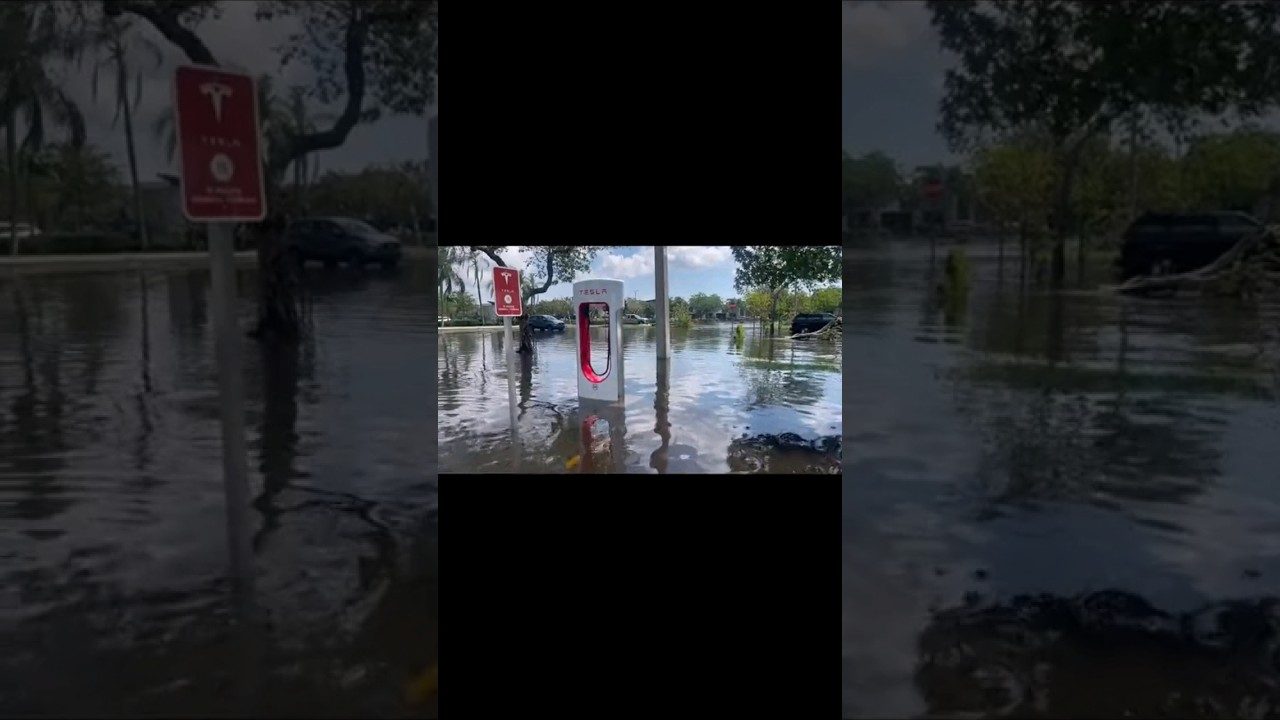
Today we came across an interesting video about a flooded Tesla Supercharging station, most likely somewhere in the United States.
As we can see in the video, provided by Twitter user Jeremy Judkins (@jeremyjudkins_), not only is the station under water but the entire area is flooded.
The water is not very deep - about 10-12 inches according to the video, which theoretically allows you to drive to the stall, open the doors without flooding the vehicle itself, and to connect and charge - if the station is up and running.
However, the description above the video is: "Would you charge at a flooded Tesla Supercharger?" The safety concern is always very important.
The author of the video says that he needs just nine minutes of recharging to continue his journey.
We assume that the Tesla Supercharging station is working just fine, just like in the rain or snow. As we understand, as long as the water does not exceed a critical level for the stall and the power electronic cabinet (somewhere nearby), everything should be fine.
Anyway, because electricity and water are potentially a dangerous combination, the main question is whether it is really safe, especially is it safe if there is some additional faulty element in the electrical circuit on the charger or the car side?
For your convenience, we attached also a YouTube version of the video:

Flooded charging stations happen from time to time, just like in the case of flooded roads or houses. Below we can see a different site, in Europe, which was heavily flooded to a point at which there was no possibility of even accessing the stalls.
This might be the answer for us - the station will work, as long as you can access it (charging in standing water would then be a secondary safety issue).

Let's note that the electric vehicle charging systems, both AC and DC, are designed from the start to prevent users from a current short. Voltage is turned on after mechanical connection and digital (low-voltage) handshake between the car and the charger. Additionally, during charging, the current should be shut down immediately after detecting any issue (temperature-wise, or a coolant leak, or even an isolation fault or other problems).
See also
RECOMMENDED FOR YOU

One Owner Just Did What Tesla Couldn't: Upgrade An Older Car To HW4
Europe’s EV Sales Explode, Now Making Up A Quarter Of New Cars
Tesla’s New Three-Row EV Is The Longest-Range Model Y Tested By Edmunds
Walmart's EV Charging Network Just Hit A Big Milestone: 100 Stations In 20 States
Home EV Charging Has A Hidden Cost. Here’s How To Reduce It And Lower Your Bill
Rivian EVs Are Getting A Software Update That Makes It Easier To Dodge The Cops
Tesla’s Mainstream Model Y Gets A Feature Hyundai EVs Have Had For Years