
Polestar Invests In Extreme Fast Charging Battery Company StoreDot
The company follows in the footsteps of Volvo, which announced a similar move in April.


Polestar announced that it has made its first financial investment in another company - StoreDot, an Israel-based start-up engaged in the development of silicon-dominant extreme fast-charging batteries.
Becoming a shareholder in StoreDot is expected to unlock access to the technology of recharging enough energy in 5 minutes for 100 miles (160 km) of range (although the exact range replenishing speed depends on the battery size/car model and its average energy consumption).
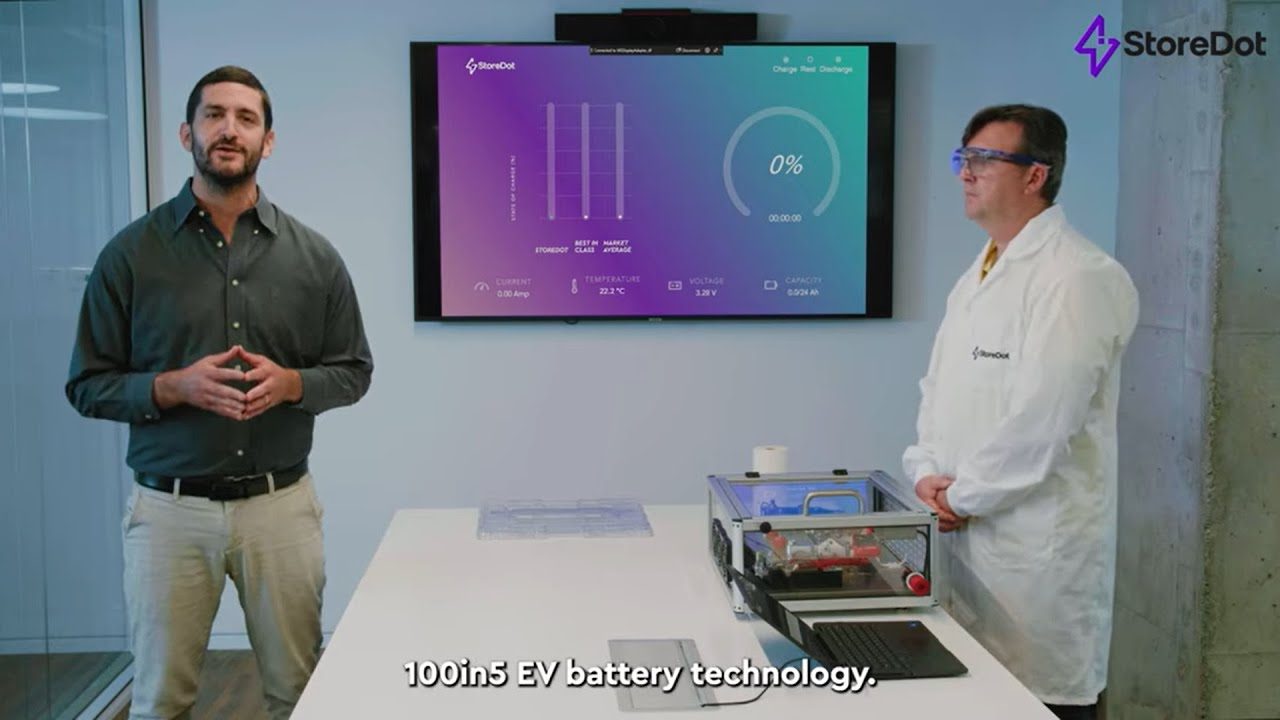
StoreDot recently demonstrated the "100in5" technology for a 20 Ah pouch battery cell, which allowed to recharge from 0-50% state-of-charge (SOC) in 5.5 minutes, 0-80% SOC in roughly 9 minutes, and 0-86% SOC in 10 minutes.
If such a system was applied to a car with 250-300 miles of range, the charging time to replenish 100 miles of driving range would really be just several minutes (while starting at a very low SOC). Within 10 minutes, the car should be ready for another 200 miles of driving.

Polestar's investment in StoreDot is not a big surprise, as in April the path was pioneered by Volvo Cars.
Polestar expressed hopes that the technology might be used in future models as early as 2026 "If our current pilot projects with StoreDot are successful". In the next few years, we may see some test/concept cars with the tech.
"As part of the strategic deal, Polestar is collaborating with StoreDot to explore adapting and applying their technology to proof-of-concept Polestar cars. Test cases already being explored include customizing StoreDot’s cell technology for Polestar cars, to enable faster charging and improved circularity."
Polestar CEO, Thomas Ingenlath said:
“Polestar can help shape the development of new battery technology for the automotive industry and provide invaluable insights from the perspective of a brand focused on performance and sustainability,”.
It's important to note that the acceleration of fast charging is not only a simple reduction of time spent at the charging point. The most important factor is probably that reducing the charging time to a comparable level of refueling a car might expand the EV market, because there are still many people concerned about range and charging, especially without a private home charging spot.
More about fast charging
RECOMMENDED FOR YOU

Volvo Wants To Make You A Safer Driver—And Lower Your Insurance Bill
This Tesla Model Y Lost 9% In One Year. Its Owner Isn’t Worried
EVs Don’t Need This Gas Car Feature. So Why Do So Many Still Have It?
This Chinese Electric SUV Just Recreated Mercedes’ Most Controversial Ad
Volvo's New EX50 Will Be A Sub-$50,000 Tesla Model Y Fighter: Report
The Porsche Taycan’s Days May Be Numbered: Report
All The EVs That Got Canceled Or Delayed In 2025 And 2026 (Updated)