
Tesla CEO Elon Musk: Redesigning The Battery-Electric Car
While Tesla's Battery Day delivered impressive advancements surrounding EV batteries, there was much, much more.


At long last, Tesla's highly-anticipated Battery Day has happened. And we've had some substantive time to process the information. Elon Musk and his team of "hardcore engineers" uncovered a lot of mission-critical, behind-the-scenes info related to what Tesla's been secretly working on. And, it turns out, it's bigger than simply batteries.
 |
The emphasis of Tesla's Battery Day was, of course, on redesigning the battery. However, what many missed was this: Elon Musk is also completely redesigning the battery electric vehicle.
First, it's important to understand Tesla's Giga castings. To provide some context, Musk noted that the Giga casting machine commissioned at the Tesla Fremont factory will be the largest casting machine ever built. His presentation slide (see below) shows that the Model Y rear underbody single-piece casting reduces 40% cost of production and excludes 79 parts in the process.
 |
Reduced manufacturing process complexity will be a massive benefit moving forward for Tesla. In essence, there's a significant number of fewer parts required. In turn, this will be reduce the amount of time needed to produce each car.
 |
In addition, Tesla is using a wholly-new material for the Tesla Model Y front and rear underbody Giga Castings. In order to make the entire Model Y rear underbody a single-piece high-pressure diecast aluminum, Tesla actually had to develop its own high-strength alloy which doesn't require heat treatment or metal coatings.
 |
In traditional alloys, if you heat treat a large single-piece casting, it starts to deform. According to Musk, "It’s just like the potato chip thing, it’s very hard to keep a large casting to have [it maintain] its shape. So in order to achieve this, there’s no alloy that existed that could do this. So we developed our own alloy, a special alloy of aluminum, that has high-strength, without heat treatment, and is very cast-able."
After the single-piece front and rear castings are made, the battery pack will also now play two roles. One as a source of energy and the other as a structural component that binds and strengthens these two large body castings.
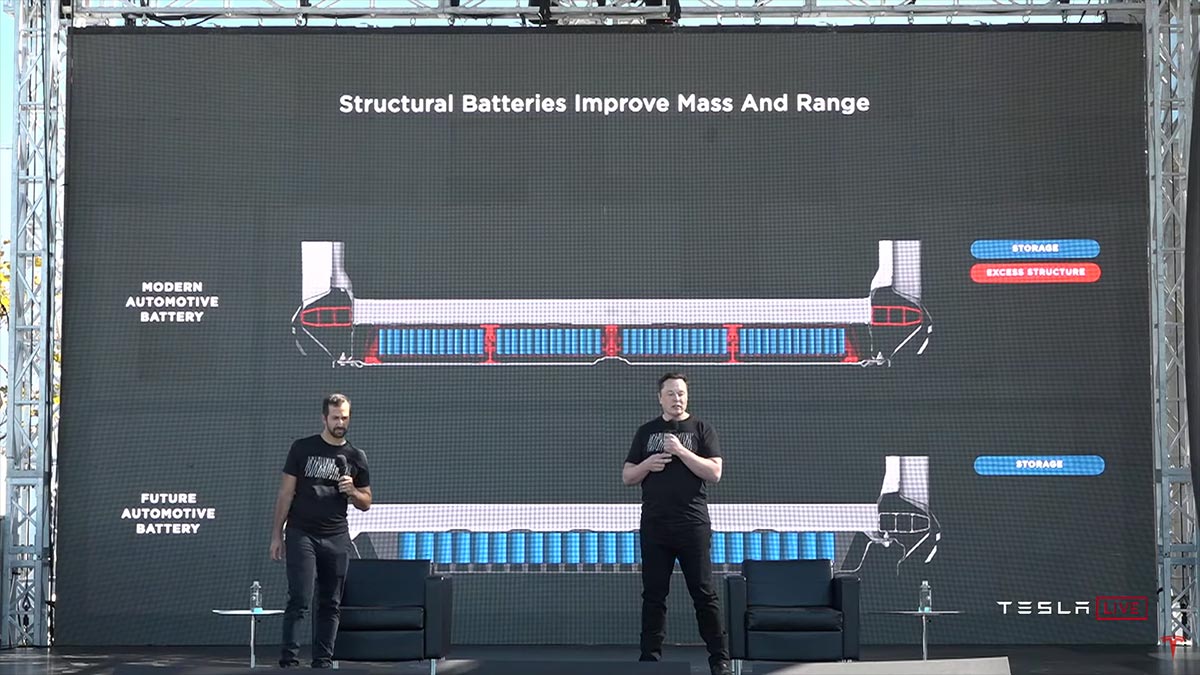 |
Use of structural batteries, according to Tesla, will reduce 370 parts currently in use and has a potential of +14% range gain and 10% mass reduction. Meanwhile, a structural battery allows the cells to be closer to the center of the car — this phenomenon reduces the probability of a side impact potentially reaching the cells. This also improves the polar moment of inertia resulting in improved handling and safety of the car.
Check Out More Tesla Articles:
While Tesla's Battery Day delivered impressive advancements surrounding EV batteries, there was much, much more. The entire architecture of battery electric vehicles could change as a result of Giga castings, new alloys, and the use of a structural battery. According to Elon Musk, "It’s the way that all electric cars in the future will ultimately be made. It’s the right way to do things."
====
Written by: Iqtidar Ali. An earlier version of this article was originally published on Tesla Oracle.
Source: Evannex
RECOMMENDED FOR YOU

Tesla Roadster Is Supposedly (Once Again) Coming 'Very Soon'
Study: DC Fast Charging Satisfaction Is Up, And Ionna Takes The Top Spot
Tesla Recalls 20,000 Cars Over Uber-Bright Headlights
Here's A Mechanic's Take On The Subaru Trailseeker
Tesla Burned Through Its California EV Rebate Funds In Just Five Days
Mitsubishi Taps iPhone Manufacturer For its Next EV
How Much Quicker Is The Newest Version Of Tesla FSD? This Test Put It Against Old Software To Find Out