Home
News
Sales
BloombergNEF: Europe And South Korea Want EVs, But The U.S. Prefers Gas Cars
This is what the more detailed forecast numbers allow us to conclude.
Gustavo Henrique Ruffo 
By: Gustavo Henrique Ruffo
May 20, 2020 at 4:53pm ET
Add InsideEVs as a preferred source in Google
- (https://twitter.com/intent/tweet?url=https%3A%2F%2Finsideevs.com%2Fnews%2F424420%2Feurope-south-korea-love-evs-us-ice%2F&text=BloombergNEF%3A%20Europe%20And%20South%20Korea%20Want%20EVs%2C%20But%20The%20U.S.%20Prefers%20Gas%20Cars&via=InsideEVs)
- copy
Share
Comment
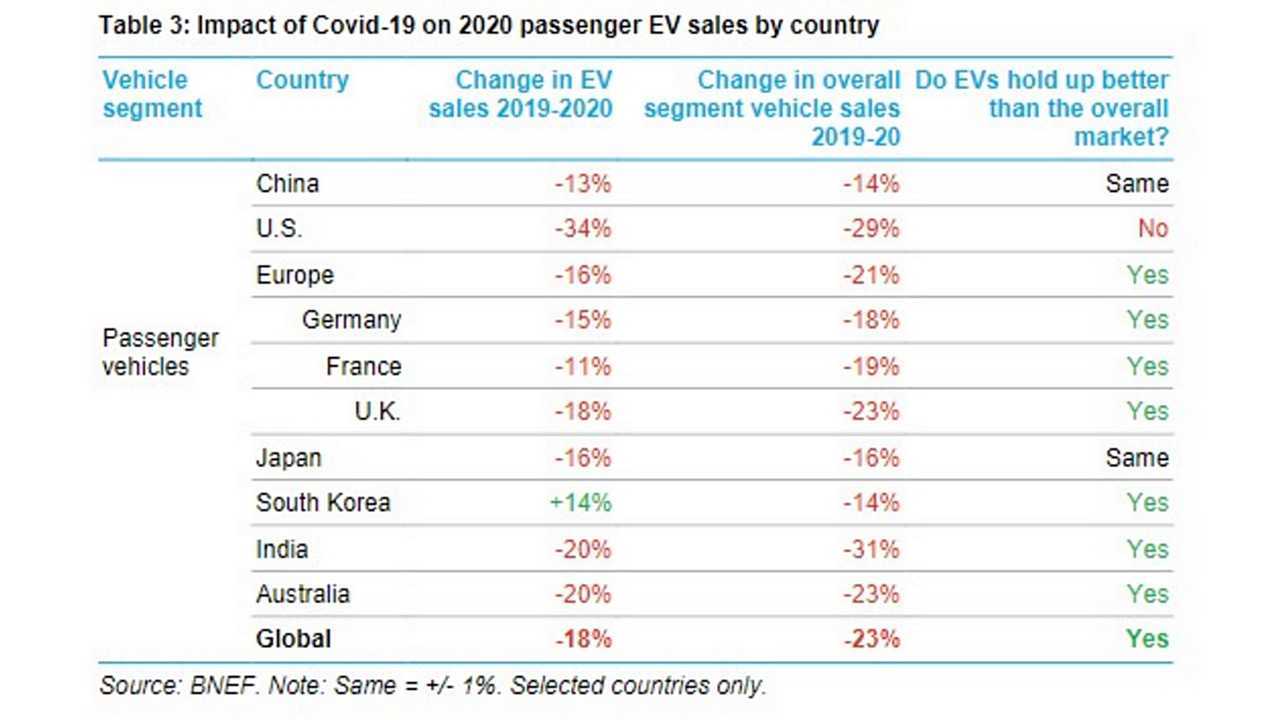
Our first report on BloombergNEF's EVO 2020 – Electric Vehicle Outlook 2020 – showed EVs have a bright world perspective ahead. The forecast for them – even with COVID-19 doing all it can to disturb – is that they will gain market share by resisting the nosedive caused by the virus. We supposed more mature markets would show even better numbers, but the answer is "yes and no." Yes, for South Korea and Europe, which have a much higher demand for EVs than they have for combustion-engined automobiles. No, for the US, which clearly prefers ICE vehicles to electric cars.
Just check the numbers in the image above. In Europe, combustion-engined vehicle sales will fall 21 percent in 2020, while EVs will lose only 16 percent of what they sold in 2019. In China, EVs lost slightly fewer sales than ICE cars: 13 percent against 14 percent. BloombergNEF considers that as a tie.
More EV Adoption News:
 In General Sales Decline Times, EV Market Share Will Rise By Falling Less
When we get to US numbers, EV sales will probably fall 34 percent, while combustion-engined car results will be 29 percent worse than a year ago. Ironically, it is the same 5 percent difference – 18 percent against 23 percent, respectively – that the world presents in favor of EVs, but upside down. In the US, the difference privileges fuel-burning machines.
What do you think?
View
Comments
The positive note on the numbers BloombergNEF shared with us is South Korea. While combustion-engined vehicle sales there are expected to drop 14 percent, EV sales will not be negative as in the rest of the world. They will probably increase by the same 14 percent. With a 38 percent difference in favor of EVs, one can expect electric cars there to achieve more significant market shares sooner than the rest of the countries.
When cheaper and more durable battery packs, such as the one SVolt will sell in 2021, we will probably see a much faster migration towards electric cars. They will not need government incentives to attract new customers. Will these new technologies be able to convince the US that EVs are the future? Or that the metric system is much better than imperial? The US has a very unique way, but we hope it joins the rest of the world's tastes for electric mobility. The sooner, the better.
We want your opinion!
What would you like to see on Insideevs.com?
Take our 3 minute survey.
- The InsideEVs team
Share this Story
- (https://twitter.com/intent/tweet?url=https%3A%2F%2Finsideevs.com%2Fnews%2F424420%2Feurope-south-korea-love-evs-us-ice%2F&text=BloombergNEF%3A%20Europe%20And%20South%20Korea%20Want%20EVs%2C%20But%20The%20U.S.%20Prefers%20Gas%20Cars&via=InsideEVs)
- copy
GO TO COMMENTS
(
)
Got a tip for us? Email: tips@insideevs.com
View all comments ( )
Trending
I Took A Rivian R2 On A Camping Trip To The Middle Of The Desert
Solid-State Cells Can Make The U.S. Competitive In Batteries Again: CEO
BYD's Futuristic EV Charger Can Run On Sunshine And Batteries
Google’s Gemini AI Assistant Now Works On Apple CarPlay
Latest Stories
- Slate Is Selling A $30 'Screenless GPS' For Its Low-Tech Truck Nov 12 - News -
- America's 3 Most Popular SUVs Are About To Be Hybrid Or Electric Nov 12 - News -
- The 2026 Chevy Silverado EV Trail Boss Makes No Sense. I Loved It Anyway Nov 12 - Car Reviews -
- Scout's New Factory Is Already Making Trucks. But You Won't Be Able To Buy One For A While Nov 12 - News -
- BYD's Futuristic EV Charger Can Run On Sunshine And Batteries Nov 12 - Charging -
- I Took A Rivian R2 On A Camping Trip To The Middle Of The Desert Nov 12 - Car Reviews -
- Solid-State Cells Can Make The U.S. Competitive In Batteries Again: CEO Nov 12 - Battery Tech -
RECOMMENDED FOR YOU
Over A Quarter Of BMW, Mini, And Rolls-Royce Models Sold In Q3 Had A Plug
Slate Is Selling A $30 'Screenless GPS' For Its Low-Tech Truck
Defying Online Backlash, The Ferrari Luce EV Is Already Sold Out Through 2027
America's 3 Most Popular SUVs Are About To Be Hybrid Or Electric
Nearly 1 In 3 Hyundais Sold In October Was A Hybrid As High Gas Prices Push Buyers To Pivot
The 2026 Chevy Silverado EV Trail Boss Makes No Sense. I Loved It Anyway
Smart’s New City EV Is Already Off To A Great Start