
Why Do So Many EVs Still Have On Buttons?
The start/stop button isn't technically necessary in a car without an engine. But car some companies are keeping it around anyway.
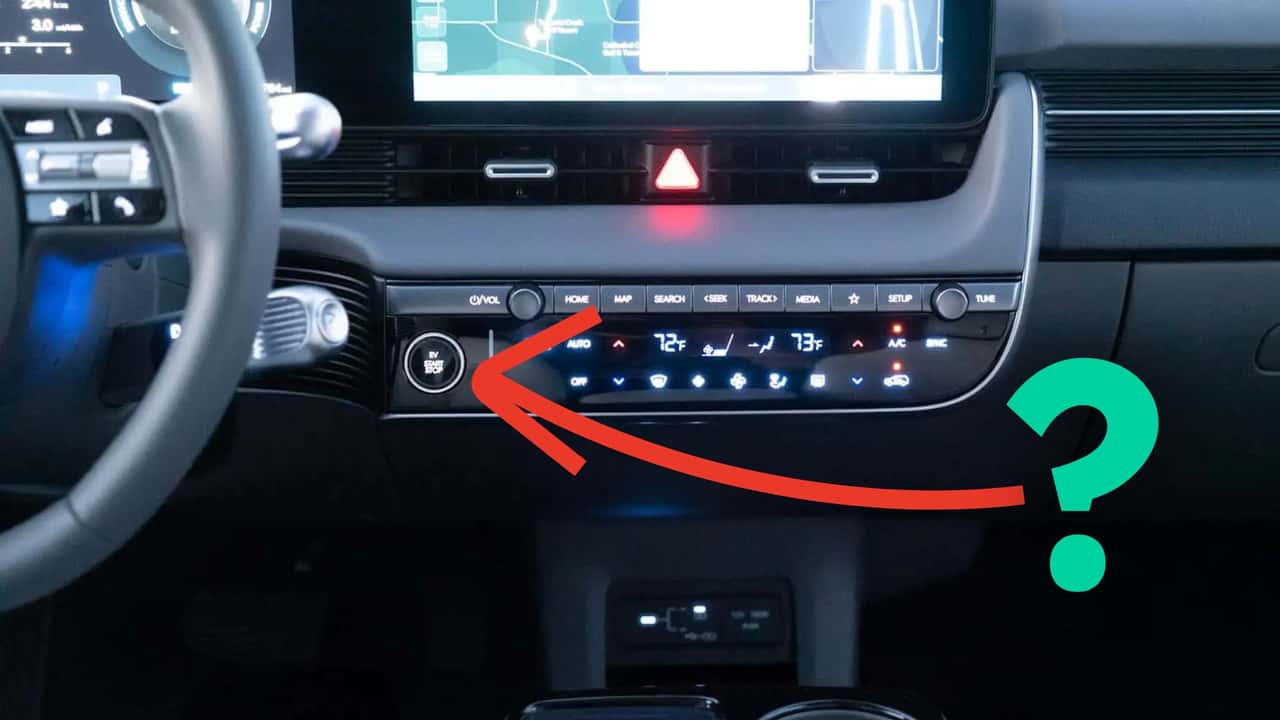

This has happened to me more than once. I’ll park a new EV I’m reviewing, hop out, and immediately get bombarded by a startling barrage of BING BONG BING BONG. The problem, according to the car’s screen? “Key not in vehicle.” Getting the car to shut up requires reaching back inside and physically hitting the start/stop button to turn the car off.
In some ways, this is just a car-reviewer problem. Sampling different cars with different control setups means I’m constantly grabbing the air for gear selectors that aren’t there or turning on the windshield wipers by accident. (Embarrassingly, this happens in my own car too, sometimes with other people in it.) Hopping between makes and models can also make it easy to forget if a particular car has a start/stop button or not. The fact that EVs are silent makes it that much more likely I’ll forget to check.
But why do some EVs still have start/stop buttons at all? They shouldn’t.

The Hyundai Ioniq 5 pictured here has a circular start/stop button down by the media and climate controls.
In a gas car, a start/stop button has a very clear purpose. You need to trigger the starter and get the engine running before putting it in drive. The engine is required to run high-draw systems like the air conditioning, too, meaning you want to decide when the car turns off. But in an EV, there’s nothing to “start,” and nothing really that needs to “stop” either. A start button pretty much just serves to take an EV from “on” to “even more on.” Many car companies take advantage of this fact to delete the start button altogether and provide what I consider to be a far more seamless experience.
Like so many innovations in electric cars, Tesla kicked this off with the Model S over a decade ago. To “start” a new Tesla, all you do is get in (with a paired phone in your pocket), hit the brake to wake the car up, then put it in gear. To “stop” it, you just put it in park and get out. The same is true for a wide assortment of other cars from techy EV-only brands like Rivian, Lucid, and Polestar, but also legacy automakers like Volvo and General Motors. Once you experience this setup in an EV, it starts to feel like the only way of doing things that makes sense.
The Tesla Model Y has barely any buttons at all, and no start/stop button to be found.
I’d liken it to FaceID on the iPhone. Up until recently I used a pre-FaceID 2020 iPhone SE. I was perfectly happy using my fingerprint or plugging in my passcode to unlock it. Until I got an iPhone 17 and learned the joys of unlocking your phone just by looking at it. I’m not turning my phone on and off every time I pick it up, either. All of my personal electronics wake up when I start using them, and go to sleep when I stop. Why should EVs be any different?
It’s not too much of a chore to hit a start button, or a stop button. But it wasn’t hard to stick a key in the ignition and turn it or click a key fob to unlock your car either. Yet the car industry invented push-to-start and keyless entry anyway, because they eliminated extra steps and made things easier. Getting rid of the start button does basically the same thing. I think it’s only a matter of time before, like those features before it, it becomes commonplace and the start button begins to feel outmoded.
The reason start buttons still exist probably comes down to keeping EVs familiar to first-time buyers, Ed Kim, president and chief analyst at AutoPacific, a market research firm, told me. Most people still are new to EVs, he said, so automakers don’t want to do anything too off-putting. “Having that start button in some ways is still kind of a security blanket,” he said. “For the uninitiated, not having a way to manually turn the car on and off feels weird.”
It's the same story with the Rivian R1S: no on button. Just tap the brake to wake it up, and start driving.
Indeed, Hyundai told me the same thing when I asked why its EVs—some of the best among legacy manufacturers—have on buttons. That, plus the fact that it makes for a clearer delineation between the car being ready to drive and not.
“While some EV manufacturers have chosen to eliminate the start/stop button, Hyundai continues to use it on its EVs because it gives drivers a clear indication that the vehicle has entered its READY state and is prepared to drive,” a spokesperson said. “For many customers, especially those moving from ICE vehicles to an EV for the first time, this familiar interaction helps reduce the learning curve and creates a seamless transition to electric mobility.”
A Toyota spokesperson told me the on button “gives customers an EV experience that feels familiar and is easy to use.”
The Toyota bZ, unlike Teslas and Rivians, has a "power" button in the familiar location behind the steering wheel.
To be sure, having a real on/off button comes with some distinct benefits too. For instance, say you want to force the car to stay on despite the driver getting out, so the A/C keeps blowing, for example. Some brands that have ditched the on button offer some kind of a “pet mode” or a “leave on” button in the touchscreen in exchange. Volkswagen EVs don’t require you to push a button to start or stop the car, but they do have a stealth-mounted button on the steering column for this purpose. The ability to restart a car easily when something is glitching can also come in handy, Kim points out.
The on-button issue speaks to a broader debate in the auto industry: Which features should carry over from the internal-combustion era, and what’s better left behind? Porsche and Hyundai are fitting some cars with simulated “gears” that you can “shift” yourself. Dodge’s Charger EV uses speakers to blast engine noise outside the car. Many EVs also creep when you let off the brake, a totally artificial feature that car companies only add to make the driving experience resemble that of a combustion car.
It’s understandable that carmakers are wary of messing too much with what people are already accustomed to. Companies can easily go too far when trying to reinvent the in-car experience.
Tesla faced backlash when it got rid of the turn-signal stalk in the refreshed Model 3. So much so that it brought it back after two model years and didn’t make the same mistake when it refreshed the Model Y last year. It has deleted the gear selector in favor of touchscreen swipes and a predictive shifting feature called “Auto Shift” that is still in beta. Screen-operated vents like the ones you find in Rivians and Teslas still feel like a downgrade from simple tabs that direct the flow.
All of that, for me, is a bridge too far. But forget about the start button—you don’t need one and will probably be happier without it.
Got thoughts on your car's on button or lack thereof, or anything else EV? Contact the author: Tim.Levin@InsideEVs.com
You Might Enjoy...
RECOMMENDED FOR YOU
The Cadillac Optiq Is Getting A China-Developed EV Platform (Update)
Telo Says Its Tiny EV Truck Can Tow More Than A Base Ford F-150
Cadillac Recalls 14,000 Vistiq EVs Over Child-Trapping Risk
Volvo's New EX50 Will Be A Sub-$50,000 Tesla Model Y Fighter: Report
I’ve Seen More Improvement In Two Years Of Reviewing EVs Than I Did In A Decade Testing Gas Cars
Ford Recalls 86,000 Mustang Mach-E EVs Over Flying Window Trim Risk
GM Is Making EV Charging A Lot Simpler With Energy Pass, NACS On All 2027 Models