
What Ultra-High-Mileage EVs Teach Us About Battery Degradation
Real-world data and expert battery testing show that even heavily used EVs often lose range gradually rather than suddenly failing.
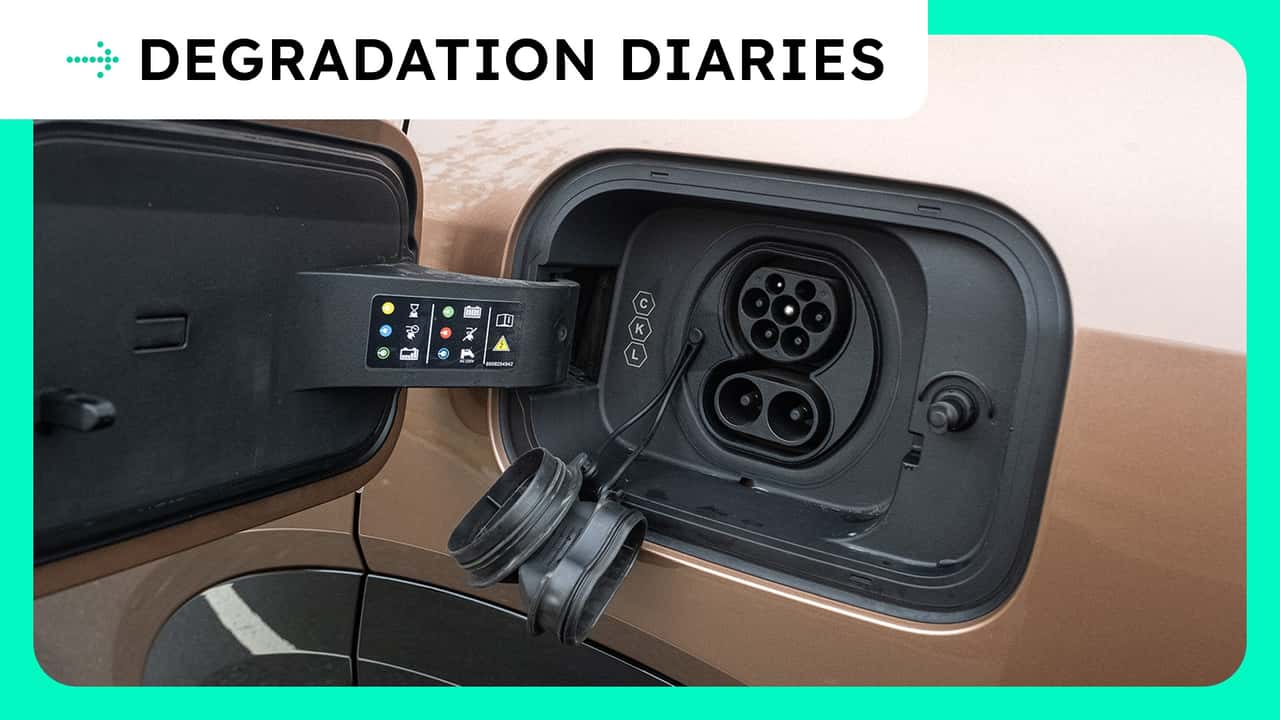

Fears of battery degradation are keeping many people from switching to electric vehicles. But is it really worth worrying about? A solid 15 years into the modern EV era, there are more ultra-high-mileage EVs on the road than ever before that can help answer that question. And these electric cars—mainly Teslas with 200,000, 300,000, or even 400,000 miles on the odometer—show that when it comes to range loss, fears may outweigh the reality on the ground.
Welcome to Degradation Diaries, a column that breaks down everything you need to know about how EVs age.
After poring over dozens of examples of high-mileage EVs, many of which still have their original batteries and provide plenty of range, the pattern is clear: Modern EV batteries generally degrade slowly, and even very high-mileage cars can remain perfectly usable long after many gas cars would be deep into their third owner (and engine).
Take, for example, this three-year-old Tesla Model 3 with 217,500 miles. Despite having been used hard as a taxi and fast-charged frequently, the car still showed 88.5% battery capacity and more than 300 miles of real-world range. One Tesla Model S from the UK had covered around 430,000 miles on its original battery and motors. It had been used as an airport taxi and frequently fast-charged, often to 100%. Yet it had apparently lost only about 65 miles from its original official range rating.
A 2019 Model 3 Standard Range Plus with 380,000 miles is still running its original battery pack. Its displayed range dropped from 240 miles when new to 158 miles, a 34.2% decrease. That is heavy degradation, to be sure. But it is also not dead. After nearly 400,000 miles, it still has enough usable range for commuting, local driving, and shorter trips.
Cars like the famous 2014 Model S with over 1.2 million miles are clearly outliers. By the time it had reached that milestone, it was on its fourteenth motor and fourth battery pack. But that also means each pack lasted around 300,000 miles, which may surprise people.
Research backs up these anecdotes. One recent study found that the average EV that had racked up over 150,000 miles still had anywhere between 81% and 91% of its starting range remaining. Add it all up, and it's clear that a very high number on the odometer doesn't necessarily mean an EV's battery will be toast.
To better understand how high mileage impacts degradation, I spoke with Davide Giacobbe, the co-founder and CEO of Voltest, a company specializing in EV battery testing for car dealerships. While Giacobbe has found that EV batteries can hold up remarkably well even over hundreds of thousands of miles, high mileage does increase the chances of battery wear, “because batteries go through charge and discharge cycles, and those cycles are directly proportional to mileage.”

In other words, it’s not the miles themselves that hurt a battery. What matters is what those miles require the pack to do: repeated charging and discharging, thermal stress, fast charging, and potentially more time spent at high or low states of charge. That is why two cars with similar mileage can age differently. A high-mileage EV that lives in a garage, charges mostly at home, and avoids extreme heat will have a healthier battery than a similarly high-mileage EV that has spent years being fast-charged to 100% in hot climates.
“You can still find good surprises and bad surprises, which is why we recommend testing the car,” Giacobbe said.
One reason for the strong results among some high-mileage cars: Battery deterioration tends to happen quickly when a pack is new, then level off.
“The degradation has a bigger step down at the very beginning, in the first two to three years or the first 50,000 miles,” he said. “After that, the curve is usually very slow.” For Tesla Long Range models with nickel-based batteries, he said a state of health around 90% is a useful reference point for the early capacity drop before it starts to taper off.

Battery type also plays a role, with LFP (lithium iron phosphate) batteries performing better over time than NMC (nickel manganese cobalt) ones. Giacobbe noted that Voltest has seen many Teslas with NMC batteries wind up with a state of health in the high-70% to low-80% range after 200,000 miles. LFP packs, which trade away some energy density but are cheaper and more durable, appear to be holding up better. He said Voltest has seen LFP-powered cars cover the same distance and still show over 90% battery health.
“That is positively surprising, but it is aligned with what the science says," he said. "LFP is less affected if you top up to 100% more often, and fast charging also seems to affect battery health less. That is confirmed by the data we are collecting.”
One prime example: A Tesla Model 3 Standard Range with an LFP pack and 189,000 miles checked by Voltest. It had been fast-charged more than 90% of the time, but still showed around a 91-92% state of health.
Is the degradation curve getting better in newer cars? Yes and no, Giacobbe said. Some of the best results Voltest is seeing for high-mileage battery capacity retention are in older Model S and Model X cars. This may be because those vehicles were built in lower volumes and were different types of products from the more mass-market Model 3 and Model Y, he said.
But the proliferation of liquid cooling for batteries in the modern EV era has made a big difference. "Even on cars that are more than 10 years old, as long as the battery pack is liquid-cooled, it is good," Giacobbe said. "The worst results we are seeing are on older Nissan Leafs and that type of vehicle, but that is not related to the battery chemistry or the cell itself. It is related to the air-cooled architecture.”
None of this means that EV batteries will last forever, or that every high-mileage electric car is automatically a safe buy. Battery degradation is real and worth looking into if you're buying a used EV. But mileage itself doesn't tell the whole story either.
Giacobbe, for his part, told me he was surprised at how well EV battery packs are faring over hundreds of thousands of miles. His company has tested vehicles with 300,000 miles on the odometer and found that some still retained around 75% of their battery capacity.
“That is impressive. That is almost 500,000 kilometers,” he said. “I challenge you to do 500,000 kilometers in an internal-combustion car.”
RECOMMENDED FOR YOU
Everyone Is Afraid Of EV Battery Degradation. It's All The Nissan Leaf's Fault
BMW Is Finally Planning An Electric Convertible: Report
Is The $25K Slate Truck Just Too Basic? I Rode In One To Find Out.
Things Are Getting Really, Really Bad At Porsche. That's Not Good For EV Fans
The Xiaomi SU7 Made Me Understand How Xiaomi Conquered China
The Rivian R2 Is A Charging Beast. But It's 'Just Fine' At Road Tripping
This Simple Trick Boosted My Plug-In Hybrid's Fuel Economy To 50 MPG