
Ford Is Trying To Build EVs That Can Match China. We Went Behind The Scenes To See How
Can the American giant learn to move at "China speed?" We went to its EV Development Center in Long Beach, California to find out.
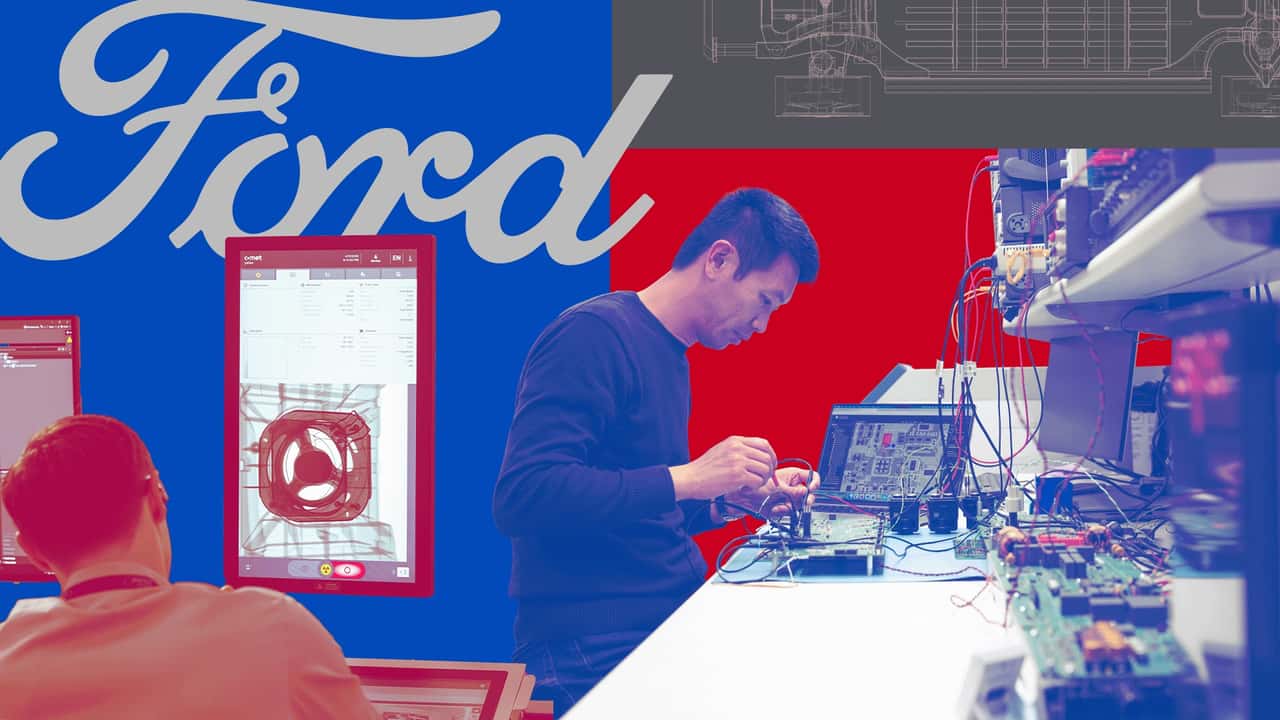

Last October, Ford CEO Jim Farley was blunt about the challenge his company faces. With growing production capacity, advanced technology, and world-beating prices, Chinese automakers, he said, could “put us all out of business.”
The old way of building cars isn’t going to get Ford out of this. The company knows this, which is why it set up a separate campus, free from Ford’s bureaucracy and processes, to create its next generation of EVs.
It’s called the Ford Electric Vehicle Design Center (EVDC), and it’s situated just outside of Long Beach Airport in Long Beach, California. Last week, I went inside on a group media tour to see how Ford is taking on this challenge.
I learned a lot about how Ford is approaching the problem. But it’s still too early to know if the company has the solution.
Gallery: Ford EV Development Center




How It’s Different
A key reason that EVs from Chinese automakers and upstarts like Tesla are cheaper is that they are ground-up, software-defined EVs. That means the company that makes the car controls all of the software in it, and designs it holistically to minimize the amount of wiring, computers, and suppliers required. That drastically reduces costs and shortens development times, as you don’t need to have a constant back-and-forth with a deep roster of suppliers in order to make a minor change.
Ford isn’t built for that approach, or at least it wasn’t. American, European, Japanese, and Korean automakers typically function more as project managers, coordinating a vast group of suppliers that actually write the software and design the advanced driver assistance systems (ADAS) that the automakers then integrate into a final product.
Trying to nudge a team that works that way into becoming a full-fledged software-first team is not an easy task. As the Chinese automakers show, it’s easier to start from scratch than it is to pivot a massive organization like Ford.
So the company did the next best thing. It set up EVDC, where 350 employees work outside of the typical structure of Ford’s headquarters in Dearborn, Michigan.
Ford's EV Development Center in Long Beach.
“We’re also able to collaborate with another—about—480 employees between Dearborn and Palo Alto that help us with program management, manufacturing, engineering, body engineering, and software,” Andrew Reimer, senior director of vehicle integration and engineering at EVDC, said. “We collaborate every day.”
At EVDC itself, the teams that handle vehicle engineering, design, prototype production, field validation, software engineering, and manufacturing engineering all live under the same roof. The idea is to speed cross-domain collaboration, creating the sort of fast-failing, fast-adapting design process that you’d see at BYD or Tesla. The latter comparison is no coincidence; Alan Clarke, Ford’s vice president for advanced development projects and effective head of the EVDC, is a Tesla vet that helped design the Model S, Model 3, Model Y, and Cybertruck.
How It’s Bringing ‘China Speed’ To The U.S.
Under Clarke’s stewardship, the advanced EV team has rethought how the company assembles vehicles. With its upcoming Universal Electric Vehicle (UEV) platform, spearheaded by its planned $30,000 electric truck, the company is ditching the linear assembly line. Instead, the front, rear, and floor modules of the vehicle will be assembled separately, then joined at the end.
The first vehicle on the UEV platform will be a midsize electric truck. We don't know what it will look like, but Ford has released this teaser.
The result is that manufacturing workers won’t have to constantly lean into open doors to install key interior components. Instead, the seats, center console, and other accoutrement will be installed right on top of the battery. The front clip, where the power electronics, HVAC system, cooling system, and front motor live, gets built separately, as does the rear structure. The whole system means less bending, twisting, and maneuvering around obstacles for line workers, Ford claims, saving time and easing the load on the worker. It should lead to faster production times, which saves money.
“We’ve now shrunk the time from when we start to the end, which is going to increase the ability for quality loops,” Ford Advanced Manufacturing Program Chief Kevin Young said. Essentially, as the process gets shorter, it gets easier to check and improve the quality process, in theory.
The other part of that is bringing all of the key teams under one roof, and limiting how much the company is relying on suppliers to problem-solve during the design phase. Because all of the teams are in the same building—which isn’t true in Dearborn—Ford employees repeatedly claimed throughout the tour that their issue-finding and remediation process was speeding up.
“What we’re really trying to do is develop the best possible product in the most cost efficient fashion,” Scott Anderson, a senior manager on the seating team, told reporters. “And to help those processes come together, what we’re trying to do here at EVDC is develop the mindset of fast iteration. You know, fail fast, learn, repeat, and hopefully at the end of the day you have a much better product coming to market.”
Ford's on-site textile shop is limiting material waste and increasing the speed of iteration, Ford claims.
Anderson said that in his own process of developing seating designs that use materials efficiently, the ability to iterate in-house without needing supplier input at every step has drastically reduced iteration time. He claimed that a design review and improvement process that would take 12 weeks using the Dearborn method can now be done in 2-3 weeks at EVDC.
Promising, But Incomplete
As we moved into the second building of the tour, however, one tough truth was hard to ignore. The hot- and cold-weather full vehicle dynamometer was still being constructed. The team that handles battery cell validation and design was preparing to move out of its temporary dwellings into a more permanent home. Large plastic sheets blocked off sections of the facility, and the equipment and detritus of active construction abounded.
For all of Farley’s mentions of the “skunkworks” team on earnings calls dating back years, and all of Ford’s claims about how the facility was accelerating development, the company admitted that most of the UEV truck was developed outside of these walls.
Many of Ford's engineers are still working in temporary locations, as the company builds out its EVDC.
“With the midsize pickup truck,” Clarke said, referring to the first model on the UEV platform, “we’ve had to use outside test labs. We’ve had to use all the labs in Dearborn. We flexed every muscle possible and pulled every resource Ford has to offer to develop the mid-size pickup truck. What you saw today was about continuing that, but being able to do it at a higher velocity with the team that’s here.”
Simply put: This facility isn’t really for Ford’s first software-defined EV. It’s for its second, third, and tenth. It’s also a recognition that, for all of its boldness in rethinking the model, Ford is starting from behind companies like BYD and Geely, by Farley’s own admission. It has invested millions in reworking its operations, but the payoff from that investment hasn’t arrived yet.

What Happens Next
Throughout the tour, Ford representatives repeatedly claimed that the new facilities and new processes will enable it to innovate faster, reduce costs, improve efficiency, and create a world-beating EV. I found them convincing, and it was clear that Ford’s approach at EVDC is considerably leaner and more modern than traditional vehicle design at a legacy automaker.
But consumers don’t buy processes. They buy products. Because I still haven’t seen the final product, I can’t test any of Ford’s claims. On logic and on merit, it seems like a smarter, faster way to build a car. To actually prove it out, Ford has to build the car.
Alan Clarke, a Tesla vet, leads Ford's advanced EV team.
The gears are already in motion. Ford representatives said that hundreds of prototypes were in production as we spoke, and that the Louisville, Kentucky factory where the midsize truck will be built is already under renovation. The company is clearly serious about this, and is openly rethinking most of its core assumptions on car-building. It’s not standing still.
But will the end product of this venture truly be an EV with universal appeal? Ford seems confident that the answer is yes. The rest of us will have to wait until next year to judge for ourselves.
Contact the author: Mack.Hogan@insideevs.com
Related Stories
RECOMMENDED FOR YOU
Used Tesla Model S Prices Have Fallen Dramatically. But Their Batteries Are Holding Up Great
Home EV Charging Has A Hidden Cost. Here’s How To Reduce It And Lower Your Bill
After 500 Hard Miles In A BMW iX3, Range Anxiety Feels Outdated
Who Needs Leather? Bentley's First EV Will Offer Merino Wool Seats
I Was Worried When My Parents Went Full EV, But They Proved Me Wrong
Is Telo Trucks The Real Deal? I Interviewed The Founders To Find Out
Everyone Is Afraid Of EV Battery Degradation. It's All The Nissan Leaf's Fault